Newsletters


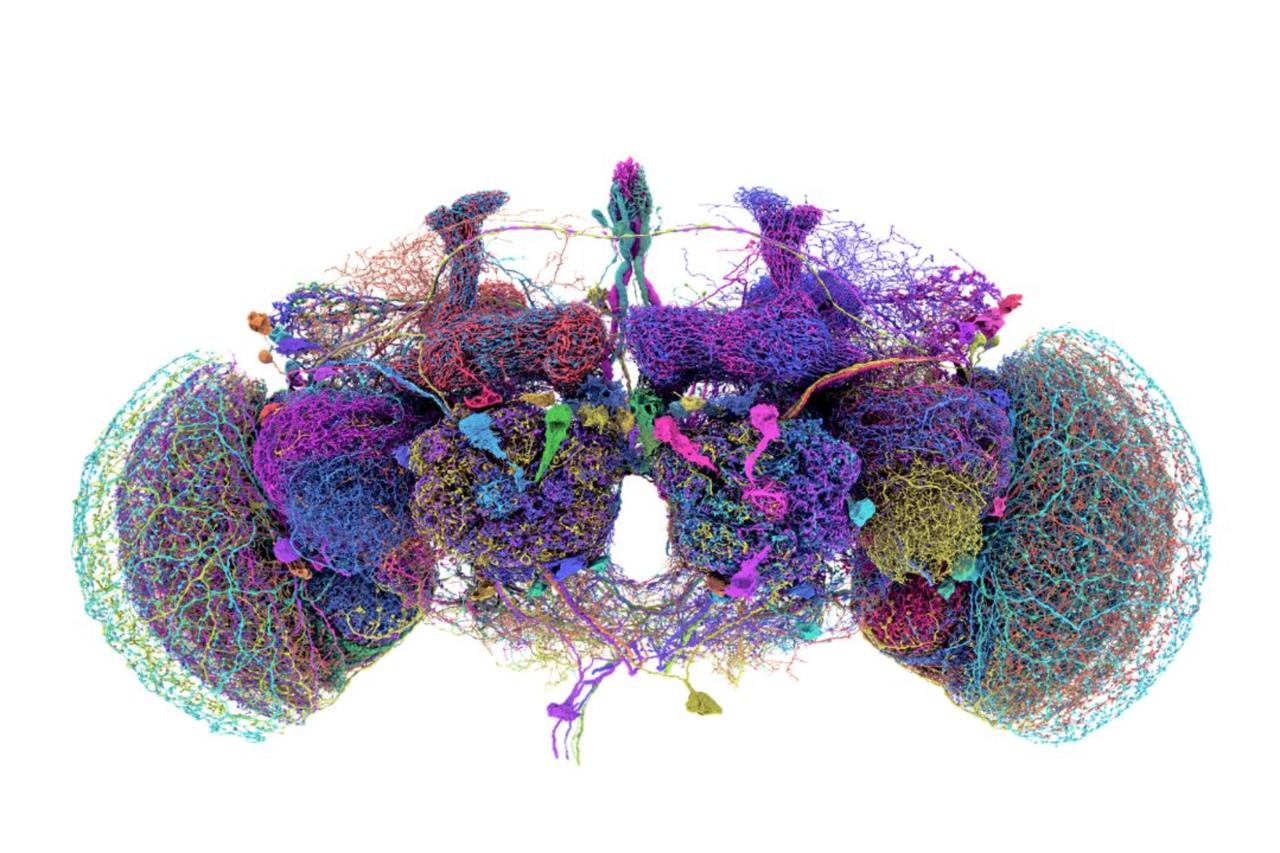


Neurotechnology company Eon Systems released this demonstration as a clear example of a brain model, based on a real biological connectome, controlling a physics-based body in a closed loop. More broadly, this work highlights a fast-growing area of neuroscience that is moving from static brain maps to digital systems where the brain, body, and environment interact.
At the center of the work is the fruit fly, Drosophila melanogaster, a tiny insect that has become one of neuroscience’s most useful model organisms. Its brain is far smaller than a mammal’s, but still complex enough to support navigation, feeding, grooming, and other organized behaviors. That makes it a practical starting point for researchers trying to understand how a complete biological brain can be reconstructed and simulated in software.
The groundwork for this new demonstration was set in 2024, when researchers published a computational model of the adult fruit fly brain with over 125,000 neurons and 50 million synaptic connections. The model was built using the FlyWire connectome and machine learning to predict neurotransmitter identity, according to the source materials. Philip Shiu, an Eon senior scientist, led this research.
That earlier model was a major milestone, but it had a key limitation: it was essentially a brain without a body. While it could simulate neural activity and predict motor behavior, it did not work within a physical environment where signals could move from sensation to movement and back. The new demonstration addresses this by connecting the brain model to a simulated fly body using MuJoCo, a physics engine commonly used in robotics and simulation.
The virtual fly shows behaviors like walking, grooming, and feeding. The main point is that these actions were not programmed as simple animations. Instead, the project description says they came from the brain model’s own neural circuits, as sensory input traveled through the connectome and motor output returned to the body.
This is what makes the demonstration unique. Earlier research often focused on only one part of the problem. Some projects mapped nervous systems in detail but did not link them to an active body. Others built realistic simulated animals that could move well, but these were controlled by reinforcement learning or engineered control systems rather than by a brain model reconstructed from biological wiring. Eon says its latest work brings these elements together more fully.
Alexander D. Wissner-Gross, a founding adviser to Eon Systems, says the project marks an important step in whole-brain emulation. This field aims to copy a biological brain neuron by neuron and synapse by synapse, then run it in a digital system. Supporters see the fruit fly as a manageable first test case before moving on to more complex animals, such as mice and possibly humans in the future.
For now, the fruit fly project should not be mistaken for creating a conscious digital organism. What researchers have shown is more limited, but still important: a biological brain’s wiring can be mapped, modeled, and connected to a body inside a simulation. This is less like a science-fiction “brain upload” and more like a real step toward understanding how nervous systems generate behavior.


 Set as preferred source
 Set as preferred source



 1 min read