Newsletters


Turkish Trade Minister Omer Bolat said bilateral trade volume between Türkiye and Belgium reached $9.3 billion in 2025.
The minister further said that the two countries aim to increase it to $15 billion in a sustainable and balanced manner.
“The two countries aim to achieve a sustainable and balanced bilateral trade volume of $15 billion,” Bolat said at the Türkiye-Belgium Business Forum organized by the Foreign Economic Relations Board (DEIK).
The event was attended by Belgium’s Queen Mathilde, Presidential Investment and Finance Office President Burak Daglioglu, DEIK Chairman Nail Olpak, Belgian officials, and business representatives.
Speaking at the forum, Bolat said the global economy is undergoing major transformations driven by geopolitical tensions, disruptions in supply chains and growing protectionist trends.
“In such an environment, reliable partners and resilient economies are no longer a preference but a necessity,” he said, adding that Türkiye stands out due to its strategic position and industrial capacity.
Bolat said Türkiye’s location at the crossroads of Europe, Asia and Africa provides direct access to more than 1.3 billion consumers.
“With a national income of $1.6 trillion, Türkiye is the world’s 16th-largest economy and one of the fastest-growing economies among OECD countries,” he said.
Bolat also highlighted Türkiye’s growing international profile, noting that the country will host the NATO Summit, the U.N. COP31 conference and the International Astronautical Congress this year.
He said Belgian investments in Türkiye have reached approximately $5 billion, while Turkish investments in Belgium are approaching $750 million.
“The presence of 719 Belgian companies operating in Türkiye is a clear sign of confidence in our economy,” Bolat said.
He added that Turkish firms are expanding in Belgium in sectors including logistics, defense, manufacturing, retail and advanced technologies.

Bolat said the defense industry is emerging as one of the most promising areas for cooperation between the two countries.
“Our defense and aerospace exports increased from $248 million in 2002 to over $10 billion in 2025,” he said.
“This represents nearly a 40-fold increase and places Türkiye 11th in defense product exports globally.”
He also pointed to opportunities in logistics, emphasizing Türkiye’s $150 billion logistics market and its role as a transportation hub.
“Türkiye’s rapidly expanding transportation infrastructure further strengthens this ecosystem with 58 airports, 247 million passengers and 356 destinations,” Bolat said.
“There are currently 80 weekly passenger flights and 14 cargo flights between our countries.”
Over 600,000 Belgian tourists visited Türkiye last year, he added.
Bolat said Türkiye continues to work closely with the European Union and member states on modernizing the Customs Union agreement.
“We believe Belgium supports this approach within the EU in accordance with today’s economic realities,” he said.
Bolat thanked the Belgian government for supporting efforts to modernize the Customs Union between Türkiye and the EU.
He stressed that EU trade and industrial policies should remain inclusive and should not weaken integrated supply chains between Turkish and European companies.
According to Bolat, annual trade volume between Türkiye and the EU reached $233 billion, while around 70% of the $290 billion in foreign direct investment into Türkiye last year came from European companies.
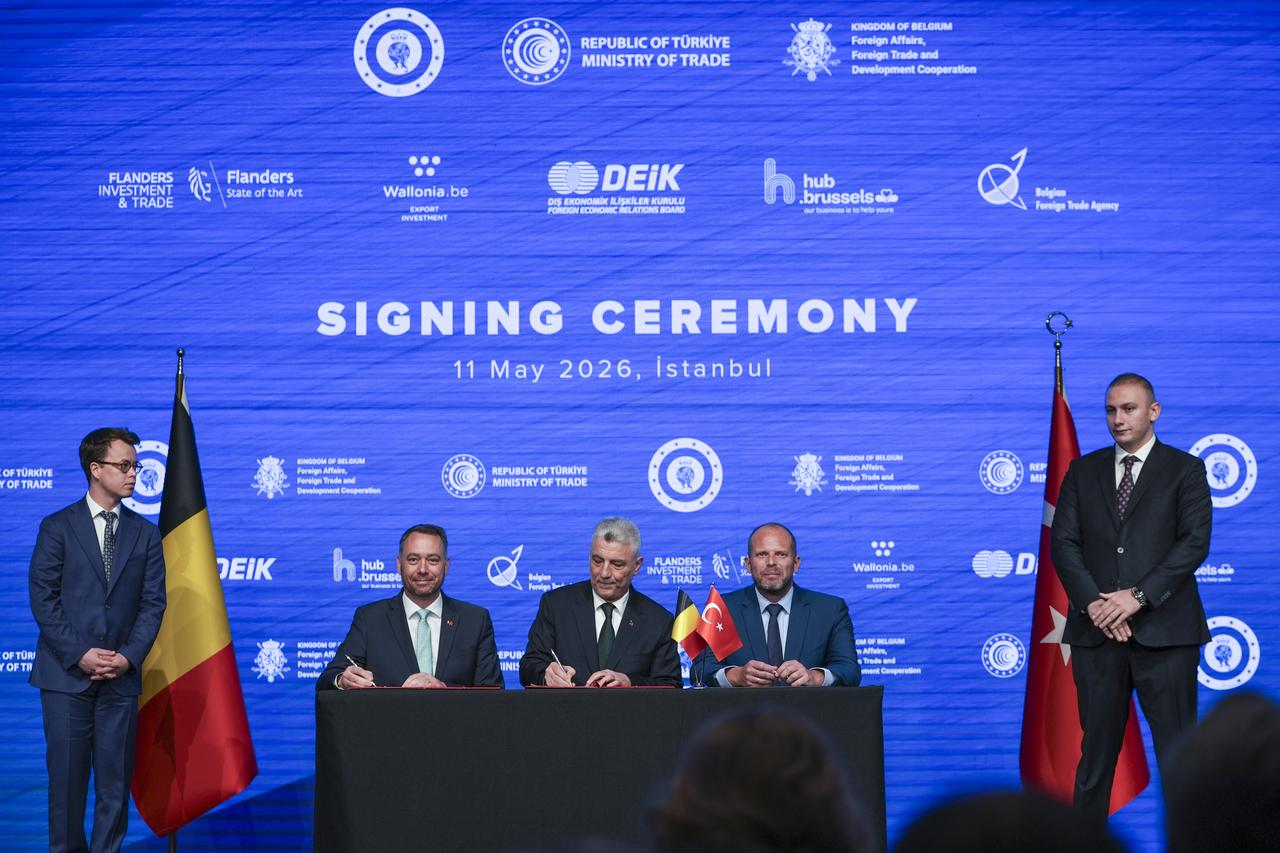
As part of the forum, Bolat, Belgian Deputy Prime Minister and Foreign Minister Maxime Prevot, and Belgian Defense Minister Theo Francken signed a joint declaration on the development of bilateral trade relations between Türkiye and Belgium.


 Set as preferred source
 Set as preferred source


 1 min read
 1 min read