Newsletters





The global trade in illicit drugs is booming, with cocaine production and methamphetamine seizures reaching record highs, according to a United Nations report that warns new synthetic drugs are filling a gap left by the collapse in heroin supply.
Cocaine production surged to about 4,100 metric tons of pure product in 2024, the latest year on record, a fourfold increase within a decade, the United Nations Office on Drugs and Crime (UNODC) said in its annual World Drug Report.
Meth seizures suggest production is growing by 13% a year, the UNODC said.
"We have seen an unprecedented spike in new types of drugs on the market, and worryingly, some are more potent or dangerous than before," UNODC Executive Director Monica Juma said in a statement.
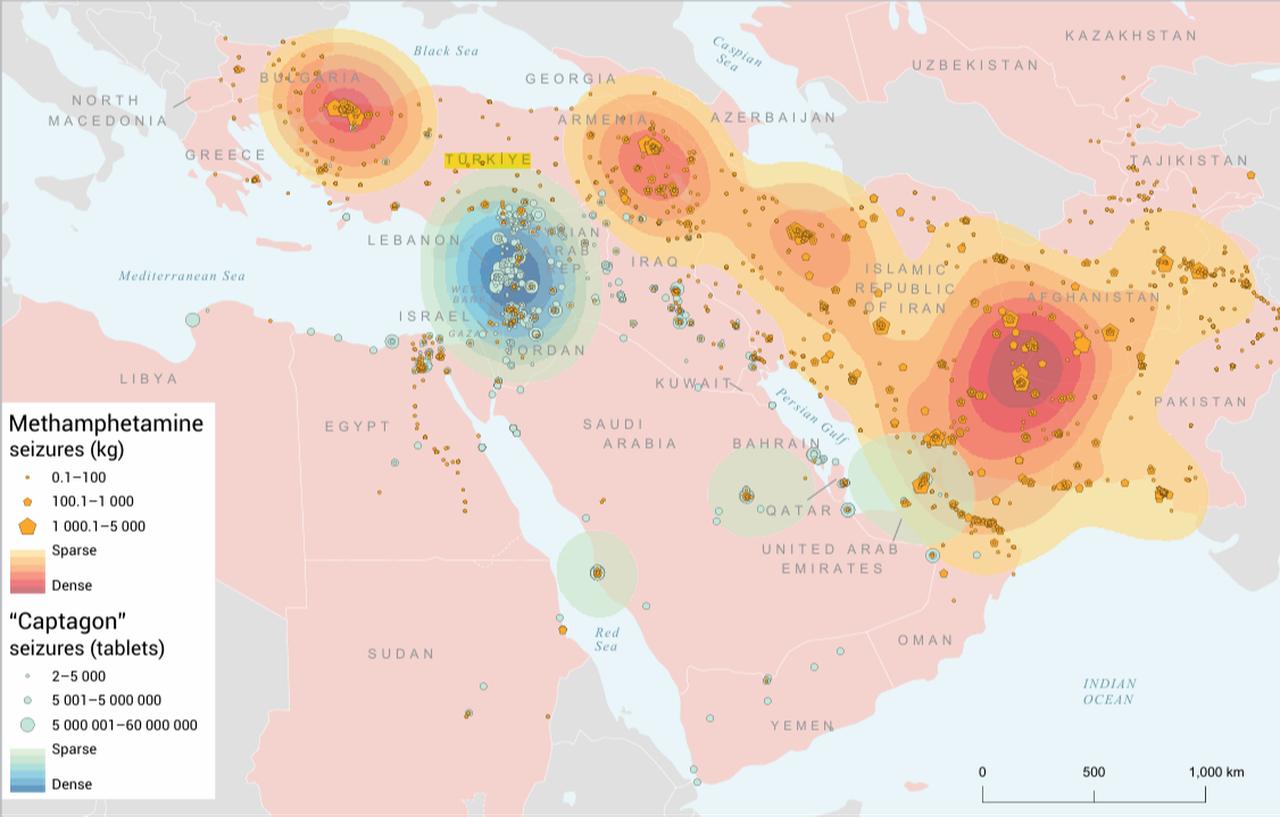

Meth has become the leading drug of concern in Türkiye, overtaking heroin and captagon in terms of treatment provision and seizure cases, according to the report.
The report said meth has also become the main drug of concern in Iraq and Türkiye in terms of treatment provision. In Gulf countries, it has been linked to drug overdoses in recent years, while in Saudi Arabia, its use is believed to have taken root among people who had previously used captagon.
The report points to Türkiye as one of the clearest examples of how the global rise in meth is no longer limited to consumer markets, but is also affecting transit countries and regional drug routes.
According to the U.N. report, meth seizures in Europe have risen sharply in recent years, reversing a previous pattern in which amphetamine seizures had clearly exceeded those of meth.
The shift was mainly linked to a strong rise in meth seizures in Türkiye, with much of the drug reportedly originating in South-West Asia.
The report said the change reflects a wider transformation in regional drug markets. In Türkiye, meth has recently become the foremost drug of concern, surpassing heroin and captagon in both treatment services and the number of seizure cases.
Opium production in Afghanistan, long the dominant supplier, plunged in 2023 after the Taliban returned to power and banned it, Reuters reported. Production has not recovered since, leading to a decline in the supply and use of heroin, which is derived from opium.
But 2024 saw a sharp increase in reports of new synthetic opioids, including fentanyls and even more potent nitazenes, which could be filling at least some of the gap left by the drop in heroin supply, particularly in Europe, the UNODC said.
"Instances of NPS (new psychoactive substance) synthetic opioids reported in early warning systems increased in 2023 and 2024 across most regions, but most prominently in Europe, Oceania and Africa, suggesting a recent diversification by market actors," the UNODC said.
North America, where fentanyl has largely displaced heroin, reported about a 10% increase in the number of NPS synthetic opioids identified in 2024 from the previous year. The number rose by more than 80% in Europe and by 150% in Oceania, the agency said.
Supply and harder-to-estimate demand for cocaine continued to increase strongly, the report said. It also said the way cocaine is consumed has changed as purity has increased and prices have dropped.
"Qualitative research conducted in 2024 indicates an expansion of cocaine use to social settings beyond the nightlife scene and its integration into daily routines, together with an upsurge in the use of 'crack' cocaine among socioeconomically disadvantaged groups, along with a shift from heroin use to 'crack' cocaine use," the report said.
Data on those receiving treatment for drug use strongly suggests an increase in crack cocaine use in Western and Central Europe beginning in 2015, it added.


 Set as preferred source
 Set as preferred source


 2 min read


 1 min read