Newsletters


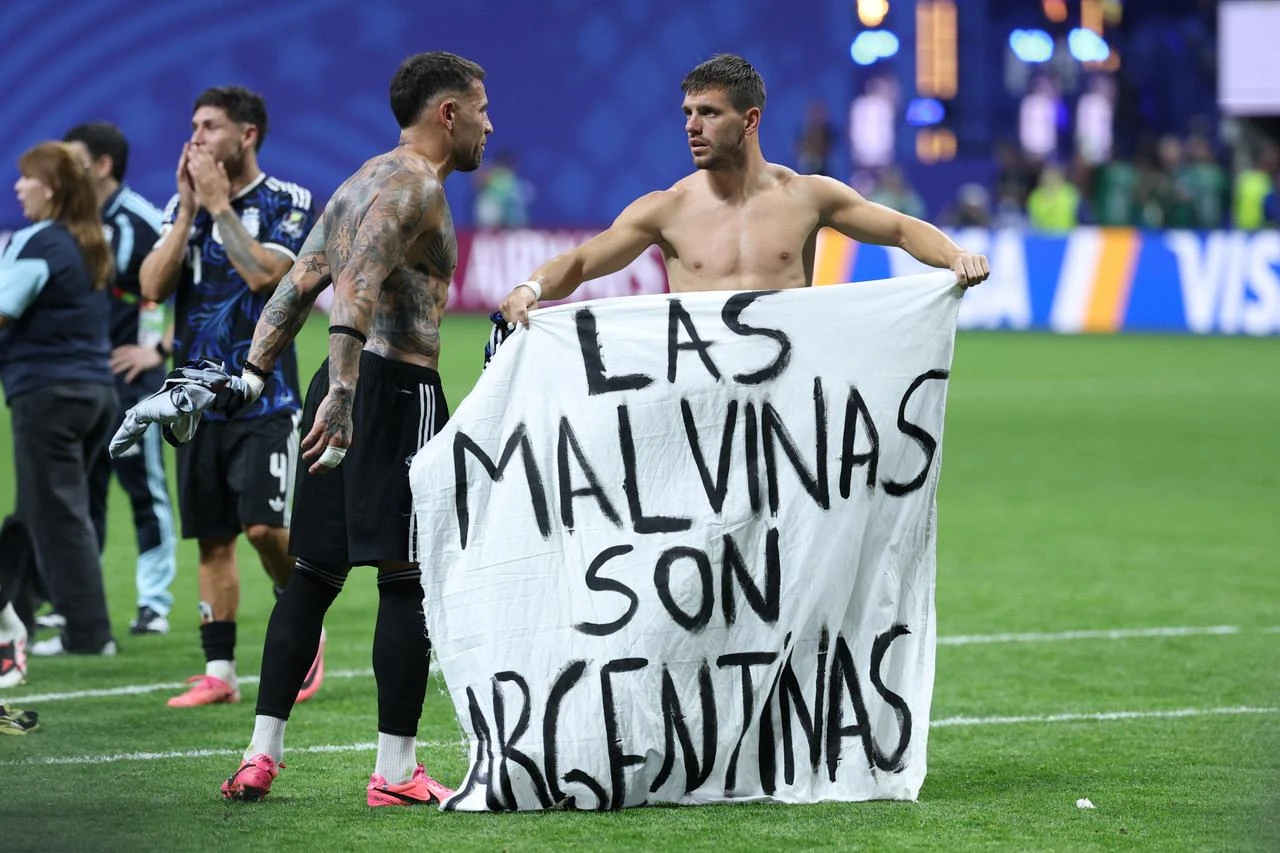


British Prime Minister Keir Starmer has backed calls for FIFA to investigate Argentinian players who displayed a banner asserting the country's claim to the Falkland Islands after their World Cup semifinal win over England, reviving a decades-old dispute over political messaging in football.
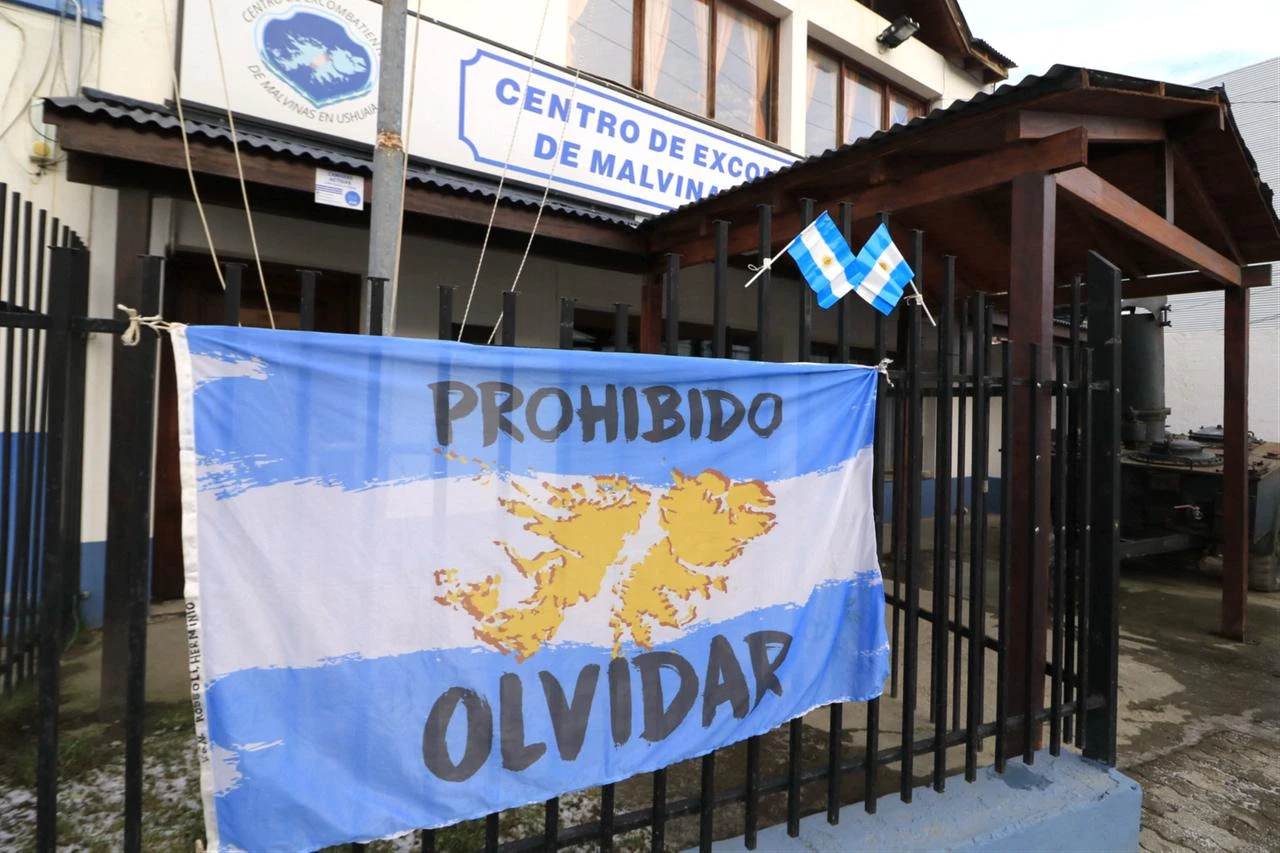
Argentina defeated England 2-1 in the semifinal in Atlanta, after which players Lisandro Martinez and Giovani Lo Celso held up a banner reading "Las Malvinas son Argentinas," using Argentina's term for the South Atlantic islands.
Starmer endorsed a call by Business Secretary Peter Kyle for FIFA to "thoroughly" investigate whether the banner breached rules banning political messaging on the field of play.
Asked about the incident, the prime minister's spokesperson said, "The World Cup might not be ours, but the Falklands definitely are."
The spokesperson added that the government's "position is unchanged, and our commitment to the Falklanders is unwavering."
The spokesperson confirmed that Starmer supported Kyle's call for a FIFA investigation, adding that any subsequent action would be a matter for the governing body.
Asked which team the prime minister would support in Sunday's final, the spokesperson said the "PM wishes both teams well for the final—especially Spain."
The islands are known to the British as the Falklands and to Argentinians as the Malvinas. Argentina says it inherited the territory from Spain after gaining independence in 1816 and that Britain seized control in 1833 through an illegal colonial act. The two countries fought a brief conflict over the islands in 1982.
FIFA's Stadium Code of Conduct prohibits banners, flags, flyers, apparel and other paraphernalia deemed political or offensive inside stadiums.
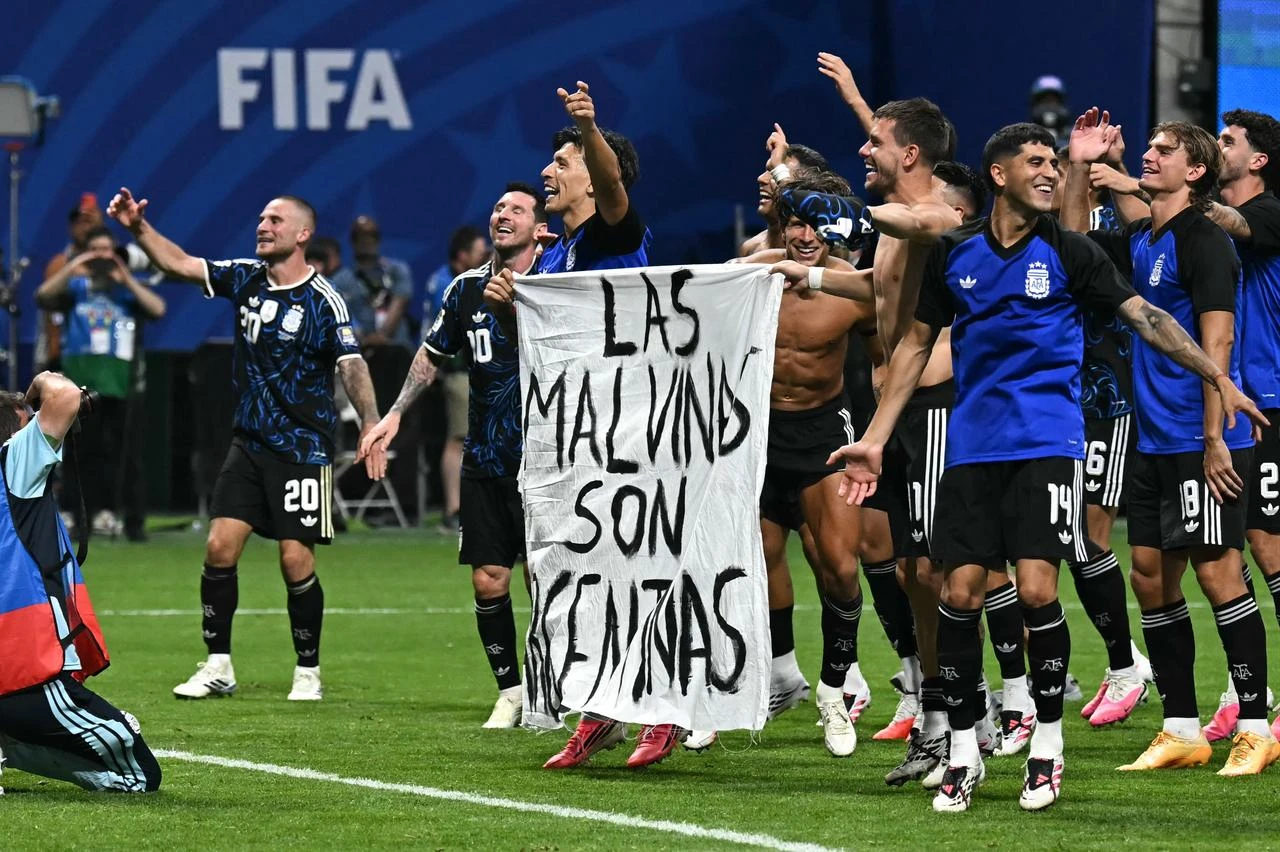

The banner display is not the first time Argentina's national team has used the slogan at a football event. Before a 2014 World Cup friendly against Slovenia in La Plata, Argentina, the entire national team posed behind a banner carrying the same message.
FIFA subsequently opened disciplinary proceedings against the Argentine Football Association, issuing a reprimand and a $33,000 fine for team misconduct and political messaging.
Under the International Football Association Board's Laws of the Game, playing equipment must not carry "any political, religious, or personal slogans, statements, or images."
The rules extend to banners, flags, flyers, apparel and other materials that are political, offensive or discriminatory in nature.
FIFA and IFAB maintain guidelines on sanctions for breaches, including suspensions and financial penalties for players or teams found in violation.
The Falklands banner is the latest in a long line of political-messaging disputes that have tested football's neutrality rules in recent tournaments.
Last month, FIFA defended its decision to prohibit the display of Iran's pre-1979 "Lion and Sun" flag at World Cup venues after a group of Iranian-Americans filed an emergency lawsuit in Los Angeles, arguing the ban infringed on free speech. A U.S. federal judge declined to block the policy.
Following Egypt's first-ever World Cup knockout-stage win, over Australia in the Round of 32, head coach Hossam Hassan carried the Egyptian and Palestinian flags onto the pitch, saying he dedicated the victory to "the Egyptian people and the Palestinian people."
Before Egypt's Round of 16 match against Argentina, Hassan said "anyone... should feel for what the Palestinian people are going through." FIFA has not announced disciplinary action over the gesture.
Ahead of the tournament, FIFA also rejected a commemorative Haiti jersey marking the country's 1804 independence, ruling that its imagery breached equipment regulations barring political, religious or personal messages.
Other tournaments have produced similar disputes. After Spain's Euro 2024 win, captain Alvaro Morata and midfielder Rodri led supporters in chanting "Gibraltar is Spanish," for which UEFA handed both players a one-match suspension.
At the same tournament, Türkiye defender Merih Demiral received a two-match ban for making the "Grey Wolves" hand gesture after scoring against Austria, a decision the Turkish Foreign Ministry called "a cause for disappointment."
At the 2022 World Cup in Qatar, seven European teams abandoned plans for their captains to wear the rainbow-colored "OneLove" armband after FIFA warned of automatic yellow cards, while Germany's players covered their mouths in a team photo to protest what the German Football Association called being "silenced."
Iran's players also stood in silence during their national anthem before their opening match, amid nationwide protests following the death of Mahsa Amini.
In 2018, Switzerland's Granit Xhaka and Xherdan Shaqiri were fined after making a double-headed eagle gesture tied to Albanian identity following goals against Serbia, while at the 2012 London Olympics, South Korea's Park Jong-woo was suspended for two matches after displaying a banner reading "Dokdo is our territory" during a medal celebration.
FIFA and IFAB have said their political neutrality rules are intended to keep international matches focused on sport rather than on diplomatic or territorial disputes between member federations.
Officials have previously said enforcement decisions are made on a case-by-case basis, weighing the intent, symbolism and context of each display.
Argentina's football association has not issued a public response to the renewed criticism over the banner.
FIFA has yet to say whether it will open a formal investigation into the latest incident, though its 2014 handling of the same slogan suggests disciplinary proceedings could follow.
Argentina and Spain are scheduled to meet in Sunday's World Cup final.


 Set as preferred source
 Set as preferred source


 2 min read