Newsletters


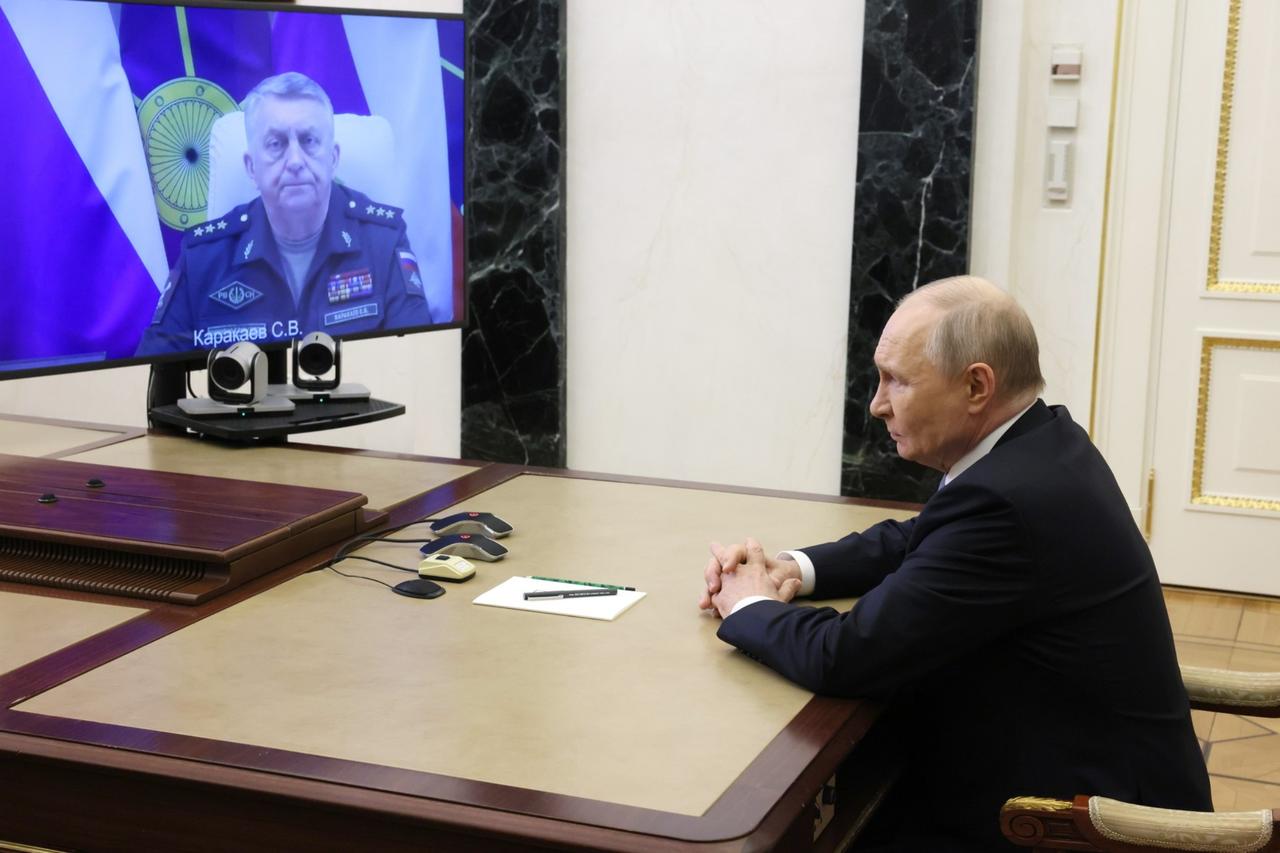


Russia will place its Sarmat intercontinental ballistic missile on combat duty by the end of 2026, Russian President Vladimir Putin announced Tuesday following what the Kremlin described as a successful test launch of the weapon, which Putin called the most powerful missile system in the world.
Putin received a videoconference report from Sergei Karakayev, commander of Russia's Strategic Missile Forces, confirming that a test launch was conducted at 11:15 a.m. Moscow time. Karakayev told Putin the launch mission had been accomplished and that test results confirmed the correctness of the design and technology solutions employed.
The Sarmat is a heavy, liquid-fueled, silo-based intercontinental ballistic missile developed to replace the Soviet-era Voyevoda system. Putin said its combined warhead yield is more than four times greater than any Western equivalent and that its range exceeds 35,000 kilometers, allowing it to travel along a suborbital trajectory rather than a conventional ballistic one. "It has the ability to penetrate all existing and future anti-missile defence systems," Putin said.
The first regiment equipped with the Sarmat system is to be placed on combat duty at the Uzhur formation in Russia's Krasnoyarsk Territory. Development of the missile began in 2011, and the program was publicly disclosed in 2018 when Putin first announced a broader suite of advanced nuclear systems.
The announcement comes after a troubled testing history. A test in September 2024 left a deep crater at the launch silo, according to Western experts cited by Reuters.
The Sarmat is one of several advanced weapons systems Putin highlighted Tuesday.
He noted that the Avangard intercontinental hypersonic glide vehicle has been on combat duty since 2019, the Kinzhal air-launched hypersonic missile since 2017, and the Oreshnik medium-range ballistic missile since 2025.
Two additional systems, the Poseidon nuclear-powered underwater drone and the Burevestnik nuclear-powered cruise missile, are described as nearing completion.
Putin framed the development of these weapons as a direct response to the United States' withdrawal from the Anti-Ballistic Missile Treaty in 2002, saying Russia was "compelled, and I want to emphasise this, compelled, to reassess how to ensure our strategic security."
Work on advanced deterrence systems, he said, resumed in the early 2000s during what he acknowledged was a very difficult period in Russia's history.
Since the invasion of Ukraine began in 2022, Putin has made repeated public references to Russia's nuclear arsenal in statements widely interpreted in Western capitals as a strategy to discourage deeper NATO support for Kyiv.
The Sarmat deployment announcement continues that pattern, with Karakayev arguing the system would significantly enhance the combat capabilities of the ground-based strategic nuclear forces in meeting strategic deterrence objectives.


 Set as preferred source
 Set as preferred source


 1 min read
 1 min read