Newsletters


A giant deepwater pipelay vessel bound for Romania temporarily halted ship traffic in the Bosphorus on Thursday as it made its way through the strategic waterway to support a major offshore natural gas project in the Black Sea.
The Bahamas-flagged JSD6000, measuring 215.9 meters (708 feet) in length, entered the strait from the south after departing Italy for Romania.
Turkish authorities suspended two-way ship traffic during the transit, while three tugboats and six rescue boats from the Directorate General of Coastal Safety escorted the vessel through the passage.
Delivered to Italian offshore engineering company Saipem in 2024, the JSD6000 is one of the world's most advanced deepwater pipelay and heavy-lift vessels.
The ship can accommodate up to 399 people and is equipped with a DP3 dynamic positioning system, enabling it to maintain position with high precision during offshore operations.
The vessel is designed to install subsea pipelines in both J-Lay and S-Lay modes, allowing it to work across a wide range of water depths and project types. It can lay pipelines up to 36 inches in diameter in J-Lay mode and up to 60 inches in S-Lay mode at depths reaching 3,000 meters (9,843 feet).
The ship is also fitted with a revolving heavy-lift crane capable of lifting up to 5,200 metric tons, making it suitable for installing offshore platforms, subsea infrastructure, decommissioning projects and offshore wind developments.
British energy services company Petrofac in 2014, construction of the vessel was halted after the contract was terminated in 2015. Chinese shipbuilder ZPMC later took over the project, completed the vessel and delivered it to Saipem under a long-term charter agreement in 2024.
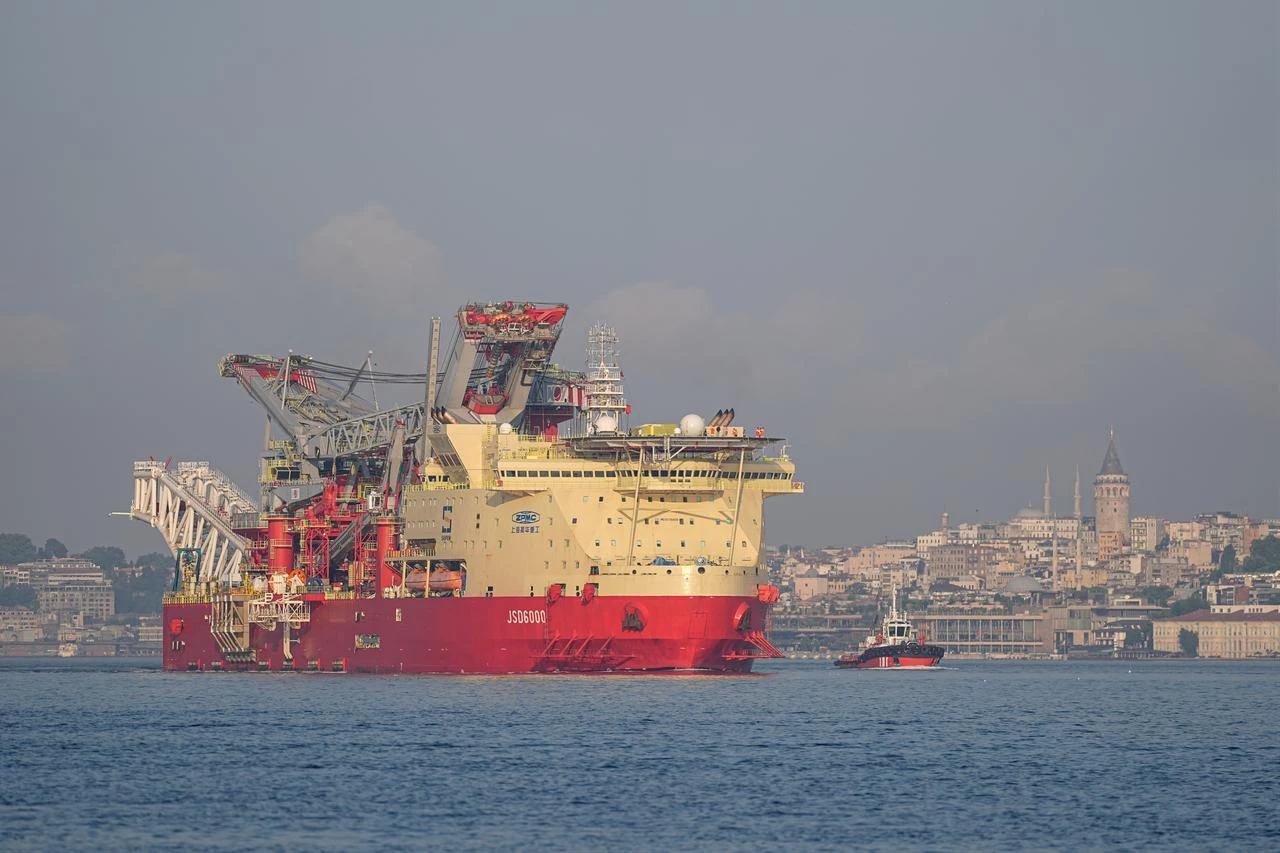

The JSD6000 will be used to lay pipelines for Romania's Neptun Deep project, the country's largest offshore natural gas development in the Black Sea.
Developed by OMV Petrom and Romgaz, the project is expected to begin production in 2027. It is estimated to hold around 100 billion cubic meters of recoverable natural gas.
Construction includes a 160-kilometer (99-mile) offshore pipeline that will carry gas from production facilities in the Black Sea to the Romanian coast near Tuzla before connecting to the national transmission network.
Romania has stepped up construction on the €4 billion ($4.5 billion) Neptun Deep project, deploying a large offshore fleet for the campaign. Around 50 vessels are expected to take part in various phases of the work, including pipeline installation, subsea infrastructure deployment and production platform construction. Up to 10 ships will be directly involved in laying the pipeline.
The JSD6000 is the latest in a series of oversized offshore assets to pass through the Bosphorus in support of Romania's Neptun Deep project. In mid-June, the Saipem 7000, one of the world's largest semi-submersible crane vessels, transited the strait en route from Libya to Romania.
A week later, the Castro XI pipeline installation platform also crossed the Bosphorus while being towed to the Black Sea, where it is set to support offshore pipeline installation for the same project.


 Set as preferred source
 Set as preferred source


 1 min read
 1 min read