Newsletters


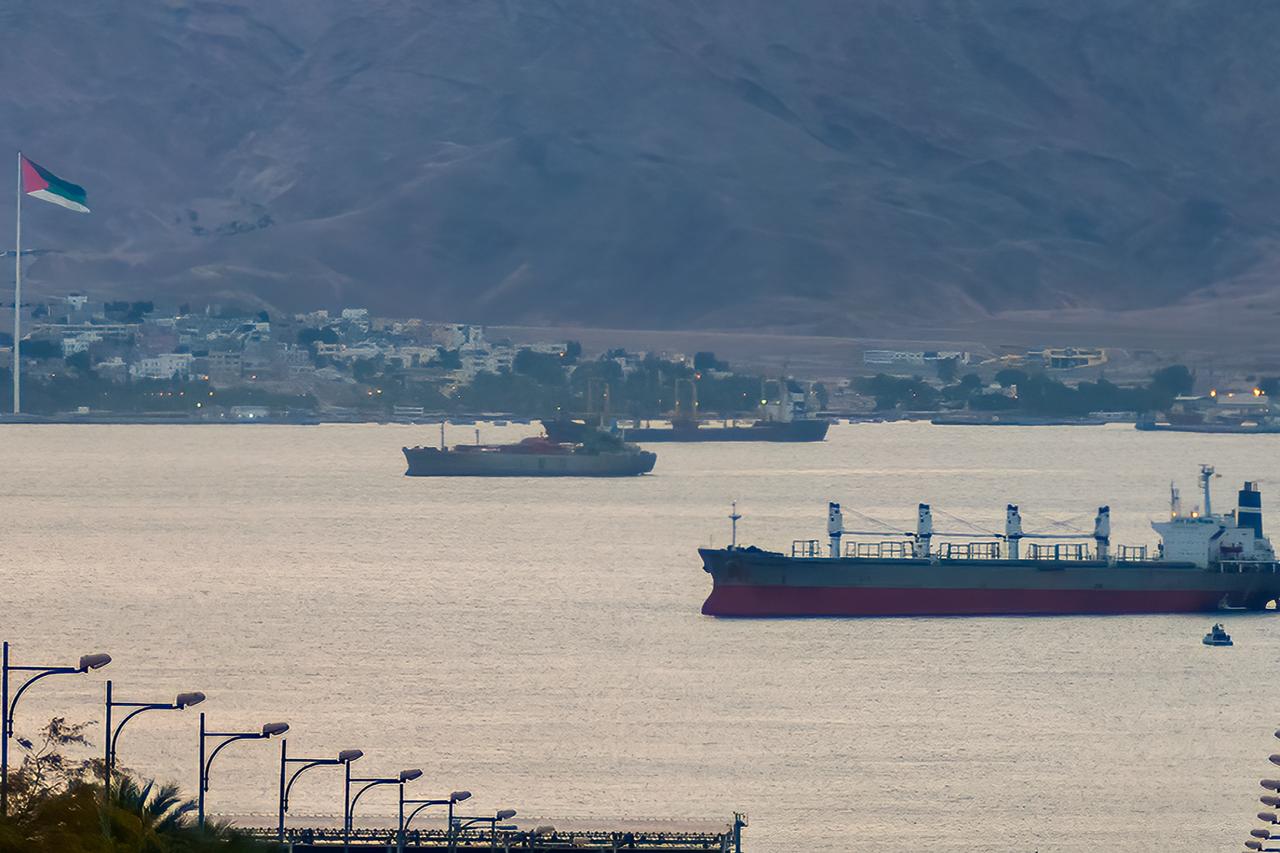


Middle East crude exports from the Gulf countries returned to pre-war levels, excluding Iran, in September, as producers shifted shipments to pipelines, alternative ports and a new tanker shuttle system.
At least 16.5 million barrels per day (bpd) left the region between Sept. 1 and 28, matching the pre-war average excluding Iran and standing 10.5 million bpd above March's monthly average, according to maritime tracking firm Kpler.
The recovery came through different routes. Before the war, 83% of the region's crude crossed the Strait of Hormuz. In September, 40% bypassed the waterway, mainly through Saudi and United Arab Emirates pipelines.
In September, 60% of the crude, or 9.9 million bpd, crossed Hormuz, mostly using shuttle tankers. Another 23% was loaded along the Gulf of Oman coast, primarily at Fujairah, while 17% left through the Red Sea.
Most of the crude that crossed the strait did not stay on the same tanker. More than 70% of the crude crossing Hormuz in August changed tankers offshore in the Gulf of Oman.
At least 63 very large crude carriers, or VLCCs, joined the shuttle trade. A core fleet of 35 completed at least three round trips each, typically about 16 days apart, and accounted for three-quarters of shuttle voyages.
The main transfer points were Fujairah and Sohar, which handled 54% and 45% of transfers, respectively.
The workaround developed rapidly. In March, 97% of non-Iranian crude leaving the region bypassed Hormuz. By May, 86% of the crude crossing the strait changed tankers in the Gulf of Oman.
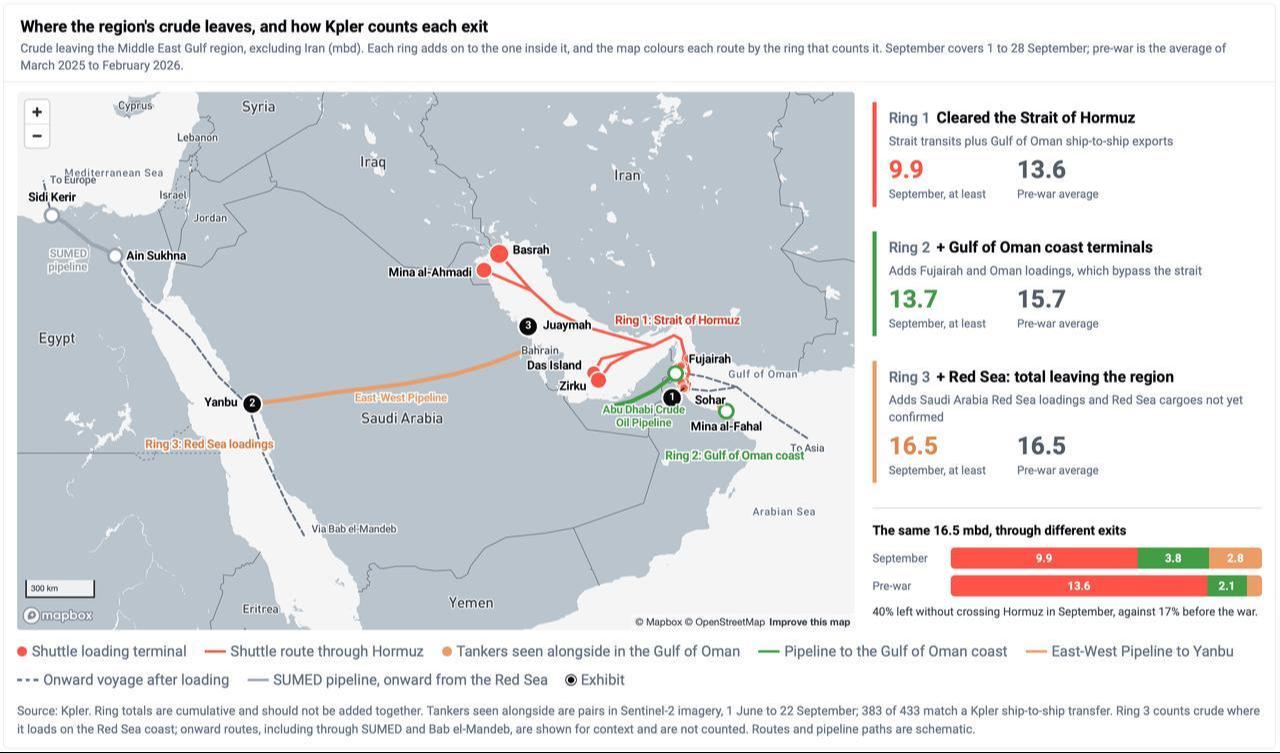

Saudi Arabia expanded shipments through its East-West Pipeline to Yanbu on the Red Sea after the conflict disrupted Gulf routes. Saudi Red Sea loadings rose from 0.75 million bpd before the war to 4.3 million bpd in June.
The system then faced another disruption. An attack on the East-West Pipeline on Sept. 10 halted Yanbu loadings, prompting Saudi exports to shift back toward the Gulf coast.
Seven days after Kpler found no tankers at Yanbu on Sept. 13, all six Juaymah offshore loading moorings were occupied. By Sept. 27, after the pipeline restarted, all seven Yanbu berths were full again.
Iran remained outside the regional recovery. Iranian crude crossings through Hormuz fell close to zero after a U.S. naval blockade began April 13 and stayed near zero after a temporary June recovery.
Iran averaged 1.7 million bpd before the war. Its absence explained why September exports reached pre-war levels excluding Iran but only 91% of the pre-war level when Iranian volumes were included.
Kpler's data showed Iranian crude stocks rose by about 20 million barrels from mid-February to late May and held near 67 million barrels from mid-August.
The regional export system had already absorbed disruptions to the Red Sea route, the U.S.-Iran memorandum of understanding and the East-West Pipeline. The main constraints ahead were Iran's potential return to the market, repairs to the Yanbu route and limited tanker-transfer capacity in the Gulf of Oman.
Despite the recovery, the export network remained fundamentally different from its pre-war structure, with pipelines and offshore tanker transfers now playing a much larger role, Kpler said.


 Set as preferred source
 Set as preferred source


 1 min read

 1 min read