Newsletters





The closure of the Strait of Hormuz following the outbreak of the U.S.-Israel war on Iran will increase Türkiye's energy import bill by $14 billion between March and the end of 2026, raising the annual import burden by roughly 30%, according to a new analysis published Friday by energy think tank Ember.
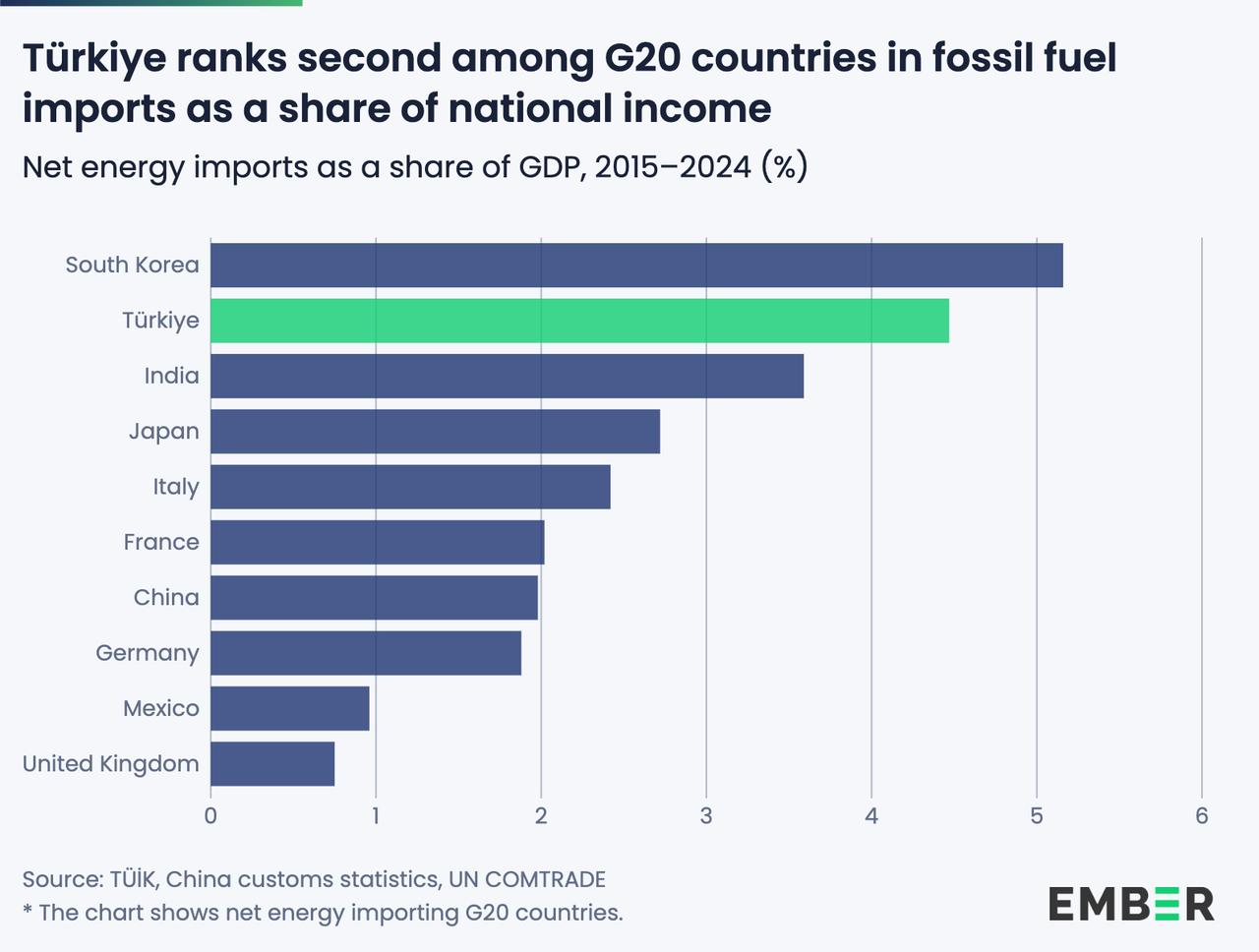
Türkiye meets approximately two-thirds of its energy needs through imported fossil fuels. It ranks second among G20 countries in energy imports as a share of GDP, behind only South Korea, making it structurally vulnerable to a global fossil fuel price shock like the one triggered by the Hormuz crisis.

Between Feb. 28 and May 1, 2026, Brent crude oil prices surged 50%, European gas prices rose 45%, and coal prices increased 3%.
Net energy imports in March, April, and May already increased by approximately $3 billion compared to the same period the previous year, a 26% rise, according to Ember.
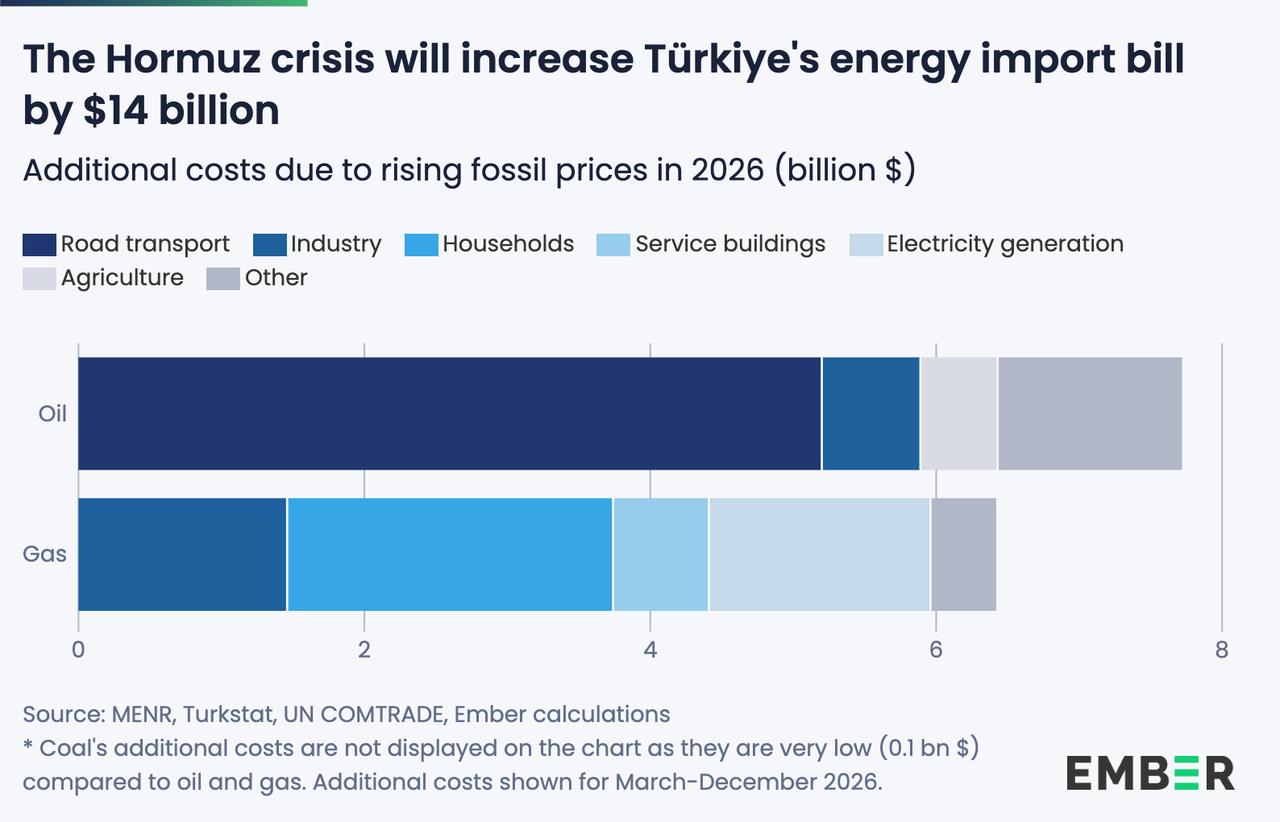
If fossil fuel prices remain at their May 1 levels through the end of 2026, the additional energy import cost would reach $14 billion, approximately $8 billion from oil and more than $6 billion from gas.
Oil import costs alone would rise $7.7 billion, with around two-thirds of that—$5.2 billion—coming directly from road transport.
Gas import costs would increase by $6.4 billion, of which $2.3 billion stems from residential consumption, $1.6 billion from electricity generation, and $1.5 billion from industry.
Coal prices surged over 30% in March but fell back to near pre-war levels by April as supply was not directly disrupted, generating an estimated $95 million in additional coal import costs for 2026, a comparatively minor figure.
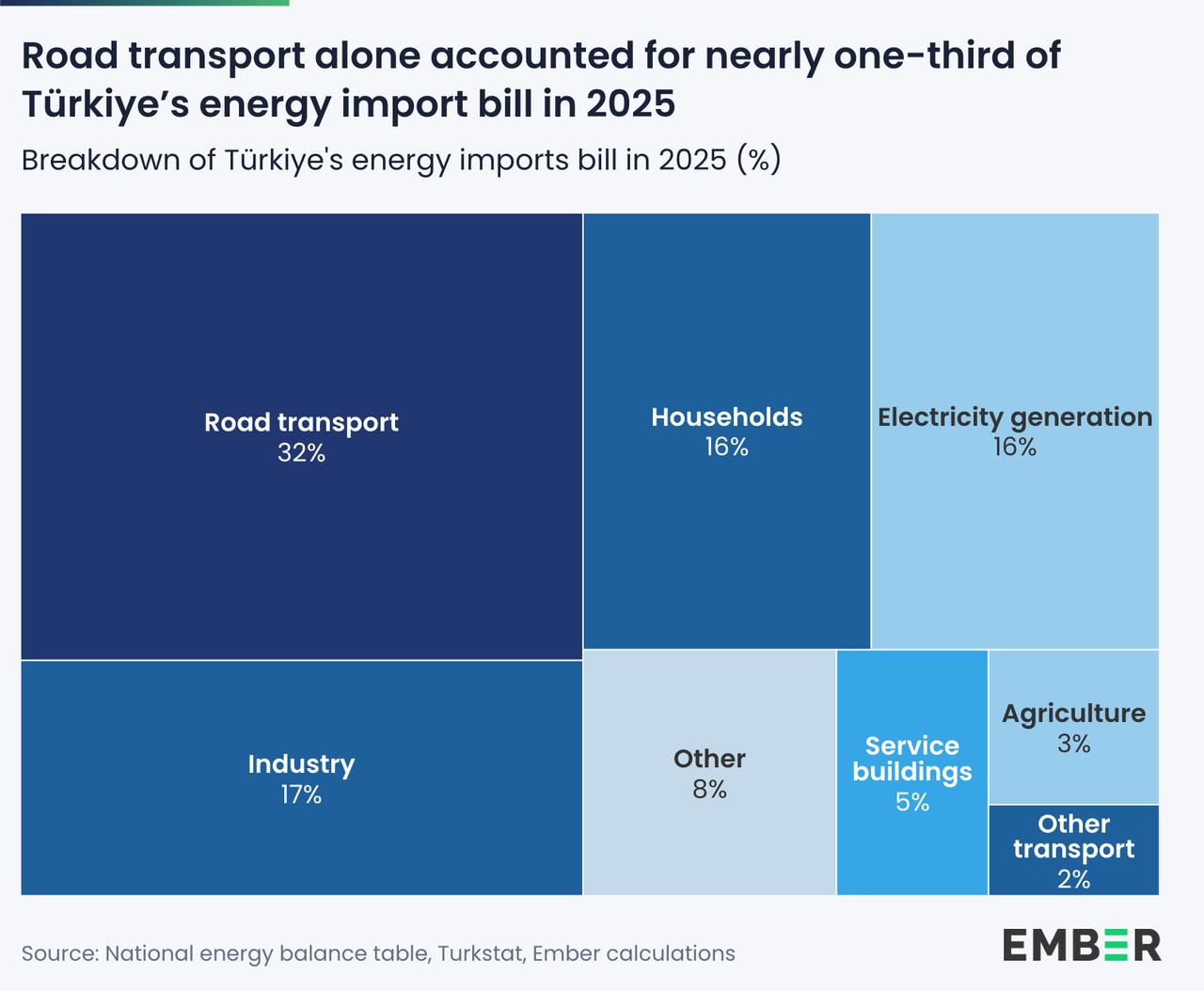
Türkiye paid $47 billion for net energy imports in 2025, of which 47% was oil, 43% gas and 10% coal.
Road transport alone accounted for nearly one-third of the total import bill, approximately $15 billion, making it the single largest contributor. Industry followed at 17%, with households and electricity generation each representing 16%.
Between 2015 and 2024, Türkiye paid an average of $42 billion per year for net energy imports, equivalent to 4.5% of GDP, placing it second among net-energy-importing G20 countries after South Korea's 5.1%.
In 2022, the Russia-Ukraine war drove net energy imports above $80 billion, reaching a historic peak of 8.6% of GDP and coinciding with Türkiye's third-largest trade deficit on record.
Ember analyst Bahadir Sercan Gumus said the structural solution lies in accelerating electrification across end-use sectors.
"Türkiye’s dependence on imported fossil fuels makes energy imports unavoidable, while also driving up the energy bill during periods of global crisis. Although the growing share of renewables in electricity generation marks an important first step towards reducing this dependency, accelerating the clean energy transition through electrification in end-use sectors, particularly transport and buildings, would permanently ease Türkiye’s import burden," he said.
The report found that every 1 million electric vehicles (EVs) on Türkiye's roads prevents approximately $900 million in annual fossil fuel imports.
As of April 2026, Türkiye had over 420,000 electric vehicles, with 17% of all new cars sold in 2025 being electric. The Turkish Energy Market Authority projects that over 5 million EVs will be on the road by 2035.
In the household sector, which accounted for $7.2 billion in gas-related imports in 2025, a 10% heat pump transition rate among Türkiye's approximately 25 million households could eliminate over $1 billion from the annual import bill. Heat pumps deliver the same heating output using roughly one-third of the energy of gas systems, drawing on domestically generated renewable electricity.
Ember recommended that Türkiye incorporate the 35% electrification target by 2035, signaled by Türkiye's COP31 Presidency, into its forthcoming National Energy Plan update.


 Set as preferred source
 Set as preferred source



 5 min read