Newsletters


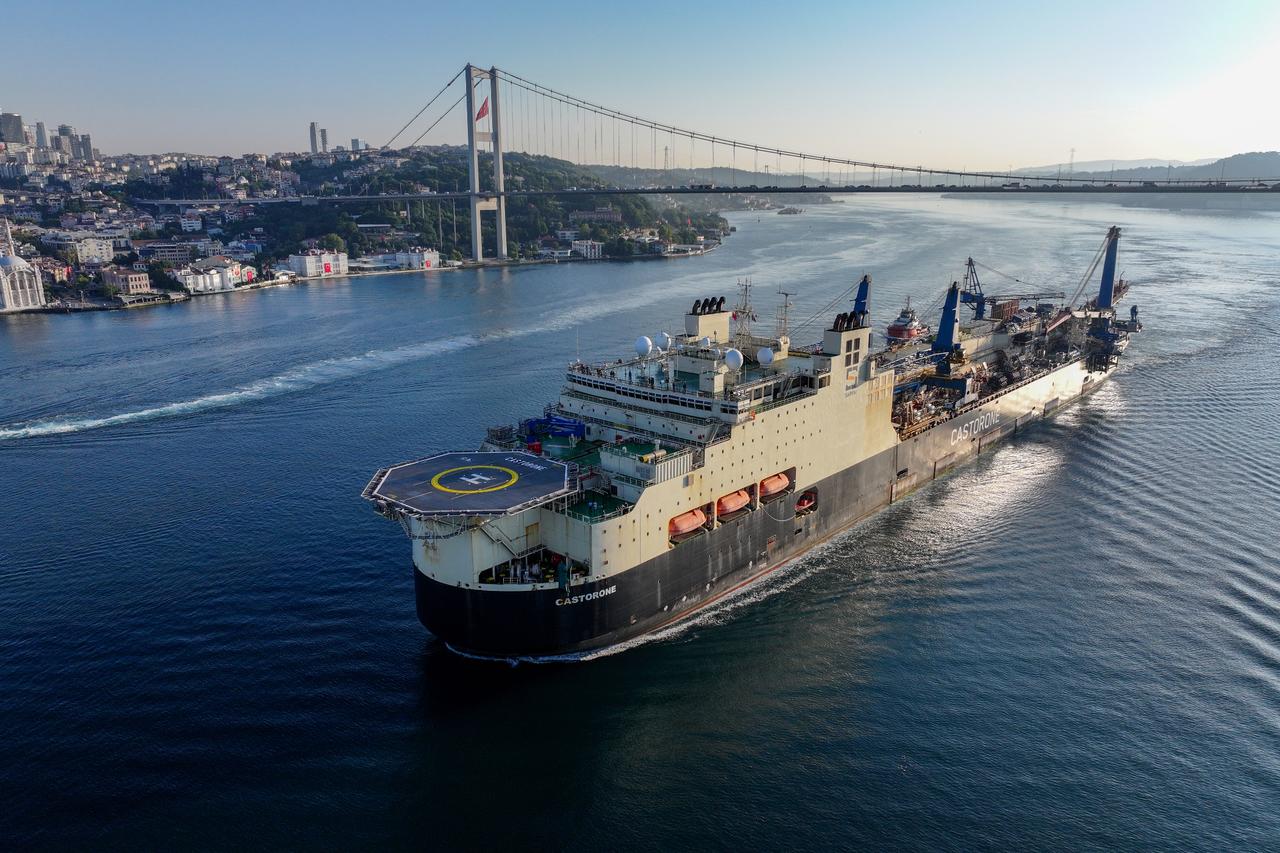


The Bahamas-flagged CASTRONE, one of the world's largest offshore pipeline installation vessels, passed through the Bosphorus early Wednesday as it headed for Romania's Neptun Deep natural gas project in the Black Sea.
The vessel entered the strait at 5:40 a.m. local time (GMT+3), escorted by emergency response, search-and-rescue, and firefighting ships operated by the Turkish General Directorate of Coastal Safety.
Measuring 325 meters (1,066 feet) long and 39 meters (128 feet) wide, CASTRONE's transit prompted authorities to temporarily suspend two-way vessel traffic in the Bosphorus. Several tugboats escorted the vessel through the strait, and maritime traffic resumed after a closure lasting about two hours.
Operated by Italian offshore engineering company Saipem, CASTRONE is one of the world's largest and most advanced offshore pipeline installation vessels.
Built in 2012, the ship is designed for deepwater pipeline construction and can install subsea pipelines in waters up to 3,000 meters deep using the S-lay method, in which welded pipe sections are gradually lowered to the seabed.
It can accommodate up to 702 personnel and carry around 20,000 tons of pipe, allowing it to remain at sea for extended construction campaigns.
The vessel also features a 600-ton crane, remotely operated underwater vehicles (ROVs), multiple welding lines and a 120-meter articulated stinger that supports pipelines as they are laid on the seabed.
CASTRONE has been deployed on several major offshore energy developments worldwide, including the TurkStream pipeline, Nord Stream 2, the Jack and St. Malo project in the U.S. Gulf of Mexico, and Türkiye's Sakarya Gas Field.
CASTRONE is supporting the construction of Neptun Deep, Romania's largest offshore natural gas project in the Black Sea. The €4 billion ($4.5 billion) development, led by OMV Petrom and Romgaz, is expected to start production in 2027 and is estimated to hold around 100 billion cubic meters of recoverable natural gas.
The project includes a 160-kilometer offshore pipeline that will carry gas from production facilities in the Black Sea to the Romanian coast near Tuzla, where it will connect to the country's national transmission network. Around 50 vessels are expected to take part in different phases of construction, with up to 10 ships directly involved in laying the pipeline.
In recent weeks, the Bosphorus has seen a series of oversized offshore vessels heading to Romania's Neptun Deep project.
Before CASTRONE, the Saipem 7000, one of the world's largest semi-submersible crane vessels, the Castro XI pipeline installation platform, and the JSD6000, Saipem's newest offshore construction vessel, all passed through the strait to support different stages of the development.


 Set as preferred source
 Set as preferred source


 1 min read
 1 min read