Newsletters




Businesses in Türkiye view macroeconomic developments and cyber incidents as the most pressing risks in 2026, according to the latest edition of the Allianz Risk Barometer, a global annual survey assessing corporate risk perceptions.
Based on responses from over 3,300 risk management professionals across 97 countries and 23 sectors, the report revealed that 50% of respondents in Türkiye ranked macroeconomic issues as their top concern—up from second place last year. Cyber incidents climbed from seventh to second place with a 46% share of responses, highlighting a growing awareness of digital vulnerabilities in local corporate ecosystems.
Political risks and violence were ranked third at 35%, followed by natural catastrophes at 27%, a decline from first place last year. Regulatory changes and climate change each received 19%, tying for fifth in Türkiye’s rankings.
For the first time, artificial intelligence (AI) entered Türkiye’s top 10 corporate risks list, landing in seventh place with 15% of the vote. Talent and workforce challenges, also at 15%, debuted at the same rank. Other newly listed risks include reputational or brand value loss and market developments, both cited by 8% of respondents.
Allianz Türkiye CEO Tolga Gurkan noted that local companies are beginning to view AI not only as a strategic asset but also as a source of operational, legal, and reputational challenges.
"In 2026, while companies work to integrate AI into their systems, they will increasingly face issues such as system reliability, data quality, integration challenges, and a shortage of qualified talent," Gurkan said.
He added that the appearance of workforce-related concerns in the top 10 reflects a growing awareness of the digital skills gap in Türkiye, in line with global trends.
Despite a drop in ranking, natural disasters remain a major concern both globally and in Türkiye. Gurkan noted that insured losses from such events have exceeded $100 billion annually for six consecutive years.
"Risks are becoming more complex and interconnected," he said. "This underlines the need for integrated resilience strategies and forward-looking risk management frameworks."
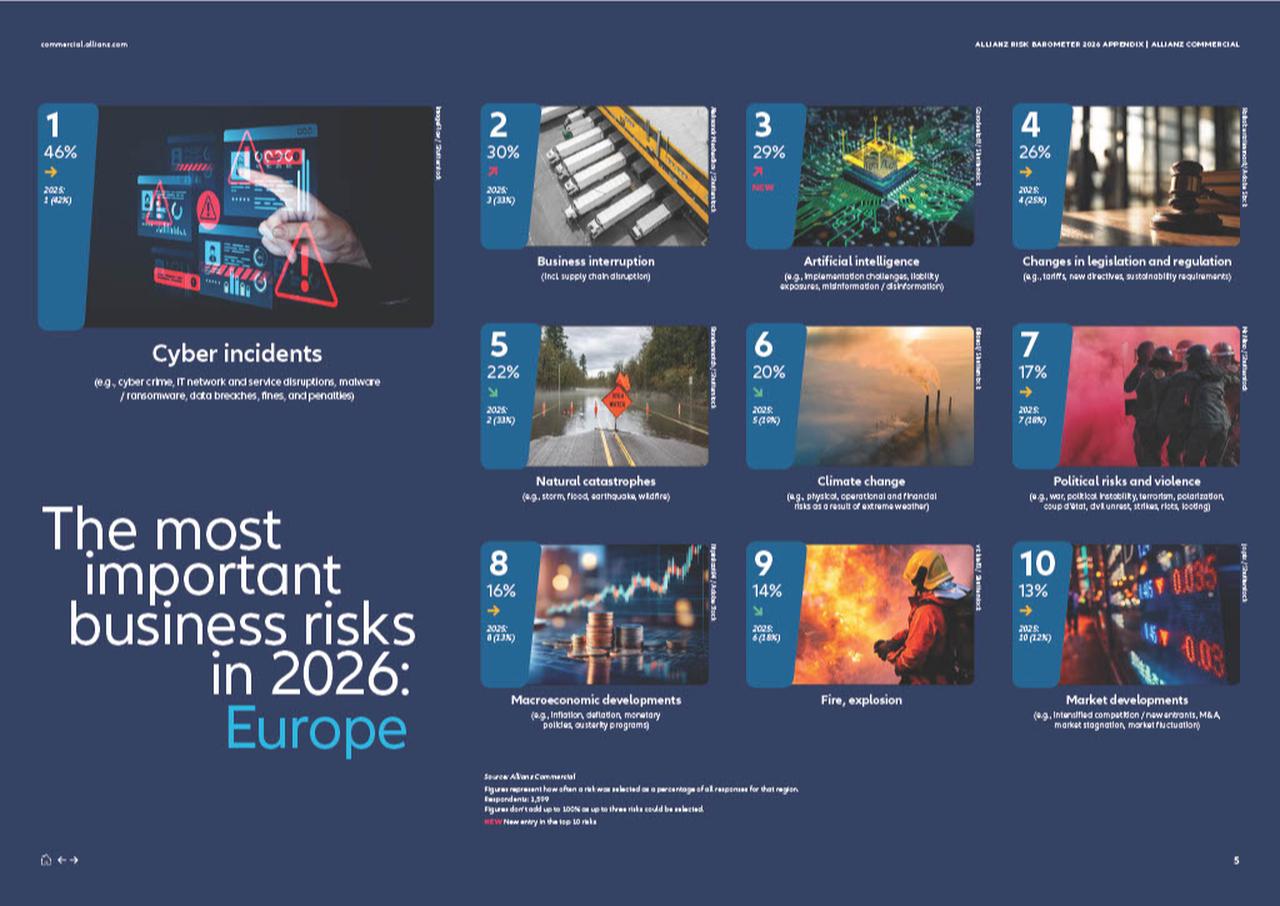

Globally, cyber incidents topped the risk list for the fifth consecutive year, garnering 42% of total votes.
AI saw a record jump to second place with 32%, up from 10th last year, while business interruption fell to third with 29%.
Regulatory changes, natural catastrophes, and climate change followed in the rankings, with political risks and violence rising to their highest-ever global position at seventh. Rounding out the list were macroeconomic developments, fire and explosion, and market dynamics.
About half of global respondents said AI presents more of a benefit than a threat, though one in five held the opposite view.
He concluded that AI, while posing new challenges, can also serve as a valuable tool to help companies adapt to shifting risk environments.


 Set as preferred source
 Set as preferred source


 1 min read

 1 min read