Newsletters





Türkiye should move from a tight monetary policy to selective industrial policies in a new "paradigm shift," Burhan Ozdemir, chairperson of the pro-government Independent Industrialists' and Businessmen's Association (MUSIAD), said, calling on economic policymakers to adopt a new approach.
"Monetary policy has done what it needed to do," Ozdemir told reporters during a meeting, arguing that it was time to rethink the next phase of economic management. However, he also said relying solely on interest rate cuts to exit the current period of tight monetary policy could create deeper structural problems.
"The goal should be to transition from tight monetary policy to selective industrial policy," he emphasized.
Ozdemir argued that Türkiye should move away from an industrial model built on cheap loans and broad subsidies, instead backing sectors based on specific needs and priorities.
He also called for a stronger coordination mechanism between the public and private sectors, saying closer cooperation would help identify which industries require access to lower financing costs.
Such a framework would allow policymakers to direct support more efficiently rather than relying on economy-wide measures, he noted, adding industrial policy should become the centerpiece of the country's economic strategy if meaningful change is to be achieved, CNBC-e reported.
"We must place industrial policies at the center; otherwise, not much will change," he stressed.
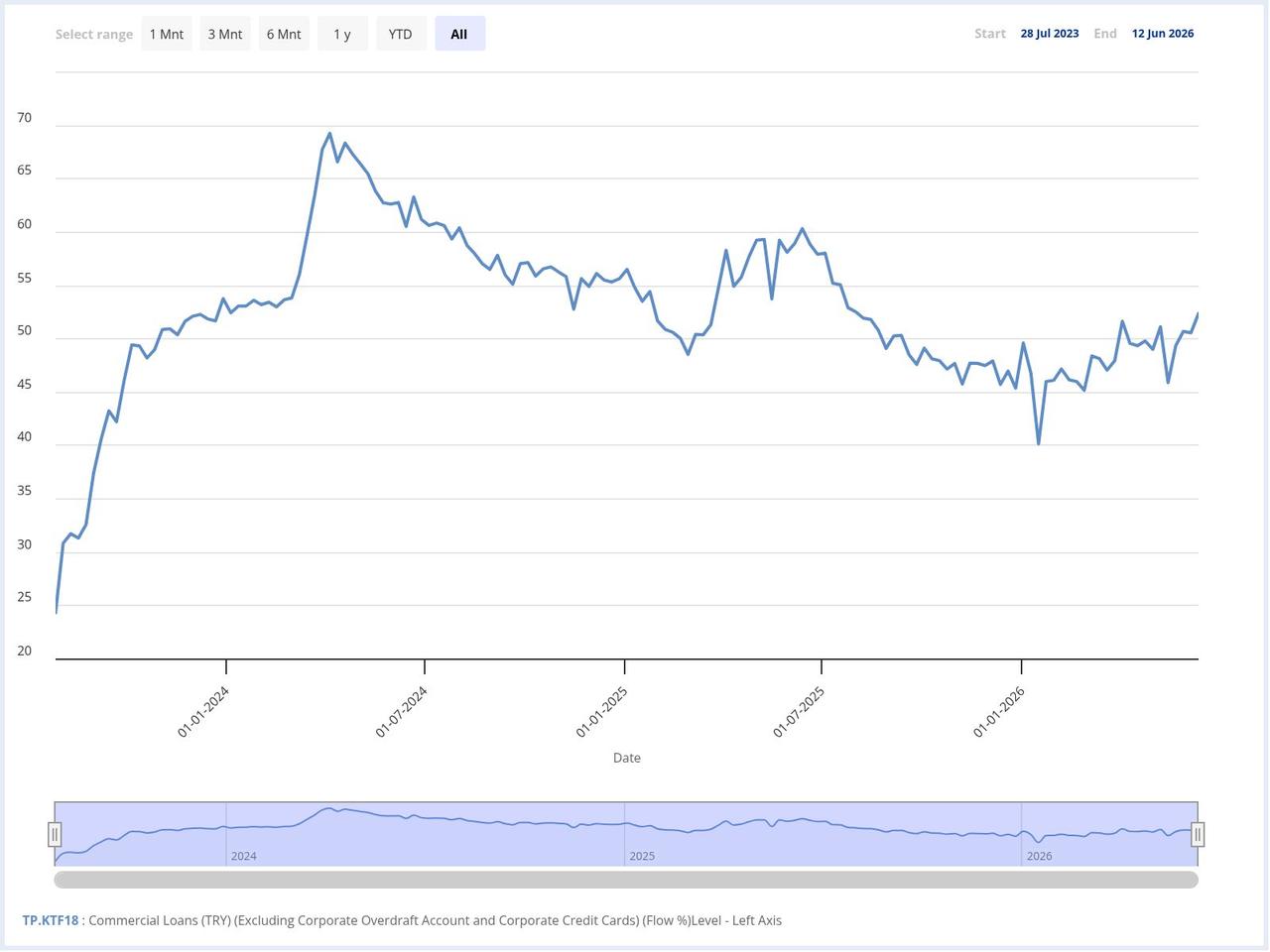

Having raised its policy rate to 50% in early 2024, the central bank later began a gradual easing cycle in July 2025. The cycle was interrupted in March amid market volatility triggered by the Iran conflict, however, and policymakers have since left the benchmark rate unchanged at 37% for three consecutive meetings.
Earlier, in May, the central bank also tightened macroprudential rules by lowering the eight-week loan growth cap for Turkish lira SME loans from 5% to 4.5% and for non-SME commercial loans from 3% to 2%, further tightening financing conditions.
As a result, the weighted-average interest rate on commercial loans climbed back above 50%, putting additional pressure on businesses, particularly those operating in the manufacturing sector.
During the first quarter of 2026, Türkiye's economy grew 2.5% year-on-year and just 0.1% from the previous quarter, while the industrial sector contracted 0.8%.
Earlier this month, President Recep Tayyip Erdogan said economic officials would conduct a comprehensive review of possible support measures for the manufacturing sector.


 Set as preferred source
 Set as preferred source


 1 min read
 1 min read