Newsletters





Gold prices surged to a record $4,690.59 on Monday, rising over 2% as global investors sought refuge amid escalating geopolitical tensions sparked by U.S. President Donald Trump's renewed trade threats against European nations opposing Washington’s attempt to take control of Greenland.
Silver also rallied by over 4% to $94.12 per ounce, its new all-time high, while platinum and palladium edged up by 1% and 0.1% to $2,327.05 and $1,821.40, respectively.
The uncertainty sent global stock markets lower. Japan’s Nikkei 225 fell 1.0% to 53,412.88, while Hong Kong’s Hang Seng Index slipped 0.7% to 26,670.01. Shanghai’s Composite dipped 0.1% to 4,099.23, though South Korea’s Kospi rose 1.3% to 4,904.66.
Futures for both major U.S. stock indices and Europe’s Stoxx 600 declined by roughly 1%. The U.S. dollar retreated slightly, with the Dollar Index falling to 99.09 and the euro gaining 0.3% to 1.1634.
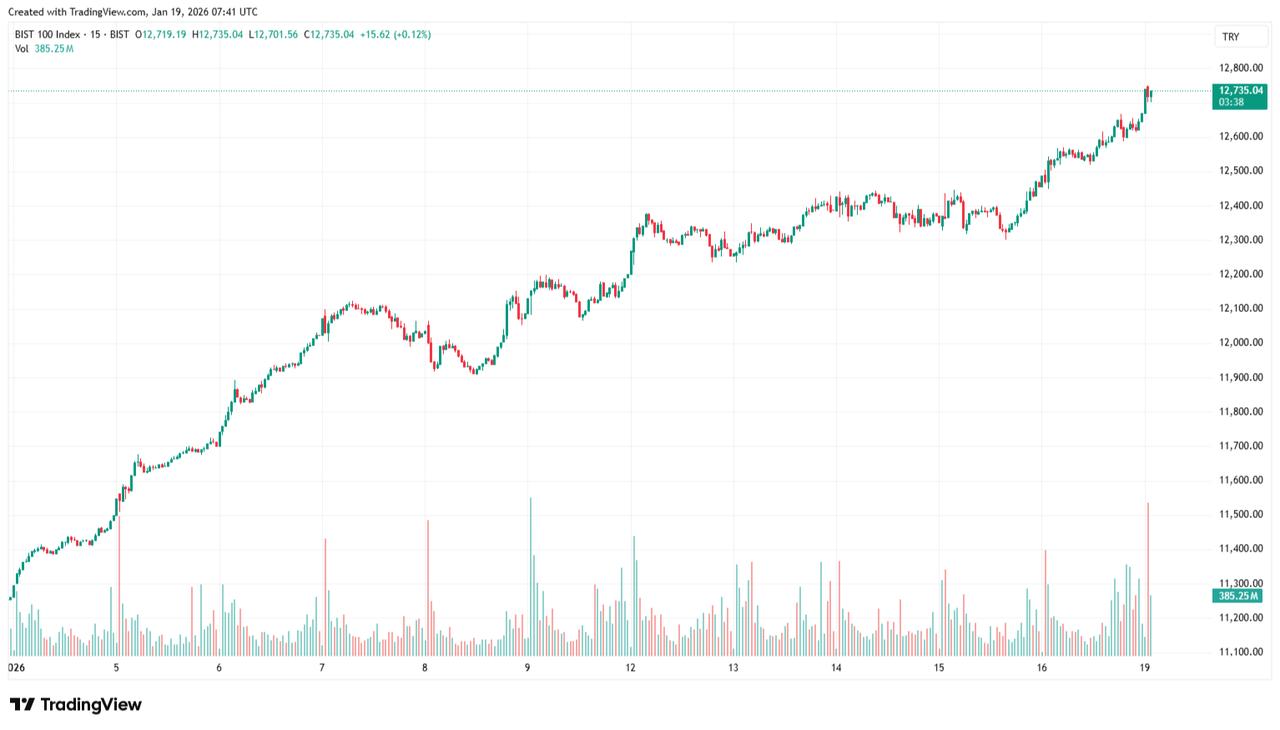
Meanwhile, Türkiye’s benchmark stock index, the BIST 100, extended its record-breaking run on Monday, opening 0.57% higher at 12,740.72 points.
Digital assets also saw steep losses. Bitcoin fell by more than 3% below $92,000, while Ethereum dropped nearly 5% to $3,177.68. Solana lost almost 9% to $130.52, and XRP declined by more than 6% to 1.8845.
In energy markets, both Brent crude and West Texas Intermediate (WTI) slipped by approximately 0.7%, to $63.63 and $58.95 per barrel, respectively.

U.S. President Donald Trump stated on Sunday that beginning Feb. 1, the U.S. would impose a 10% import tariff on goods from eight European countries—Denmark, Norway, Sweden, France, Germany, the Netherlands, Finland, and the United Kingdom, due to their opposition to the proposed acquisition of Greenland, a Danish autonomous territory. The rate is set to rise to 25% on June 1 if no agreement is reached.
The announcement came after negotiations with Denmark ended in what Trump called a "fundamental disagreement." The tariff threats, coupled with previous tensions over Iran and Venezuela, have contributed to rising market volatility.
In response, the targeted nations issued a joint statement warning that such threats “undermine transatlantic relations and risk a dangerous downward spiral.” French President Emmanuel Macron’s office also indicated plans to request the European Union activate its “anti-coercion instrument,” a mechanism that could restrict imports from the United States.
Bloomberg reported that the EU is weighing retaliatory tariffs on $108 billion worth of U.S. goods, the same volume of duties that were suspended in August 2025 during previous negotiations.


 Set as preferred source
 Set as preferred source


 1 min read

 1 min read