Newsletters




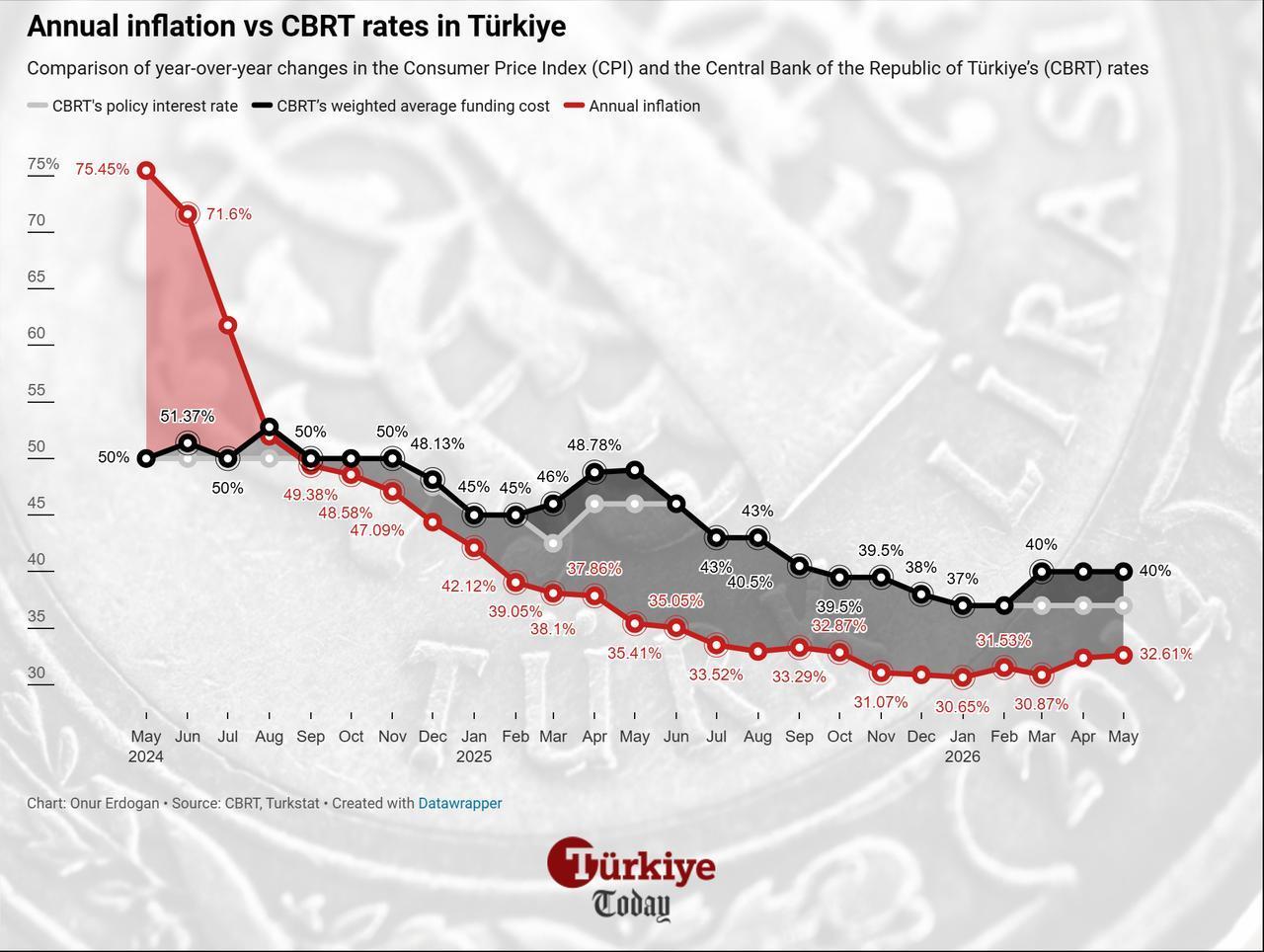
The Central Bank of the Republic of Türkiye (CBRT) is widely seen as keeping its benchmark interest rate at 37% when policymakers meet next week, although a minority of economists still foresee a hike to 40% amid persistent inflation risks.
A recent survey by Turkish financial data provider Matriks found that 27 of 33 economists expect the CBRT to leave its one-week repo rate unchanged at its June 11 Monetary Policy Committee (MPC) meeting, while six forecast a 300-basis-point increase to 40%.
The findings broadly mirror the CBRT's May Market Participants Survey, which showed expectations for the policy rate remaining at 37% over the next two meetings.
The latest Consumer Price Index (CPI) data showed inflationary pressures eased somewhat in May, as monthly inflation slowed to 1.7% while the annual rate ticked up to 32.6%, aided by softer food prices and lower global oil prices.
In its report following the release, ING forecast the central bank would leave rates unchanged, arguing that recent macroprudential measures, including tighter lending growth caps, have already added to monetary tightening.
The bank cautioned that the May data did not signal a clear return to the disinflation path and flagged oil markets as a continuing source of uncertainty.
It emphasized that energy-related shocks could still feed through to broader consumer prices despite government efforts to cushion higher crude costs through fuel tax adjustments.
The Dutch lender also pointed to two-sided risks in the food outlook, saying stronger agricultural output could help contain price growth, while higher fertilizer costs may exert upward pressure in the months ahead.
"Overall, May inflation has not yet signaled a return to the disinflation trend, confirming that the path ahead remains challenging," ING said.
Even so, the bank noted that escalating geopolitical tensions or domestic political developments could prompt a more cautious policy stance, potentially leading the CBRT to raise its policy rate toward the current effective funding rate of around 40%.

Spanish lender BBVA, however, sees the CBRT will deliver another round of tightening at its upcoming MPC meeting, with a 300-basis-point increase that would lift the policy rate to 40%.
The lender stressed that persistent inflation inertia, elevated producer-price pressures, and uncertainty surrounding regional conflicts and energy markets continue to support its more hawkish stance.
According to BBVA, lower food and energy costs helped ease headline inflation in May, although underlying price pressures moderated only modestly as services inflation remained sticky.
The bank also stressed unanchored inflation expectations and continued volatility in energy markets as key risks to the disinflation process.
While it sees a rate increase as the most likely outcome, BBVA acknowledged that policymakers could still leave rates unchanged given limited dollarization pressures and recent credit-tightening measures.
Assuming a gradual reopening of the Strait of Hormuz in the second half of 2026, average oil prices of $90 per barrel and economic growth of 3%, the lender maintained its year-end inflation forecast at 30%.


 Set as preferred source
 Set as preferred source


 1 min read

 1 min read