Newsletters




Newly examined marble inscriptions from the ancient city of Teos in western Türkiye show how Roman businessmen were tied into local trade, civic life and market administration during the first century B.C.
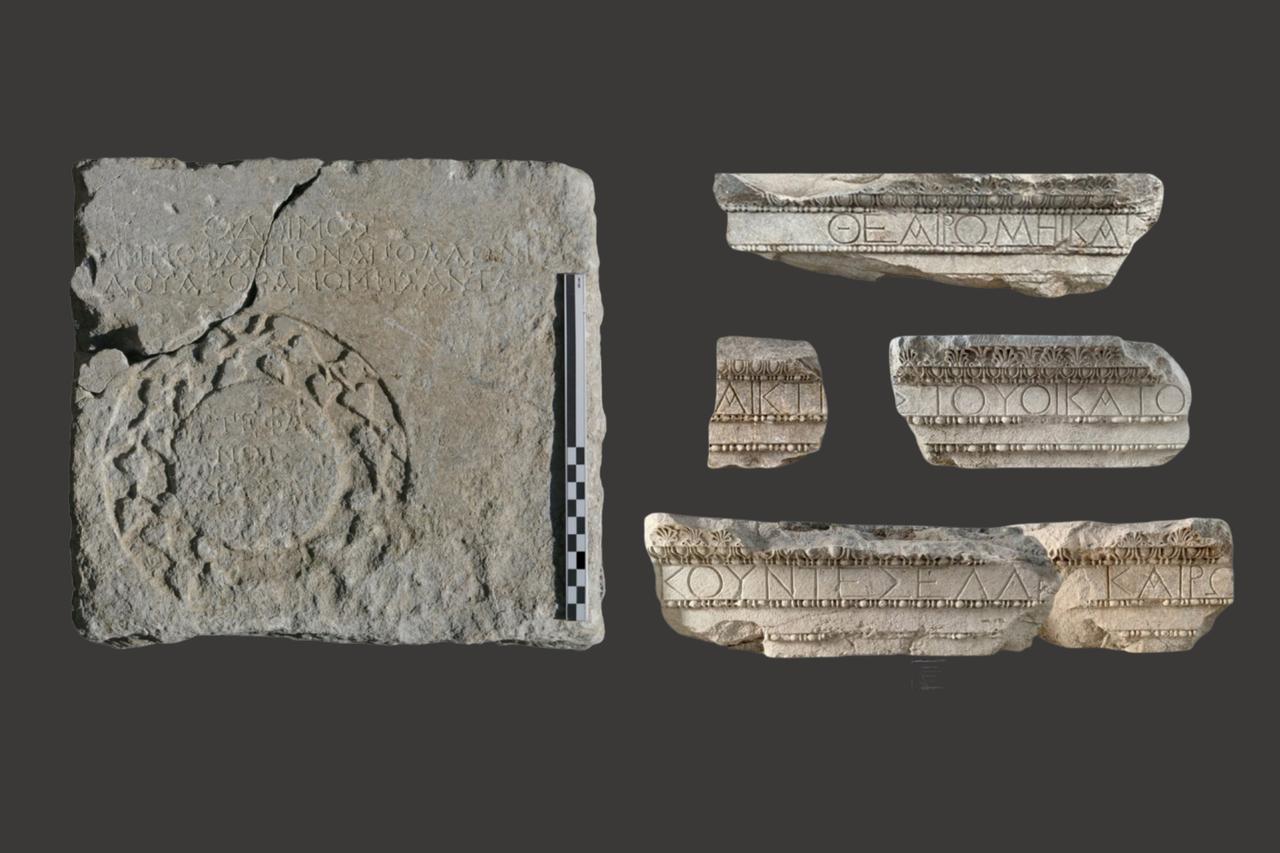
The inscriptions, found in 2021 during excavations at the Sanctuary of Dionysus near Seferihisar in Izmir, focus on Menophantos, son of Apollonides, a local official who served as an agoranomos—a market supervisor responsible for order, pricing and the smooth running of trade.
The findings were analyzed by researcher Tolga Uzun and published in the April 2026 issue of Belleten. They suggest that Roman businessmen in Teos were not temporary visitors, but an organized and influential group with close links to the city’s economic and civic structure.
One of the inscriptions states that Roman businessmen active in Teos presented Menophantos with a golden wreath because he had carried out his duties “well and honorably.” A second inscription shows that the city’s public assembly also honored the same official with a golden wreath.
The two marble plaques appear to be similar in size and workmanship, suggesting that the honors may have been given around the same time. Their lettering points to the late Hellenistic period, around the first century B.C., when Roman influence in Anatolia was expanding.
The title agoranomos can be understood as a senior market regulator in an ancient Greek city. Such officials helped oversee commercial life, settle practical problems in the marketplace and make sure trade could continue without disruption.
Teos was already an important economic center during the Hellenistic period. Its income came from products such as grain, wine, olive oil, timber and wool textiles, while its famous Temple of Dionysus, public festivals and the Artists of Dionysus association helped keep the city socially and commercially active.
This activity likely drew Roman businessmen to the city. Another major attraction was Teos’ marble, especially the stone known as Lucullus Marble or Africano, which was later widely used in Roman public buildings.
Uzun notes that Menophantos may have helped Roman businessmen with the transport or sale of this marble, or with possible disputes over pricing, customs or shipping. The study does not present this as certain, but as a likely explanation for why Roman businessmen publicly honored him.
The inscriptions use the Greek term pragmateuomenoi, which corresponds to the Latin negotiatores. This term did not simply refer to ordinary shopkeepers or small traders. In the Roman world, negotiatores were business figures involved in capital, credit, finance and large-scale trade.
This distinction matters because Roman sources separate negotiatores from mercatores, a term closer to everyday merchants or retailers. Negotiatores were usually wealthier, more influential and more closely connected to Roman political and economic power.
In Teos, the presence of such a group shows that Roman commercial activity had reached beyond major centers such as Ephesus, Smyrna and Pergamon. It also indicates that smaller but strategically located Aegean cities were tied into wider Roman business networks.
The Teos inscriptions also shed light on conventus, a Latin term used for groups or communities of Romans living and working outside Rome. In this context, a conventus can be understood as an informal business association, almost like an ancient trade chamber.
Such groups allowed Roman businessmen to act collectively, protect their interests and build structured relationships with local authorities. The Teos evidence suggests that these associations operated not only in major provincial cities but also in coastal cities with strong commercial value.
A building inscription from the Temple of Roma and Augustus in Teos also points to the presence of Greeks and Romans living in the city and possibly contributing financially to public construction. This supports the idea that Romans in Teos were involved not only in trade, but also in the city’s civic and architectural life.
The golden wreath given to Menophantos shows that trade in antiquity was not only about goods and profit. It also depended on trust, prestige and cooperation between foreign businessmen and local officials.
The Teos inscriptions reveal how Roman identity spread through economic relationships as much as through military or political power. Roman businessmen brought capital and commercial networks into local communities, while local officials such as Menophantos helped keep those networks working.
The evidence from Teos adds a new layer to the history of Roman business activity in western Anatolia. It shows that the city’s markets, marble resources and civic institutions were part of a wider economic world stretching across the eastern Mediterranean.


 Set as preferred source
 Set as preferred source


 2 min read
 1 min read