

 Newsletters


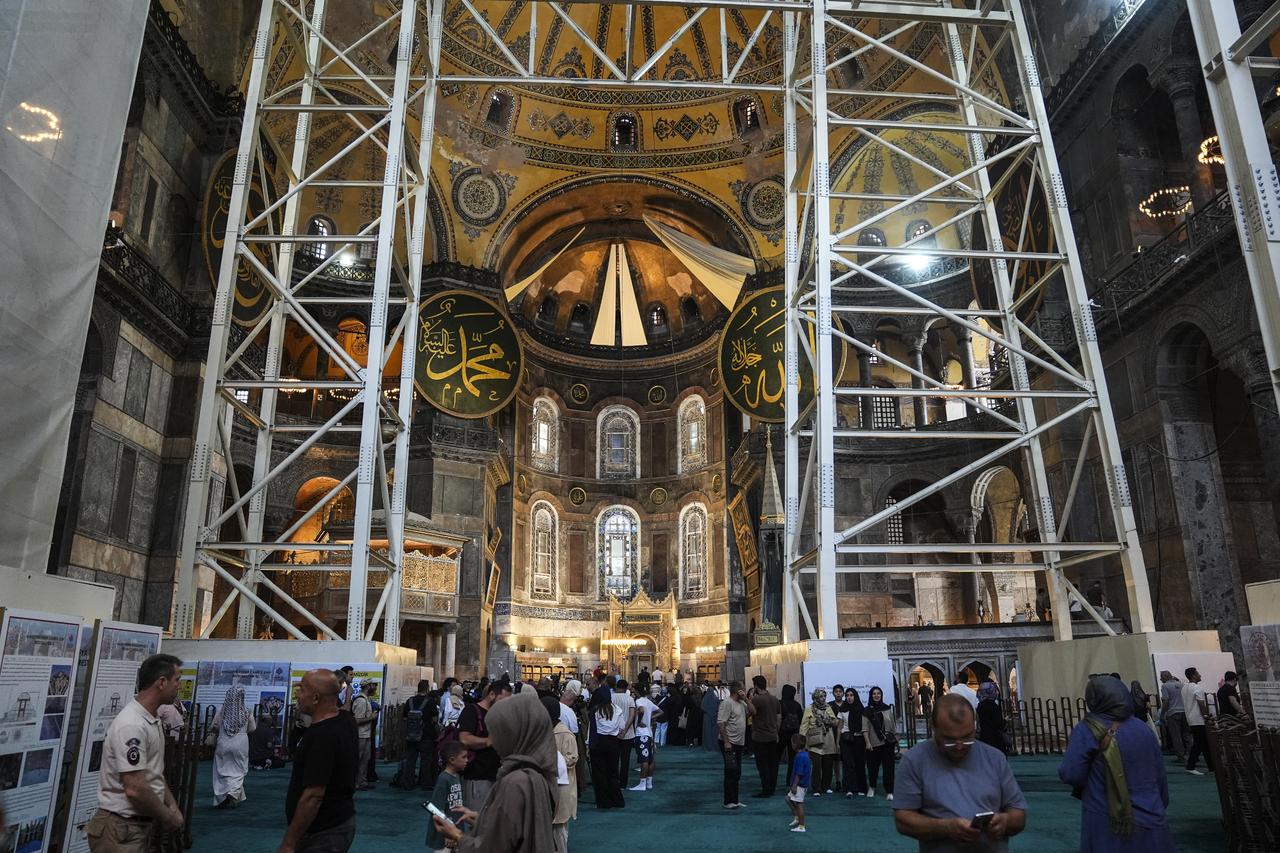


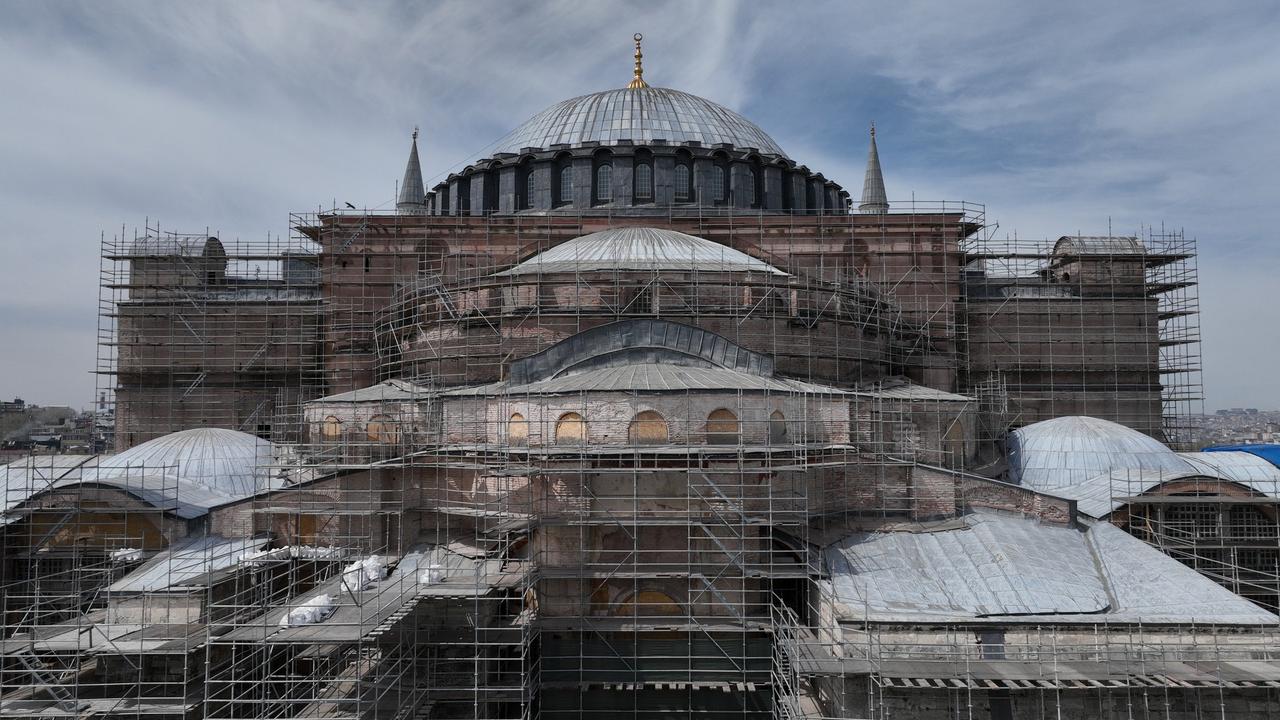
Restoration work at Istanbul's Hagia Sophia is moving into a new phase, with experts preparing to strengthen its eastern semi-dome while investigating whether a Quranic verse from the Classical Ottoman period survives beneath later decorative layers.
The work forms part of an extensive restoration, conservation and structural reinforcement project overseen by Türkiye's General Directorate of Foundations under the Culture and Tourism Ministry, with decisions and inspections carried out by Hagia Sophia's Scientific Committee and Conservation Board.
Temporary arrangements will also be introduced inside the monument so that worship and visitor access can continue while a new steel working platform is installed beneath the eastern semi-dome.
Scientific Committee member and architect Prof. Hasan Firat Diker said researchers would examine decorative layers beneath the existing surface of the eastern semi-dome, which dates from restoration work carried out by the Fossati brothers in 1847-1849.
Historical visual evidence indicates that a Quranic verse from the Classical Ottoman period existed there before the 19th-century restoration, according to Diker.
"During the restoration and conservation of the eastern semi-dome decorations, the layers preceding the current decoration will also be investigated. If the presence of this verse is identified following the scraping work, a very important layer showing Hagia Sophia's appearance as a mosque during the Classical Ottoman period could once again be brought into the world's cultural inventory," Diker said.
The planned examination will involve controlled removal and investigation of later surface layers to establish whether traces of the earlier inscription remain.
Civil engineer and Scientific Committee member Assoc. Prof. Mehmet Selim Okten said numerical modelling and structural analyses had shown that the main dome needed to be strengthened together with its semi-domes.
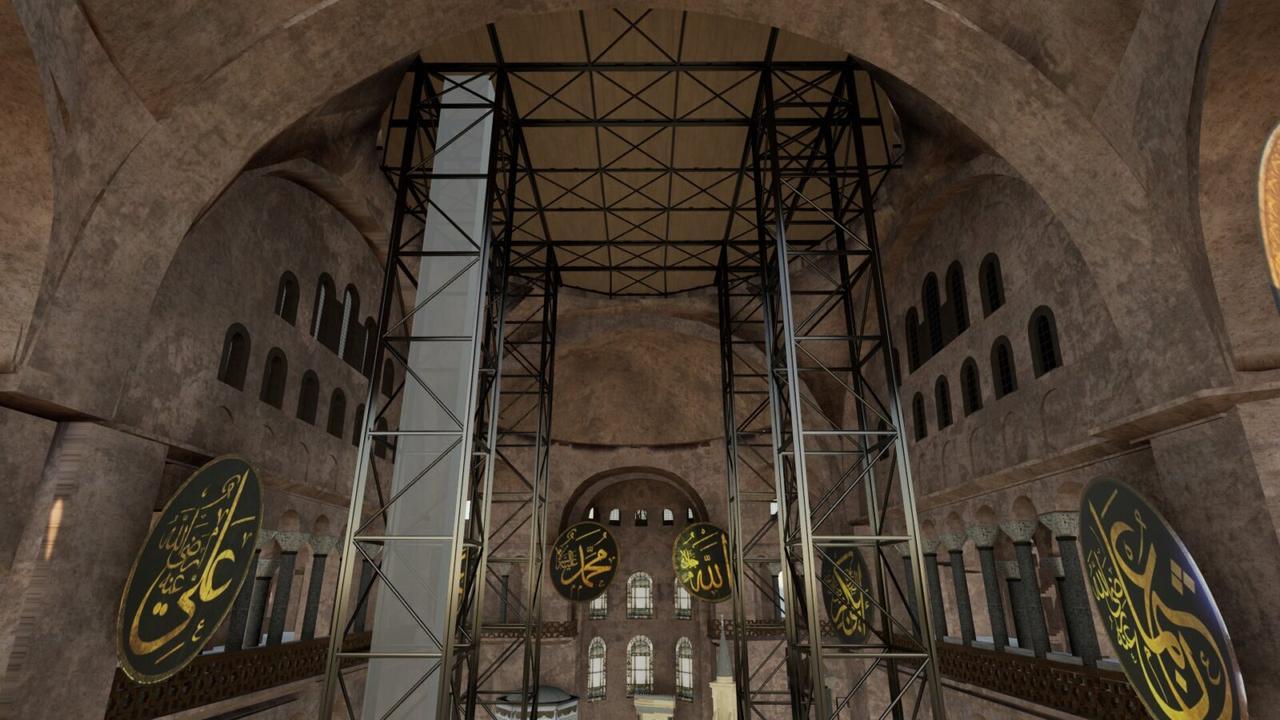
A steel platform and a membrane-covered protective dome system were therefore planned to allow restoration and reinforcement work to be carried out safely.
Conservation work is already continuing on mosaics above the steel platform installed for the main dome. Specialists are removing dust and carrying out "facing," a conservation technique in which fragile mosaic surfaces are temporarily supported with protective fabric.
A temporary steel roof has also been completed above the main dome, while work continues to open up its lead covering in a controlled manner.
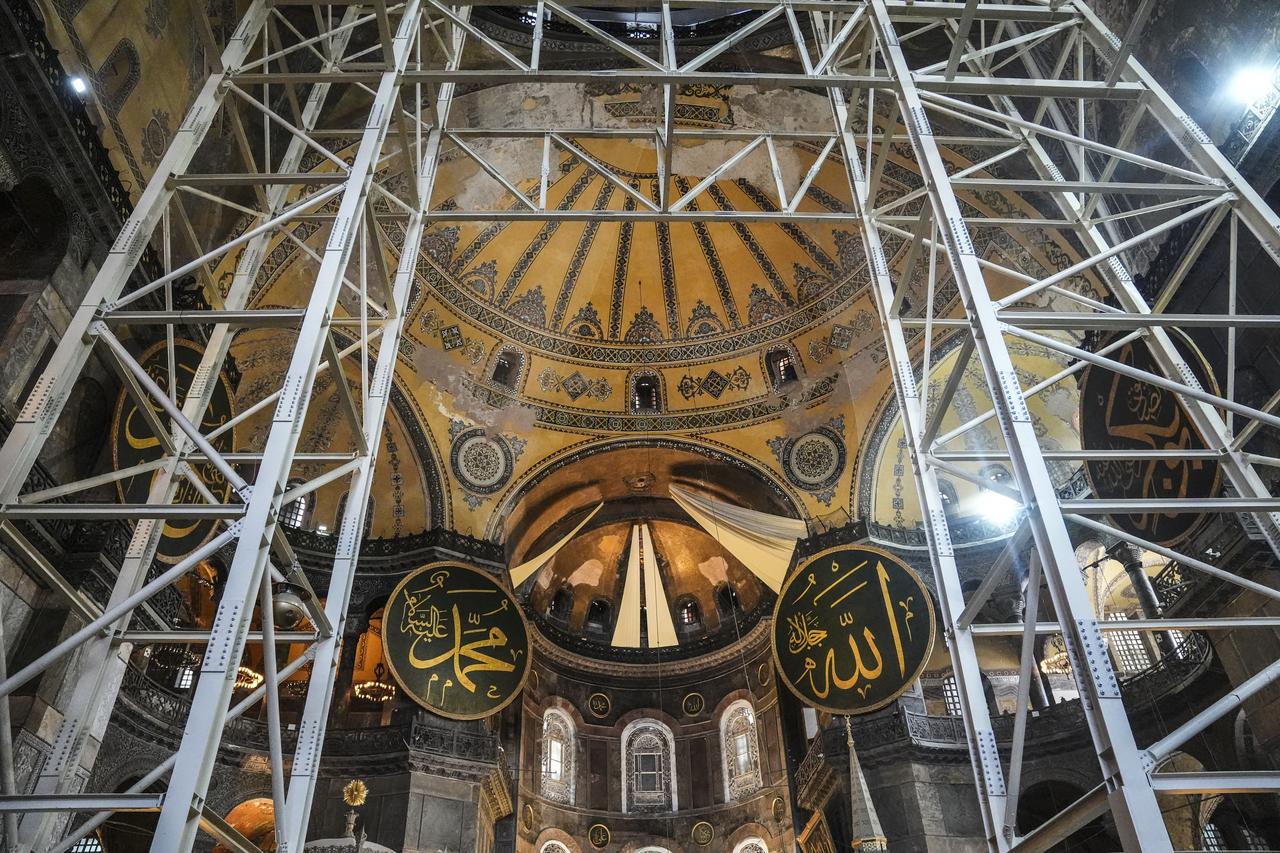

Following structural assessments, experts determined that the eastern semi-dome also required reinforcement.
Alongside structural work, mosaics and hand-painted ornamental decorations on the inside of the semi-dome will undergo conservation, while marble surfaces on the eastern wall containing the mihrab, the prayer niche indicating the direction of prayer, will be cleaned, repaired and conserved.
A steel working platform will be set up to provide safe access to the area. Before construction begins, the work zone will be separated off and covered with specially printed screens designed to preserve the visual appearance of the interior as much as possible.
A temporary mihrab and minbar, the pulpit used for sermons in a mosque, will also be installed so that worship can continue.
Historic elements, including the original mihrab and minbar, will be physically protected, while limited sections of wooden platforms and marble flooring may be temporarily removed under the supervision of specialist restorers. Chandeliers in the work area will also be taken down carefully.
The original marble floor will be protected from heavy loads and wear through a multi-layer raised flooring system, while load and vibration tests will be carried out before the main platform is installed.
Culture and Tourism Minister Mehmet Nuri Ersoy said the restoration was progressing according to schedule and that work would now move ahead on the eastern semi-dome.
He said the steel platform would make it possible to safely carry out structural reinforcement as well as conservation of mosaics, ornamental painting and marble surfaces.
Ersoy added that worship and visitor circulation would continue through temporary arrangements while the work was carried out under the supervision of the Scientific Committee and Conservation Board.
Materials scientist and chemist Prof. Ahmet Gulec said the platform created for structural work on the main dome was also helping protect the mosaics and central inscription on its interior.
Once the dome's lead covering is removed, samples of mortar, plaster and other construction materials will be collected for analysis. The results will then be used to determine the composition of materials to be applied during conservation.
Art historian Prof. Asnu Bilban Yalcin said Hagia Sophia had faced structural problems throughout its roughly 1,500-year history and had undergone repairs during both the Byzantine and Ottoman periods.
She said the current project was intended to strengthen the dome and semi-domes using modern scientific knowledge and technology while also providing experts with access to areas of the building that remain insufficiently understood.
Scientific Committee member Prof. Can Sakir Binan stressed that the project should protect Hagia Sophia's layers from different periods rather than prioritizing one historical phase over another.
"The aim here is not to return Hagia Sophia to a particular period but to preserve the unique multi-layered identity created over its 1,500-year life, together with its authenticity and integrity, and carry it into the future," Binan said.


 Set as preferred source
 Set as preferred source


 1 min read

 1 min read


