Newsletters


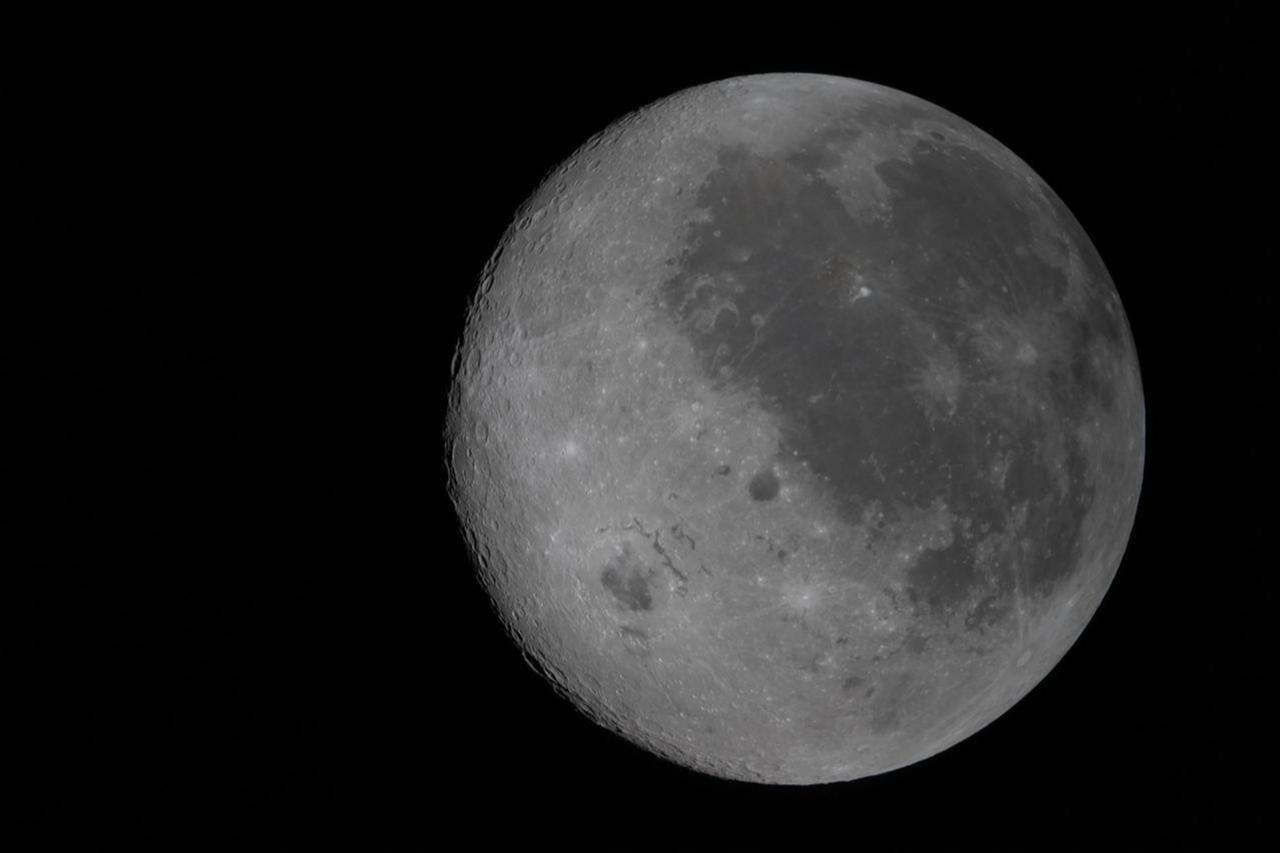


Chinese researchers have identified two previously unknown lunar minerals from the lunar samples returned by the Chang'e-5 mission.
The China National Space Administration announced this breakthrough during the opening ceremony of the 11th China Space Day in Chengdu on Friday.
Officials confirmed the International Mineralogical Association has officially approved and classified the newly discovered substances, naming them magnesiochangesite-(Y) and changesite-(Ce). This development marks the second and third lunar minerals discovered by Chinese scientists following their initial discovery of changesite-(Y) in 2022.
Globally, these findings represent the seventh and eighth new lunar minerals ever identified in returned extraterrestrial samples.
Both minerals belong to the rare-earth phosphate category and lie hidden within the fine particles of lunar dust. Researchers noted that these delicate crystal structures possess no identical counterparts on Earth.
They form part of the merrillite group, which is a class of phosphate minerals commonly found in samples from the Moon, Mars, and asteroids.
Scientist Li Ziying led a research team from the Beijing Research Institute of Uranium Geology to discover magnesiochangesite-(Y).
This mineral appears as short columnar crystals measuring merely two to thirty micrometers in size and resides primarily within basalt fragments in drilled lunar samples.
Identifying such a minuscule substance proved exceptionally challenging because magnesium dominates the crystal lattice, and the particles are roughly one-third to one-thirtieth the diameter of a human hair.
Extracting the crystal using a focused ion beam scanning electron microscope required immense precision.
Ge Xiangkun, a researcher at the institute, told Global Times the extraction process was likened to performing microsurgery, where even slight excess force could destroy the specimen.
Ge emphasized the mineral's importance, saying, "As a new member of the merrillite group, magnesiochangesite-(Y) offers a fresh mineralogical sample for studying lunar formation, magmatic activity, and chemical differentiation, helping scientists better understand the Moon's geological history."
Academician Hou Zengqian from the Chinese Academy of Geological Sciences directed the team that discovered changesite-(Ce).
Scientists located this specific mineral both in the Chang'e-5 lunar soil from the Oceanus Procellarum region and in a lunar meteorite named Pakepake 005. Explorers recovered that meteorite in China's Taklimakan Desert in 2024, making it the first officially recognized lunar meteorite discovered within the country.
Detailing its unique composition, Hou told the Global Times, "Changesite-(Ce) is a phosphate mineral rich in the rare-earth element cerium, belonging to the merrillite group. Compared with minerals of the same group found in samples from Earth, Mars, and asteroids, it shows a clear enrichment in rare earth elements and thus serves as a 'fingerprint' planetary mineral."
Hou also highlighted a significant contrast between these recent findings and older missions, saying that Apollo samples tend to show enrichment in heavy rare earth elements, whereas the Chang'e-5 samples display an abundance of light rare earth elements. This divergence suggests a major chemical differentiation during the magmatic evolution of the Moon.
Wang Yanjuan, the first discoverer of changesite-(Ce), said that the research team employed advanced analytical techniques, including nanoindentation and Raman spectroscopy, to systematically determine the physical properties of the unrecorded natural mineral.
Uncovering changesite-(Ce) opens new avenues for synthetic material development beyond simply broadening human understanding of the cosmos.
Qu Kai, a member of the Chinese Society of Petrology and Geochemistry, explained that the mineral exhibits a pronounced luminescent effect, showing strong potential for applications in the development of phosphor materials for white light-emitting diodes.
These discoveries ultimately furnish fundamental data for assessing the rare earth resource potential of the Moon and planning the future of in-situ resource utilization (ISRU).


 Set as preferred source
 Set as preferred source



 2 min read