Sign in
 Newsletters





On March 1, 2024, a group of riders pulled their quad bikes onto the side of a road in Istanbul's Eyupsultan district to deal with a mechanical problem. A car, driven, according to prosecutors, by 16-year-old Timur Cihantimur, who had no license, struck them. Oguz Murat Aci, 29, was killed. Four others were hurt.
Within hours, the teenager was on a plane with his mother, the writer Eylem Tok. The first stop was Egypt, the last was the United States, and by the end of the month the two were photographed walking down a New York street, about as far from that roadside as a person can get without a passport stamp from the moon.
The distance held until June 2024, when both were arrested in Boston on Türkiye's extradition request. Tok has spent most of the time since in the Donald W. Wyatt Detention Facility in Rhode Island, fighting her return through every rung of the American federal courts she could reach.
Now, on paper, she wants to go back. On Nov. 13, her lawyers told an Istanbul court that she will drop her last U.S. appeal and show up for trial.
In return, they asked for something close to Monopoly's most coveted card: for the Turkish arrest warrant against her to be lifted, and for her release on a cash bond. The family of the man who died reads the offer as a maneuver to stay in the United States, dressed up as a homecoming.
Tok’s attorneys in the United States did not respond to Türkiye Today’s repeated requests for comment.


Türkiye's extradition request reached U.S. authorities through its embassy in Washington in April 2024. An American arrest warrant followed on May 7, and the Boston arrest came five weeks later.
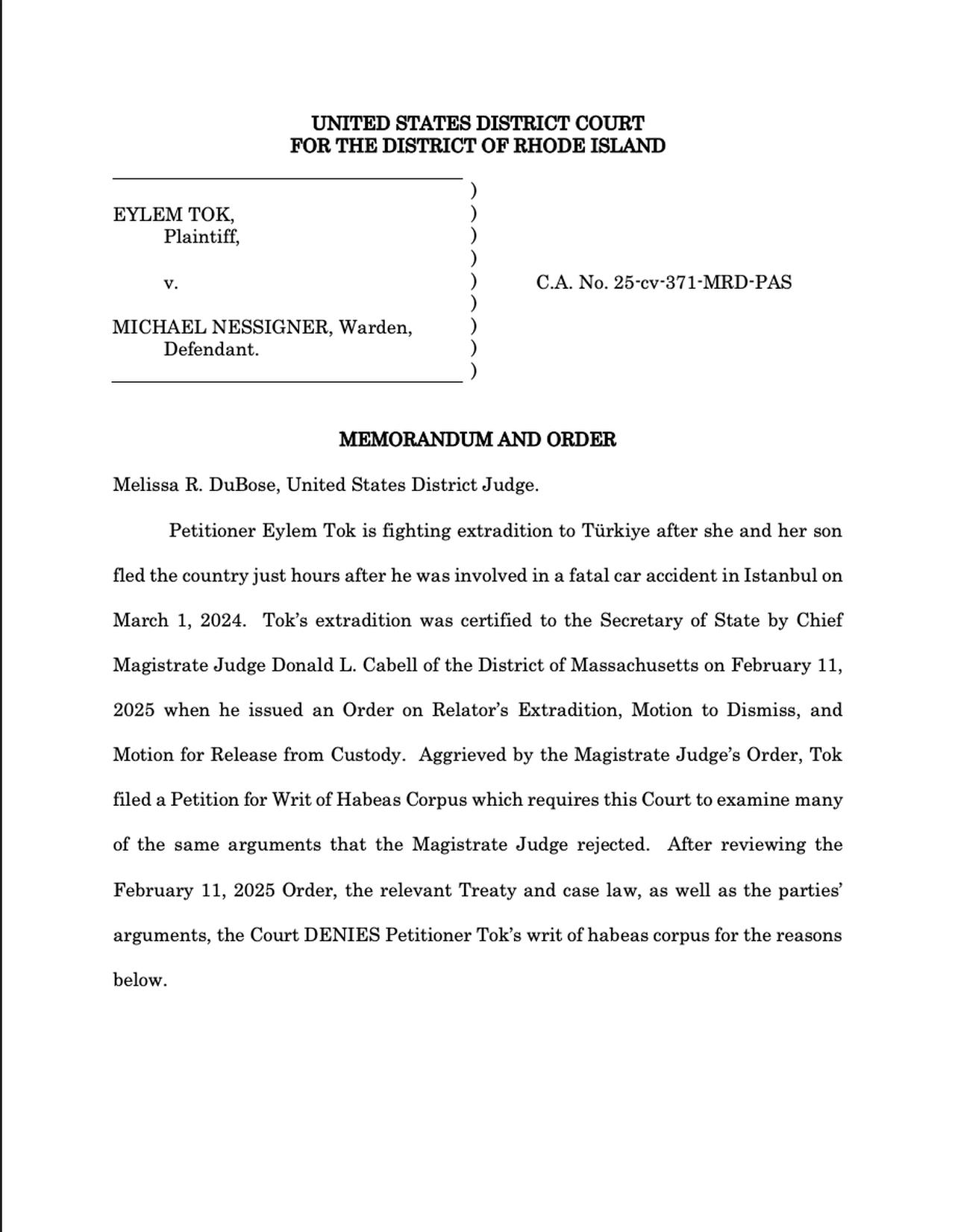
From there, the case moved at the speed of federal paperwork. In February 2025, a federal magistrate judge in Massachusetts certified that Tok could be extradited and sent the case to the secretary of state, who has the final say.
Tok answered with a habeas corpus petition, the old American tool for challenging the legality of someone's detention. A federal judge in Rhode Island rejected it in January 2026. Her lawyers filed an appeal the next morning, and a U.S. court froze her extradition until that appeal is decided.
That freeze is the only thing keeping her in Rhode Island instead of on a flight to Istanbul, and her lawyers now say she will give it up.
An indictment filed in February seeks up to 10 years for Tok, the boy's father Bulent Cihantimur and two others on charges of protecting an offender and destroying, concealing or altering evidence.
A fifth defendant faces up to five years. Prosecutors allege the group got Cihantimur out of the country before he could take an alcohol test or give a statement, and that some of them hid a phone belonging to one of the injured victims. The phone was later turned over to police.
A separate indictment in March seeks up to 22 and a half years for Cihantimur himself, up to 12 of them for Aci's death, on charges of causing death and injury through "conscious negligence," the Turkish legal category for a driver who sees the risk and takes it anyway.
Tok's own account came in a letter from detention made public in May. She said she had acted on "maternal instinct" to protect a frightened son, and claimed her family had reached a settlement with Aci's legal heirs. Ozer Aci, the dead man's father, has heard that tune before. "I don't think justice can be secured with money," he said.
The new petition, filed by Tok's attorneys, reads like a homecoming announcement.
"Our client Eylem Tok will withdraw the appeal she filed against the extradition decision concerning her, begin arrangements for her return to Türkiye before the hearing and appear before your court at the hearing," the lawyers wrote.
They also asked the court to lift the arrest warrant once she appears and to release her under "judicial control," Türkiye's version of bail conditions, with a cash bond in whatever amount the judge sees fit plus any other restrictions the court wants.
The petition gives no return date, and nothing filed in the U.S. courts shows the appeal has actually been withdrawn.

Haci Orhan, the lawyer representing the Aci family, built his objection on that gap. The defense's statements, he wrote to the court, rest not on anything that has happened but on things the defendant says she will do later. Those statements, he argued, "do not guarantee" that she will return or stay present for the trial.
In his reading, the petition is a legal setup, and the last attempt of many to avoid justice.
"The goal here is this," Orhan said. If the Turkish arrest warrant is lifted, the defense can go to American courts and say: "There is no arrest warrant against us, no order seeking us, no crime of ours that could be subject to extradition. If there were, there would be an arrest warrant or a detention order against us." The petition, he said, was filed to build exactly that argument.
Extradition runs on a live charge backed by a live warrant. Pull the warrant in Istanbul and the case in Rhode Island loses its anchor. So a defendant who has fought extradition for two and a half years is offering to skip the last round, provided the Turkish court first removes the reason she is being extradited.
Orhan doubts the homecoming would go her way even then. With the warrant gone, he said, she still could not just "buy a plane ticket and return to Türkiye" from a U.S. detention center.
Ozer Aci, the dead man's father, sees a pattern in the timing. Tok's next hearing is set for the first week of December. "As that hearing approaches, she is making efforts, wondering what benefit she can gain, how she can turn this to her advantage," he said.
What bothers him most is the bond. "They are trying to solve everything with money," he said. In his view, the warrant should stay in place until Washington sends her back. "When will America decide on her extradition? She'll come then and appear before the court," he said.
The court has yet to rule. Aci has already written his verdict on the last two and a half years. "I hope they understand the price of fleeing," he said.


 Set as preferred source
 Set as preferred source



 3 min read