Newsletters


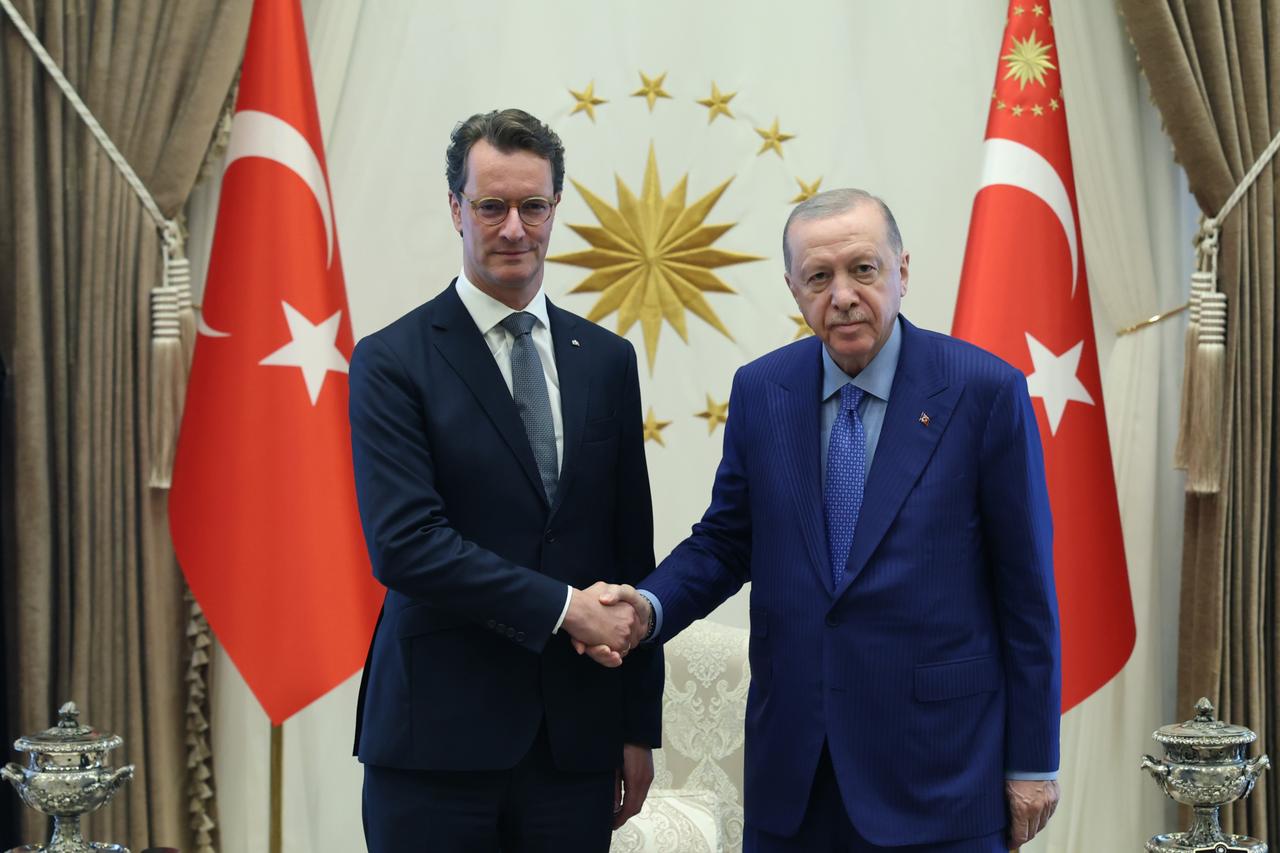


President Recep Tayyip Erdogan received Hendrik Wust, the minister-president of Germany's North Rhine-Westphalia, at his office in Ankara on Monday in a meeting that stretched to 50 minutes, longer than planned, and touched on Germany's recent state election results, Wust said afterward.
Erdogan follows German domestic politics "very, very closely," including developments in North Rhine-Westphalia, Wust told reporters following the talks. "He was also very interested in my assessment of the recent election results," Wust said, adding that the two discussed the topic intensively.
Wust said Erdogan was informed about a wide range of issues shaping public opinion in Germany, down to recent developments in football.
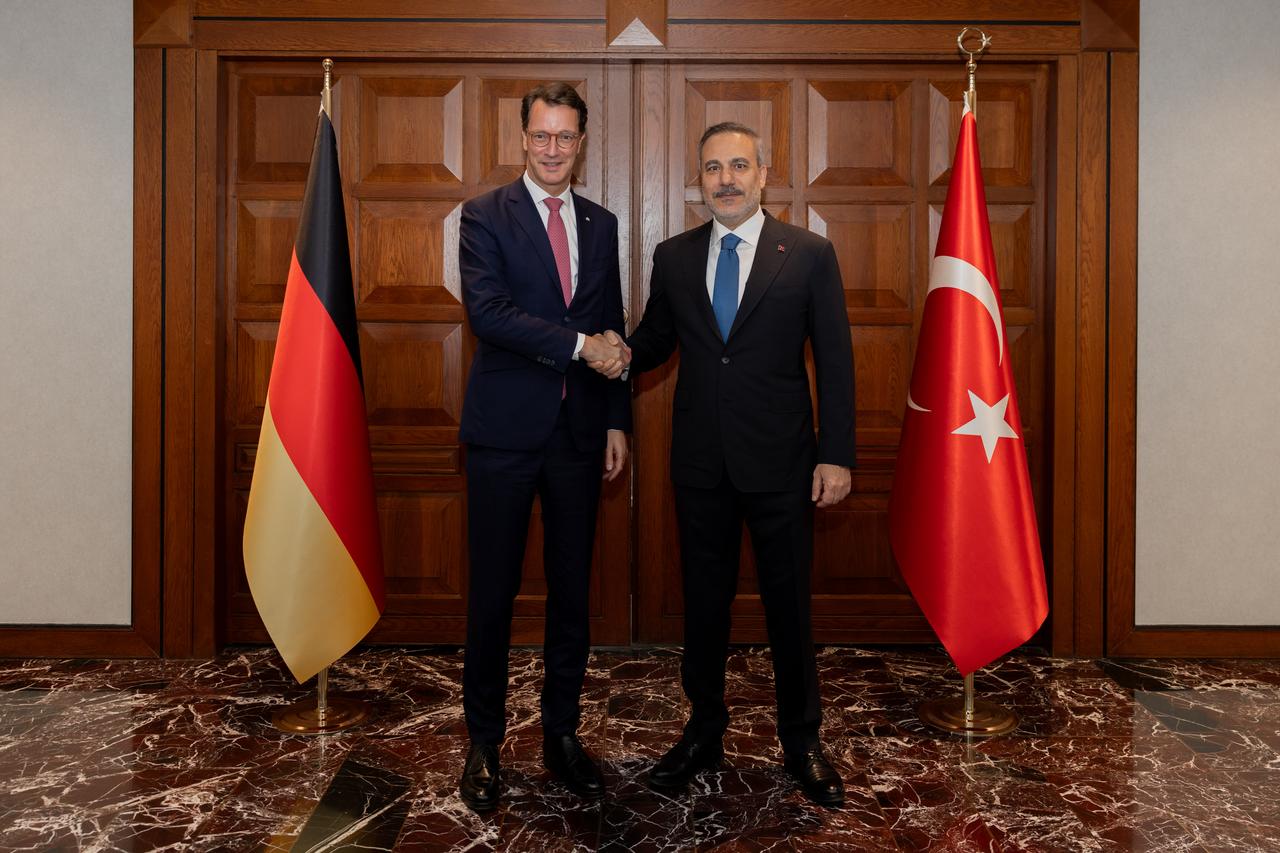

The meeting was protocolarily unusual and was not part of Wust's official published itinerary. Regional German government leaders are not typically received by Türkiye's head of state, and members of Wust's delegation said Erdogan, in his current role as president, had never before met with a German state premier.
Türkiye's president did meet with Lower Saxony's Stephan Weil in 2014, when Erdogan still served as prime minister; Weil also met then-President Abdullah Gul during that visit.
Erdogan's decision to meet Wust was widely linked to North Rhine-Westphalia's close ties to Türkiye. About one-third of people of Turkish origin living in Germany, close to a million people, reside in the state, which officials describe as having the most intensive contacts with Türkiye of any German region.
Wust said Türkiye, as a NATO member, has a strong interest in deepening cooperation in the defense sector and in mutually benefiting from innovation, adding that the interest runs both ways.
He said Erdogan was well informed about what North Rhine-Westphalia's defense industry has to offer.
The talks also covered economic cooperation between North Rhine-Westphalia and Türkiye, relations with the European Union, and easing visa requirements, according to the state chancellery, which said Türkiye is gaining importance for companies in the state as a production base and for diversifying supply chains amid geopolitical shifts.
Ahead of the trip, Wust called for a modernization of the EU-Türkiye customs union and faster processing of business visas in an interview with Turkish outlets.
A statement released afterward said the state government "follows domestic political developments in Türkiye with concern" while also committing to "open dialogue" with the country.
The visit, Wust's first to Türkiye and the first by a North Rhine-Westphalian government leader, was built around the 65th anniversary of the 1961 labor recruitment agreement between Germany and Türkiye, which opened the way for hundreds of thousands of Turkish workers to migrate to Germany.
Speaking during a visit to a Henkel plant in Elmadag, near Ankara, Wust credited those workers with helping drive Germany's postwar economic recovery.
"Without these people, it would not have been possible to achieve the economic upswing after the war," he said, noting they worked in steel mills, in mining, at Ford's Cologne plant and in road construction "everywhere."
The Elmadag facility is Henkel's second-largest plant worldwide and supplies the Middle East and Africa; Wust toured it alongside Henkel chief executive Carsten Knobel.
Wust had called at the start of the trip for opening a "new chapter" in German-Turkish relations, saying, "We want to focus on the positive for strengthened cooperation in the future," and that a close partnership makes it easier to raise critical issues and push for improvements.
The visit came as Wust, a member of Chancellor Friedrich Merz's Christian Democratic Union, has been widely discussed in Germany in recent weeks as a possible successor to Merz, who has faced mounting pressure after CDU losses in state elections in Saxony-Anhalt and Mecklenburg-Vorpommern.
On the eve of his departure, Wust reiterated on German broadcaster ZDF, "I want to remain minister-president of North Rhine-Westphalia." Elections in the state are due in April 2027.
Wust departed Dusseldorf on a scheduled flight Monday morning with a large delegation, including a senior business delegation and more than 30 journalists, and plans to travel to Istanbul before returning to Germany Wednesday evening.
In Türkiye, he is also due to meet senior representatives of Turkish companies at an investor gathering promoting North Rhine-Westphalia as a business and investment hub.
German-Turkish relations had long been marked by open friction, but inaugural visits by Merz and Foreign Minister Johann Wadephul roughly a year earlier set a different tone.
Wadephul said at the time that Germany sought an overall "positive agenda" with Ankara, and Merz's visit to the Turkish capital, alongside his wife Charlotte, was aimed at reviving a genuine strategic partnership between the two countries.


 Set as preferred source
 Set as preferred source


 1 min read
 1 min read