Newsletters




This article was originally written for Türkiye Today’s weekly economy newsletter, Turkish Economy in Brief, in its Sept. 14 issue. Please make sure you are subscribed to the newsletter by clicking here.
In a week when fighting resumed in the Middle East, uncertainty spread across a wider area, including the Red Sea, and oil prices once again climbed above $100 a barrel for the first time since May, the Central Bank of the Republic of Türkiye (CBRT) announced its latest interest rate decision.
The CBRT kept its policy rate unchanged at 37%, in line with market expectations. It also left the interest rate corridor unchanged, keeping the overnight lending rate at 40%, the policy rate at 37%, and the overnight borrowing rate at 35.5%.
The CBRT gave no clear guidance on the path for interest rates in its decision statement. Instead, it struck a balanced tone, combining positive and cautious messages on inflation.
The CBRT said recent inflation data and leading indicators pointed to a decline in the underlying inflation trend. It also said the pass-through from supply shocks to domestic prices remained limited and linked this to weak domestic demand.
These two messages may perhaps be seen as the reasons behind the return to the policy rate framework, following the resumption of weekly repo auctions on Aug. 23 and the 3-percentage-point rate cut.
The central bank said high energy prices posed an "upside risk" to the inflation outlook.
It also maintained its message that "monetary policy will be tightened if there is a significant and persistent deterioration in the inflation outlook," indicating that the inflation outlook and the path of energy prices will be key factors in determining the pace of rate cuts ahead.
The CBRT's decision came at a time when the European Central Bank raised interest rates by 25 basis points, and markets were also expecting a similar move from the U.S. Federal Reserve that week, with the probability exceeding 80% based on Friday's CME FedWatch pricing.
Expectations for interest rate cuts remain a key focus in Turkish markets. Following the CBRT's decision, which showed that tight monetary policy will remain in place for some time, attention has now turned to the first Monetary Policy Committee meeting on Oct. 22.
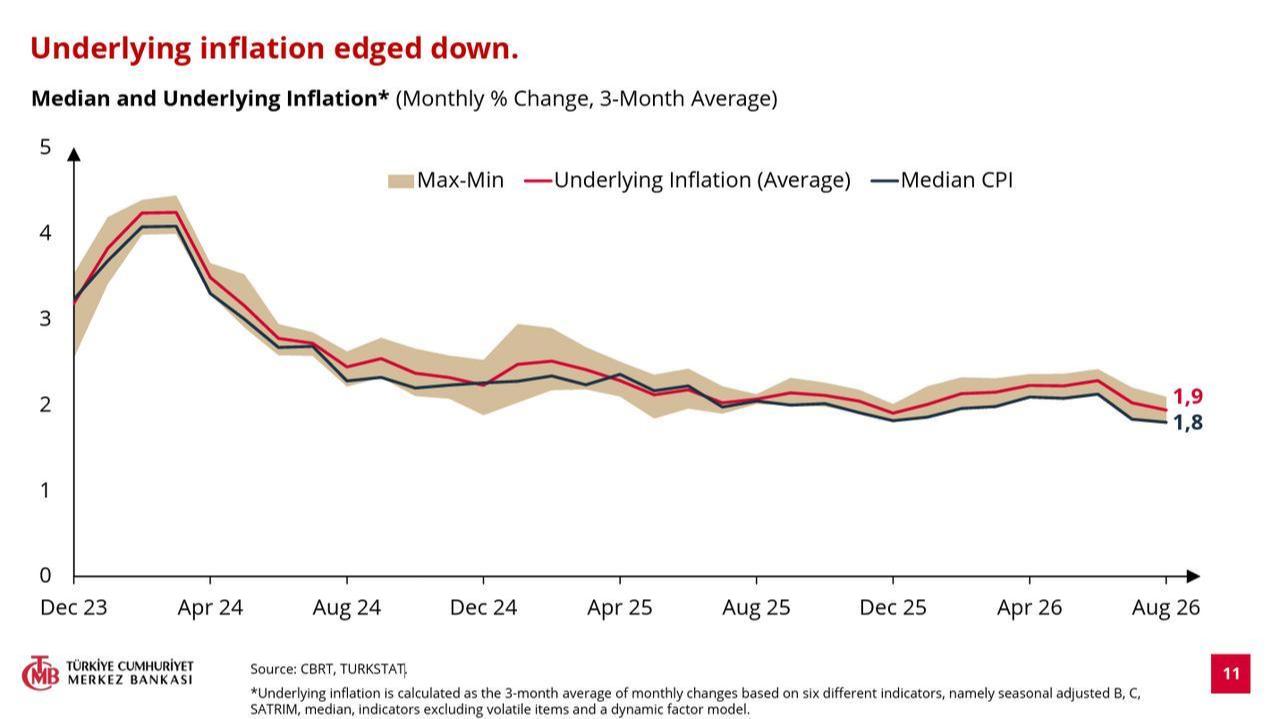

In an assessment by Is Investment, the brokerage said the CBRT was pleased with the decline in the underlying inflation trend.
However, it said the central bank preferred to wait and see how long the upward pressure from the wars in the Gulf of Hormuz, Yemen and Ukraine would affect energy and food prices and how much it would disrupt inflation expectations.
Investment said the Monetary Policy Committee statement did not signal a rate cut in October. Despite this, it maintained its forecast for 100-basis-point cuts at both the Oct. 22 and Dec. 10 meetings, citing the decline in underlying inflation and weak domestic demand.
Under its base scenario, the policy rate is expected to fall to 35% by the end of 2026 and to 27% by the end of 2027. For comparison, the brokerage forecasts inflation at 29.5% at the end of 2026 and 23% at the end of 2027.
The analysis also said geopolitical developments and rising commodity prices could delay the rate-cut cycle and limit the size of future cuts.
It noted that crude oil prices could return to the high levels seen in March and April, in which case it would expect rate cuts to spill into 2027. In an extreme scenario where the war in the Middle East damages energy infrastructure and continues even after the U.S. midterm elections, the firm said it would need to raise its 2027 interest rate and inflation forecasts.
BBVA Research also offered a notable assessment. The Spanish bank said the CBRT once again highlighted weak domestic demand while pointing to the limited pass-through of supply shocks into domestic prices.
At the same time, it emphasized that high energy prices remained an upside risk to the inflation outlook.
Given growing concerns about weak economic activity, BBVA Research said it expected the CBRT to feel more comfortable lowering real interest rates once pressure from energy prices eased.
BBVA Research said it expected monthly CPI inflation to come in at slightly more than 2% in September.
It said that if oil prices fell below $90 a barrel as the Oct. 22 Monetary Policy Committee meeting approached, annual inflation could decline to around 30%. Combined with still-high real interest rates, this would create room for a 100-basis-point policy rate cut, it said.
However, BBVA Research also said it expected the policy rate to remain at 36% until there was a more meaningful improvement in the downward inflation trend, noting that inflation was likely to stay around 30% through the end of the first quarter of 2027.
Another assessment from Alnus Investment viewed the CBRT's statement that "high energy prices pose an upside risk to the inflation outlook" as relatively hawkish, suggesting rate cuts may not be possible under current conditions.
The firm said it expected the CBRT to finish the year with two rate cuts if the inflation outlook improved by the October meeting. However, it did not rule out a scenario in which the next rate cut was pushed back to Dec. 10, 2026, if rising geopolitical risks caused the inflation trend to deteriorate.
Under current conditions, it looks increasingly difficult for the CBRT to cut rates in October as well. The risks stemming from the Middle East, which have been dominating the agenda since early March, continue to create serious uncertainty and limit the central bank's room for maneuver.


 Set as preferred source
 Set as preferred source


 4 min read