

 Newsletters


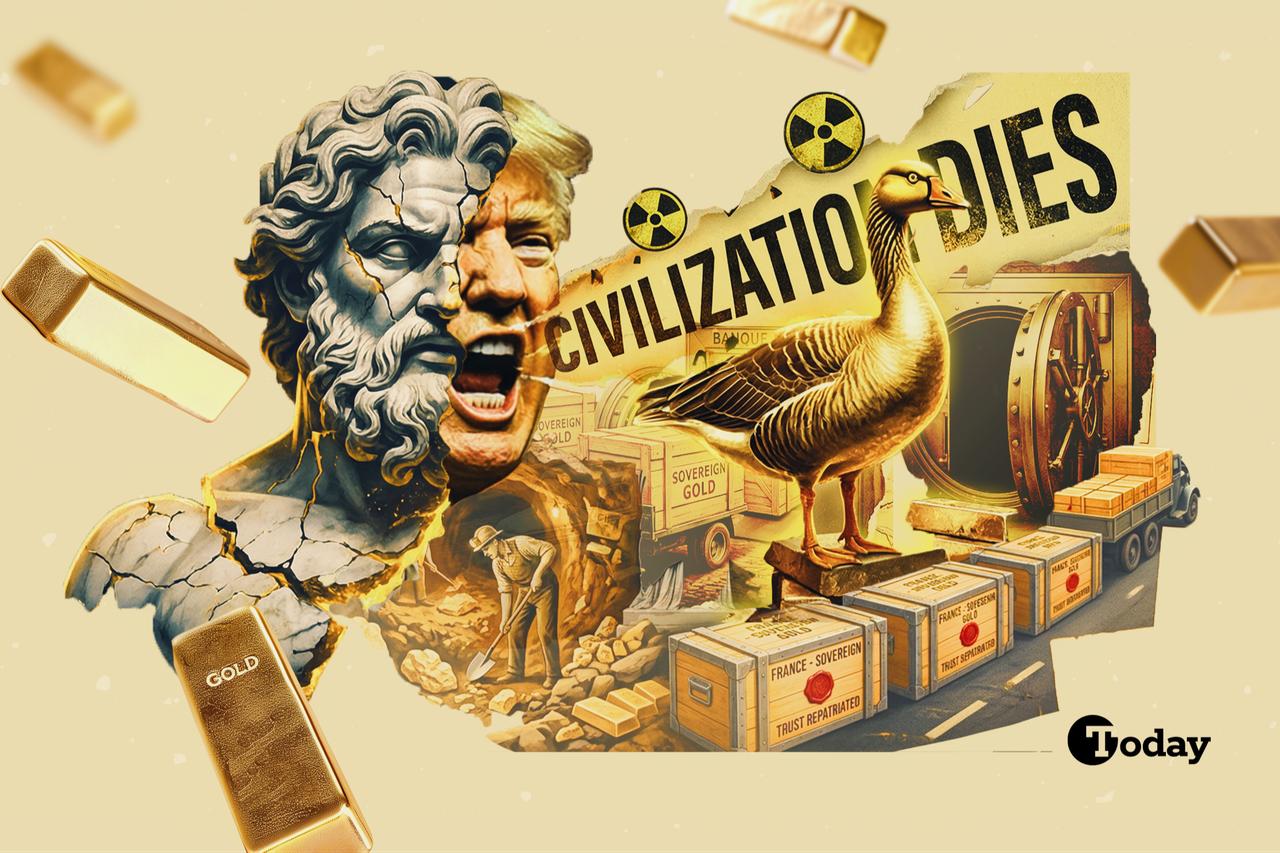


Long ago, in the courtrooms of ancient Athens, hubris was a crime, and judges weren’t shy about convicting. Sometimes the penalty was left in the hands of a higher authority. “After hubris,” the saying went, “comes Nemesis,” the goddess of justice Zeus appointed to visit Earth in the form of a golden goose. Not even King Croesus was able to buy Nemesis off.
It’s a useful myth, not because it comforts, but because it clarifies. The ancients understood something that modern empires, drunk on their own press releases, tend to forget.
Power does not merely corrupt. It distorts reality until the wielder begins to believe that consequences are optional. That history is a rumor. Those threats, even the apocalyptic kind, are just another instrument in the orchestra of dominance.
And then U.S. President Donald Trump says it out loud.
“A whole civilization will die tonight, never to be brought back again.”
It landed with the blunt force of a sledgehammer in a glass cathedral. This is not diplomacy. It is not even a strategy. It’s a chiller theater—unhinged, violent theater—performed for an American audience that has grown disturbingly tolerant of the language of annihilation wrapped in a New Testament Praise-the-Lord-and-Pass-the-Ammunition storyline.
“You see, shot down on a Friday—Good Friday—hidden in a cave—a crevice—all of Saturday and rescued on Sunday,” U.S. Secretary of War and Defense Pete Hegseth enthused over the rescue of an Air Force colonel shot down in Iran on Good Friday and Jesus Christ’s biblically reported death and resurrection.
“Flown out of Iran as the sun was rising on Easter Sunday, a pilot reborn. God is good.”
And then Trump took the pulpit to deliver the Book of the Apocalypse.
“Tuesday will be Power Plant Day and Bridge Day, all wrapped up in one, in Iran," Trump thundered.
“There will be nothing like it!!! Open the Fuckin’Strait, you crazy bastards, or you’ll be living in Hell—JUST WATCH. Praise be to Allah.”
Although Trump now promises to postpone the apocalypse for two weeks, we are well past the threshold of macabre now. The ghouls have gone corporate. They’ve gone sovereign.
They’ve gone nuclear in their rhetoric, if not yet in their actions. And the rest of the world—sober, calculating, terrified—is taking notes.
Indeed, moments before Trump announced the pause in hostilities, a talking head on the CNBC TV show Money Movers asked, “This deadline that President Trump has set, 8 p.m., has threatened to destroy a civilization." Is it a bigger upside risk or downside risk?”
Ahh, yes, Voltaire was dead-on.
“When it’s a question of money, everybody is of the same religion.”
While the headlines scream outrage, something far more consequential is happening in the shadows, in the vaults, in the quiet hum of central bank operations that insist, with bureaucratic innocence, that nothing political is afoot.
France, for example, has been busy.
Between July 2025 and January 2026, 129 tons of gold—sovereign, tangible, heavy in the way only history can be—were moved from the Federal Reserve Bank of New York to Paris. Not in a panic. Not in a spectacle. But methodically, professionally, under the antiseptic label of “operational adjustment.”
Every ounce of French sovereign gold is now stored on French soil, following a fiscal fashion set by the Turkish government in 2018, when Ankara repatriated all the country’s 220 tons of gold sheltered in the crypts beneath lower Manhattan.
The mechanics of the French gambit are almost comically tidy. Non-standard legacy bars held in New York were sold at record prices. Equivalent, compliant bars were purchased in Europe. A capital gain of €12.8 billion was booked. Total reserves of 2,437 tons remained unchanged down to the gram. On paper, it is a masterpiece of financial engineering. Elegant. Efficient. Entirely defensible.
And utterly, unmistakably political.
Let me assure doubters that no nation repatriates 129 tons of gold across an ocean because the storage fees were inconvenient. That is the kind of explanation one gives to children, or to markets that prefer not to look too closely at the machinery behind the curtain.
The real explanation is simpler and far more unsettling: trust has been fractured.
In 2022, the West froze roughly $300 billion in Russian reserves. It was a bold move, hailed in some quarters as moral clarity and condemned in others as financial warfare. But regardless of where one stood, one fact became inescapable: reserves held abroad are not purely financial assets. They are political hostages.
Every central bank on the planet watched.
Germany had already moved in this direction, repatriating its gold from New York between 2013 and 2017. At the time, it was treated as a curiosity, a relic of Cold War paranoia, perhaps. But now France has followed, and the pattern is no longer anecdotal. It is systemic.
Western central banks are bringing their gold home.
Quietly. Without fanfare. With the kind of careful language that suggests both awareness and denial. “Routine.” “Operational.” “Technical.” Words designed to soothe, even as the underlying action signals something closer to alarm.
Because beneath the surface, this is the most coordinated sovereign de-dollarization signal ever recorded, with transfers executed not through dramatic declarations but through the slow, deliberate reconfiguration of where value is stored and who controls it.
Gold is not just a commodity. It is the ultimate form of financial sovereignty. It does not default. It does not require permission. It does not care about sanctions regimes or extraterritorial legal theories. It sits, inert and absolute, a silent guarantor that a nation retains at least one asset beyond the reach of foreign courts.
Unless, of course, it is stored in someone else’s vault.
And that is where the anxiety creeps in.
The math is simple but brutal. The system that made New York the safest vault on earth is the same system that demonstrated, in 2022, its willingness to weaponize access to reserves. Add to that a political environment in which threats of civilizational destruction are tossed around with alarming casualness, and the calculus shifts dramatically.
What was once unthinkable becomes merely improbable. And then, with enough repetition, even the improbable begins to feel like a risk worth hedging against.
Governments are not sentimental. They do not move 129 tons of gold on a whim. They move it because they are modeling scenarios—ugly, low-probability scenarios—in which legal justifications are stretched, precedents are invoked, and assets held under foreign jurisdiction become subject to seizure under the expansive logic of national security or extraterritorial law.
The fear is not abstract. It is procedural.
What happens if a future administration decides that access to foreign-held gold can be restricted for leverage? What happens if legal doctrines evolve to treat sovereign reserves as instruments in a broader geopolitical contest? What happens if the line between ally and adversary becomes… negotiable?
These are not questions that make for good press conferences. But they make for very serious internal memos.
And so the gold moves.
Not in panic, but in preparation. Not with speeches, but with shipping manifests. Not as a rejection of the existing order, but as a hedge against its potential mutation into something less predictable, less constrained, more… personal.
 1 min read
Which brings us back to hubris.
The threat of annihilating an entire civilization is not just morally grotesque. It’s strategically corrosive. It signals to allies and adversaries alike that the boundaries of acceptable discourse are dissolving. That restraint is optional. That escalation is a tool to be brandished, not a last resort to be feared.
In such an environment, trust does not collapse overnight. It erodes. Methodically. Measured in tons of gold rather than headlines.
And Nemesis, if the old stories hold any truth, does not arrive with fanfare either. She comes in forms that seem almost absurd—a goose, perhaps, or a routine financial transaction. Something easy to dismiss until the pattern becomes undeniable.
After hubris comes Nemesis.
The ancients knew it. The markets are beginning to price it. And somewhere, in the dimly lit vaults beneath Paris, 129 tons of gold sit in silent testimony that even among allies, faith is no longer being taken on deposit.


 Set as preferred source
 Set as preferred source



 1 min read


