Newsletters


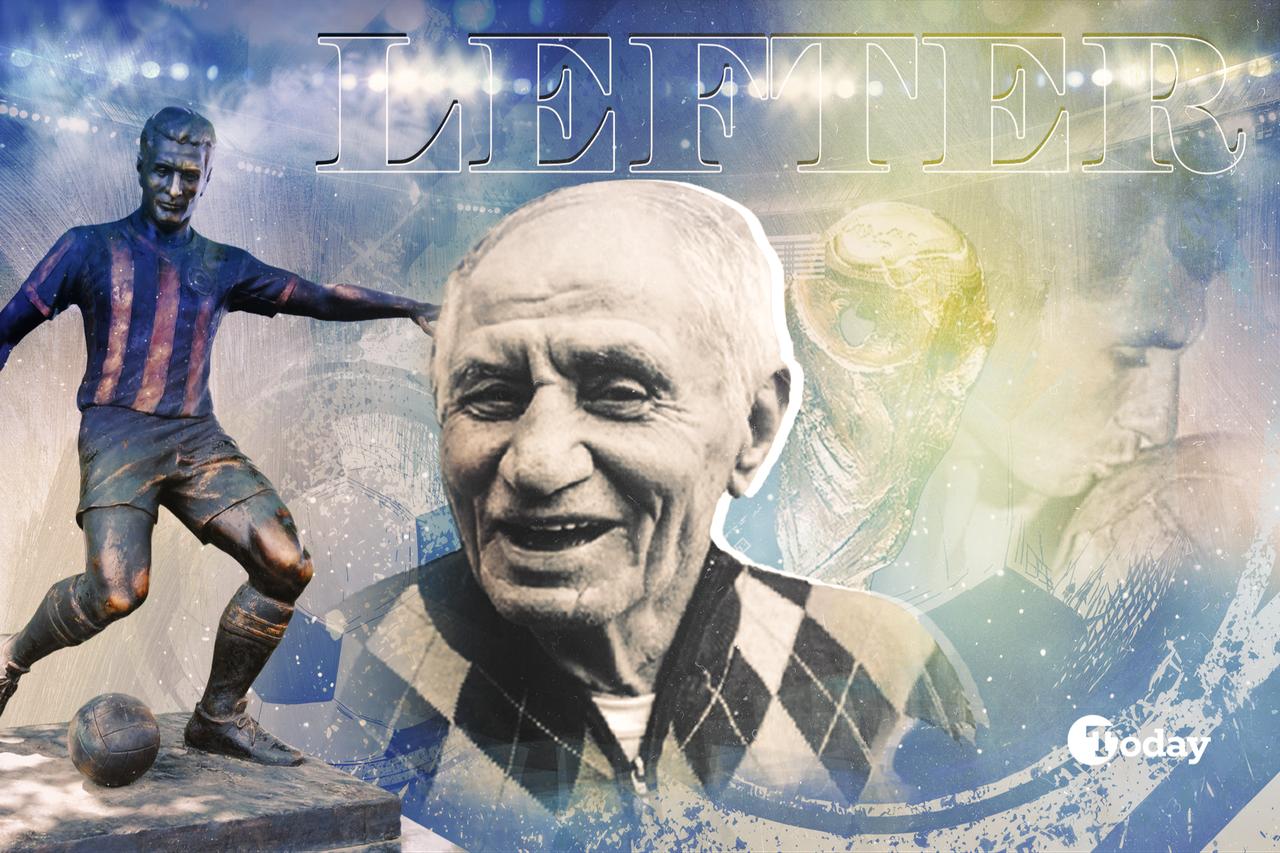


His name was too long to splash across the back of a modern football shirt. So they reduced it. As for the legend, they could not.
Turkish fans could pardon Lefteris Antoniadis for being too short. They could absolve him for arriving in Istanbul without boots, without money, without a pedigree.
But that name?
That sprawling, jumbling-syllabled name. That had to be recast, decades before football’s marketing men and image consultants found profit in monetizing monikers and copyrighting after-goal celebrations.
And so, in 1947, Turkish journalists pulled a Franz Kafka.
They metamorphosed Lefteris Antoniadis, son of a poor Greek fisherman from Buyukada Island off the Istanbul coast, into Lefter Kucukandonyadis.
They added “Kucuk” or “little” in Turkish to his surname.
A diminutive for a diminutive. A concession to national rhythm. Confusing for foreigners. Perfect for Fenerbahce fans, an anthem to how a name can carry the affection of a nation.
Tom Williams understands the linguistic power of "Kucuk" better than most. He’s the author of “Do You Speak Football?” and one of the beautiful game’s sharpest pundits.
“Lefter was the trailblazer,” Williams says, saying all that needs to be said.
Kucuk was 1.68 meters of velocity and guile, an unplayable bundle of improvisation and nerve. In 1954, when Türkiye first stepped onto the grand stage of the World Cup finals, Lefter was their standard-bearer.
He scored with the imagination of a poet and the opportunism of a street urchin. Officially, he struck 423 times for Fenerbahce, and unofficially, in hearts, in arguments, in memory, many more.
But the numbers alone do not explain why the world called him Ordinarius.
That title came from the stands. After one particularly intelligent goal for Fenerbahce, a strike of angles and anticipation, a printer named Manol Taylan leapt to his feet and shouted, “Ordinarius.”
The Professor.
In a land rebuilding itself from imperial collapse into republican resolve, the nickname stuck. It conferred both mastery and affection. It elevated the small man into the realm of the scholarly sublime.
And ultimately into Fenerbahce’s official club anthem, as a ‘‘precious, loved one.’’
So the Professor became not merely a scorer of goals but an educator in joy.
Lefter, the pupil, started out with a ball of old rags. Proper boots came only after he signed for Fenerbahce in 1947. Yet he moved with aristocratic balance, handsome and charismatic, a forward whose game blended Balkan instinct with Anatolian resilience.
In 1956, when Türkiye humbled the mighty Hungary 3–1, Lefter struck twice. On that afternoon, the world’s most celebrated player, Ferenc Puskas, was reduced to a supporting cast.
The small striker from Buyukada had stolen the spotlight from the Galloping Major himself. The young Turkish Republic, guided by the memory of Ataturk, was still discovering its modern voice. Factories rose. Institutions formed. And football, that simple game of grass and leather, became a vessel of aspiration.
Football became a symbol that Türkiye was on the right path.
Yet Istanbul was no easy choir to harmonize.
There were three great houses of passion: Galatasaray, with its high-society airs; Besiktas, rooted in working-class grit.
And then there was Fenerbahce on the multi-ethnic Asian shore. They shared a skyline with the west side and nothing else. Their skirmishes crackled across the Bosphorus and into the European game like a bolt of summer lightning.
Agence France-Presse football editor Andy Scott reckons the Istanbul rivalry is one of the most passionate in world football. “I’ve never sensed anything that could unite these fan bases,” Scott adds. “Except Lefter.”
The Professor transcended tribal arithmetic. Goals have a way of silencing prejudice, and grace has a way of disarming suspicion.
This ethnic Greek, raised speaking a language not native to the Republic, became Türkiye’s most cherished sporting son. When he died in 2012, even political figures and officials from rival clubs stood in solemn tribute. His statue outside Fenerbahce’s Sukru Saracoglu Stadium is not defaced by the jealous. It is respected.
Yet unity carried a private cost.
In the 2025 biopic “Lefter: The Story of Ordinarius,” one scene revisits his international debut for Türkiye against Greece in Athens. Rotten vegetables arc through the air. “Traitor!” the crowd roared.
The Greeks saw betrayal; some Turks saw otherness. “The Turks call me Greek scum; the Greeks call me Turkish scum,” the cinematic Lefter laments. “But I chose my nation over my heritage.”
Reality was less theatrical but no less poignant. Lefter saluted the state founder's bust in his home.
He pledged himself to the crescent and star. He bore the contradictions of identity with quiet dignity. In a century that too often demanded division, he offered allegiance without rancor.
Istanbul, of course, has never been tame. When Manchester United visited Galatasaray in 1993, the infamous banner unfurled: “Welcome to Hell.”
One British writer quipped that the city possessed a welcome Cerberus, the mythical multi-headed hound from hell, that would admire. The ferocity spills from stands to streets, from boardrooms to locker rooms.
Yet there are moments when Turkish football rediscovers cohesion. In 2002, under the steady hand of Senol Gunes, a side unburdened by club politics surged to the World Cup semi-finals, halted only 1–0 by a Ronaldo-inspired Brazil.
It was the nation’s zenith. Many whispered that such unity had not been seen since Lefter last wore the national shirt in 1963.
Now Türkiye stands again at a threshold, preparing for a decisive World Cup playoff in Istanbul. The coach, Vincenzo Montella, is himself an outsider, an Italian once nicknamed Aeroplanino, the little airplane, for his modest 1.71-meter frame and skyward celebrations.
He knows something about defying stature.
Among his charges are two prodigies born in 2005: Kenan Yildiz of Juventus and Arda Guler of Real Madrid. Their boots are lighter, their stage more global, their jerseys mercifully elastic enough to bear any name.
They carry a nation’s expectations as Lefter once did—not merely to score, but to bind.
Turkish football’s recurring dilemma has never been talent. It has been synthesized. How to channel the furnace heat of rivalry into the steady flame of collective ambition. How to make three grand houses sing one anthem.
Lefter did not solve politics. He did something rarer. He gave disparate crowds a common exclamation.
He made Galatasaray men nod in reluctant admiration, Besiktas loyalists applaud despite themselves, and Fenerbahce faithful believe they had seen something eternal.
They once thought his name too long. In truth, it proved large enough to cover a nation. And in the ledger of sport, where inches are debated and trophies tarnish, Lefter’s legacy might well be the fuel that powers Türkiye to the 2026 World Cup finals.


 Set as preferred source
 Set as preferred source


 2 min read