Newsletters


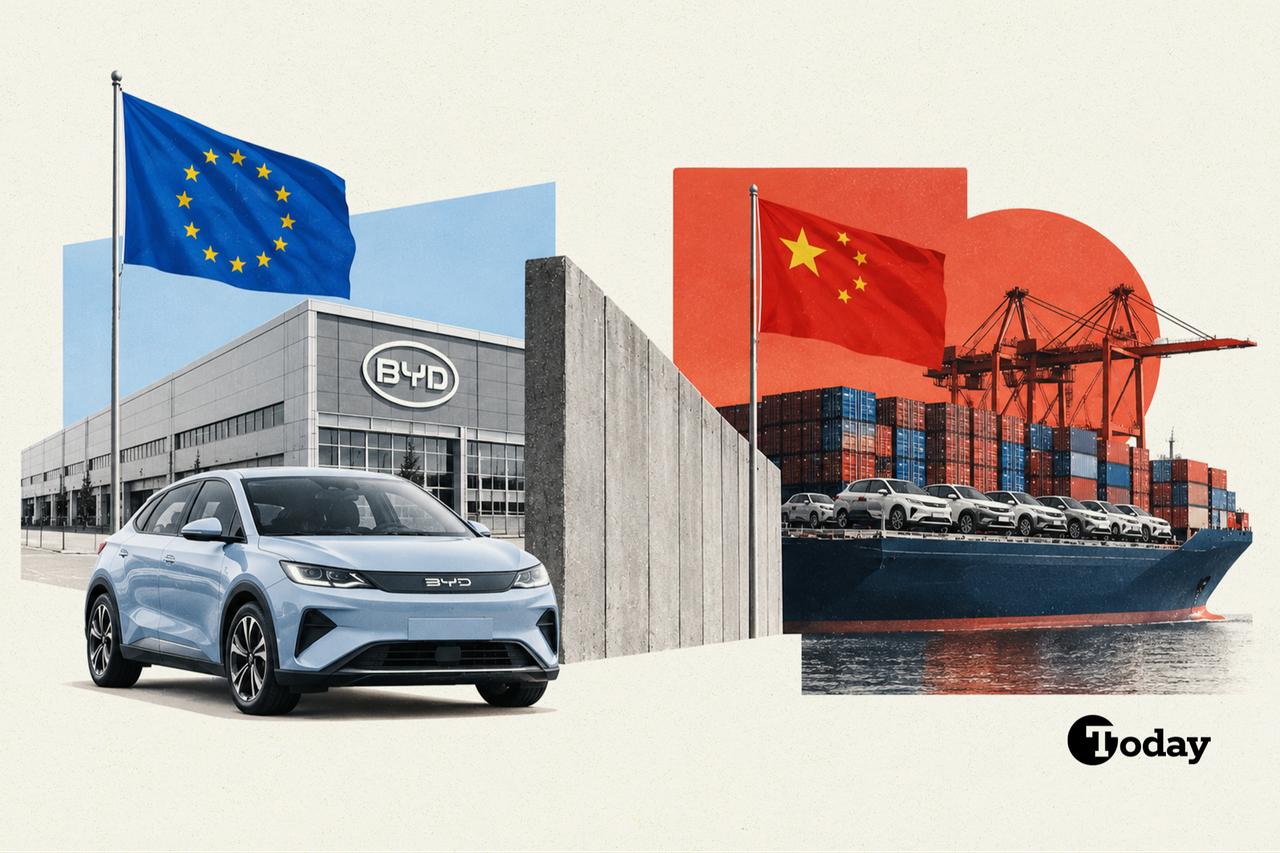


In Szeged, in southern Hungary, BYD's first European car plant is running trial production. Series output is due to start in November or December, and the first car off the line will be the Dolphin Surf, a small electric hatchback sold in China as the Seagull.
Built in China, a BYD electric vehicle (EV) pays a 10% base duty on entering the European Union, plus a 17% anti-subsidy tariff. Built in Hungary, it pays nothing. BYD can hand Brussels 27% of the value of every car or move enough of the factory to change its passport.
When Washington settled the question in 2024 by slamming its door shut with a 100% tariff, Brussels left it ajar: build here, and the duty goes.
The pressure forcing Chinese players through doors lies at home. Chinese vehicle sales fell 5.1% year on year in August while exports rose 65.3%, topping a million units for the third month running. Domestic sales have fallen by more than 20% year on year for five straight months.
By the end of August, China had shipped 7.2 million vehicles abroad, more than in the whole of 2025. In other words, foreign buyers are absorbing an adjustment that Chinese factories would otherwise have to make.
The wall also has a side gate. The anti-subsidy duties cover pure EVs only, so plug-in hybrids pay the base 10%. Chinese brands restocked their European showrooms accordingly and in August took a record 11.7% of the European market, according to Dataforce. BYD's best-seller there is the Seal U, a plug-in hybrid.
On Sept. 17, Brussels asked Beijing to hold Chinese hybrids to about 15% of the market, against more than a third today.
"If they will not limit their exports to our market, then we will," an EU official said. Beijing refused the next day. Trade Commissioner Maros Sefcovic is due in Beijing on Oct. 8.
The car's price is set long before it reaches a European port. China "isn't planning to drop its capital controls," Brad Setser of the Council on Foreign Relations told Türkiye Today, and Europe has no reason to insist that it should.
The trade surplus is "generating flows that would push the renminbi up absent state bank purchases." The controls leave Beijing holding the dial. "China can fix the yuan stronger or weaker," Setser said, which makes the level of the fix a fair quarrel for its trading partners.
Beijing has begun to turn the dial, slowly. The renminbi is at about 6.7 to the dollar, its strongest since early 2023, and Andrew Tilton and Hui Shan of Goldman Sachs expect it to gain 3% to 5% a year from here. At that pace, Chinese exporters lose almost no competitiveness. The purpose is to make renminbi assets attractive to foreign investors. China's central bank governor says the country has "never deliberately pursued a trade surplus." It will run one of more than $1.2 trillion this year, the largest in history.
Alicia Garcia-Herrero of Natixis thinks a stronger yuan helps, but warns that "if unaccompanied by robust demand-side measures," it "could intensify deflationary pressures inside China." The cure is Chinese households spending more and Chinese markets "genuinely opening" to foreign competition, and neither can be imposed at a European port.
"Europe is still too focused on border measures because they are quicker to deploy," she said. Tariffs buy "short-term protection" and "negotiating leverage." They do not reach the cause.
Türkiye was meant to show how market access compels investment. In 2024, BYD promised a $1 billion plant in Manisa, with capacity for 150,000 vehicles and 5,000 jobs, in return for land and relief from duties on the cars it imported.
More than two years on, construction has not begun.
Ankara suspended the incentives at the start of this year, and BYD's Turkish sales fell from 3,866 in January to 152 in May. In July, the industry minister told Parliament that if BYD formally abandoned the project, Türkiye would recover the waived duties with interest and reclaim the land.
In June, BYD's executive vice president Stella Li called Hungary "the number one priority." The company now prefers to buy under-used factories inside the EU, partly because a new plant would not be ready before the bloc's proposed local-content rules take effect. It expects to choose a second site, probably in Spain or France, by the end of the year.
Geely did not wait. In July, it paid €221 million ($249.77 million) for 34% of a new venture at Ford's plant in Valencia, which built fewer than 100,000 vehicles in 2025, a fifth of its capacity and its lowest output on record.
From 2028, it will make three Fords and two Geely electric SUVs. Ford sold Volvo to Geely in 2010 because it could no longer justify owning it. Sixteen years later, Geely is helping to justify a Ford factory.
This is localization of the most ambiguous kind. Spaniards will build the cars, while control of platforms and future investment will be shared with Geely. Brussels has noticed. Its proposed Industrial Accelerator Act would require subsidized electric cars to source 70% of their components inside the EU, an attempt to make origin mean more than the final bolt.
Valencia's alternative was probably closure, and Europe's exposure is partly its own work. Its capital has long preferred property, financial assets and dividends to grids, batteries and factories, and its governments discovered strategic dependence only after the commercial case for repairing it had soured. If Chinese industrial policy can be wasteful and coercive, Europe's answer has too often been elegant underproduction.
Beijing has begun, ever-so-cautiously, to cut. In September it fast-tracked the merger of the Toyota ventures run by the state-owned FAW and GAC, and the industry ministry's new five-year plan calls for "cross-regional" consolidation.
Bank of America puts China's carmaking capacity at 40 million vehicles a year, against domestic demand below 20 million and exports of around 10 million.
Much of the surplus sits in state-owned petrol-car plants that Chinese buyers are deserting. The EV makers selling into Europe are more likely to be the buyers in this shake-out, and could emerge from it stronger.
The wall works on a narrower problem than its rhetoric suggests. It can penalize an imported EV, though not yet the hybrid beside it, and it can keep an endangered factory busy. It cannot, however, decide who commands the technology, nor force Chinese households to spend.
When the first Dolphin Surf rolls off the line in Szeged, the customs account will record a European car, assembled by Hungarians and owing nothing at the border. And, sure, the factory will have moved, but the imbalance may still be coming through the gate.


 Set as preferred source
 Set as preferred source



 1 min read