Newsletters


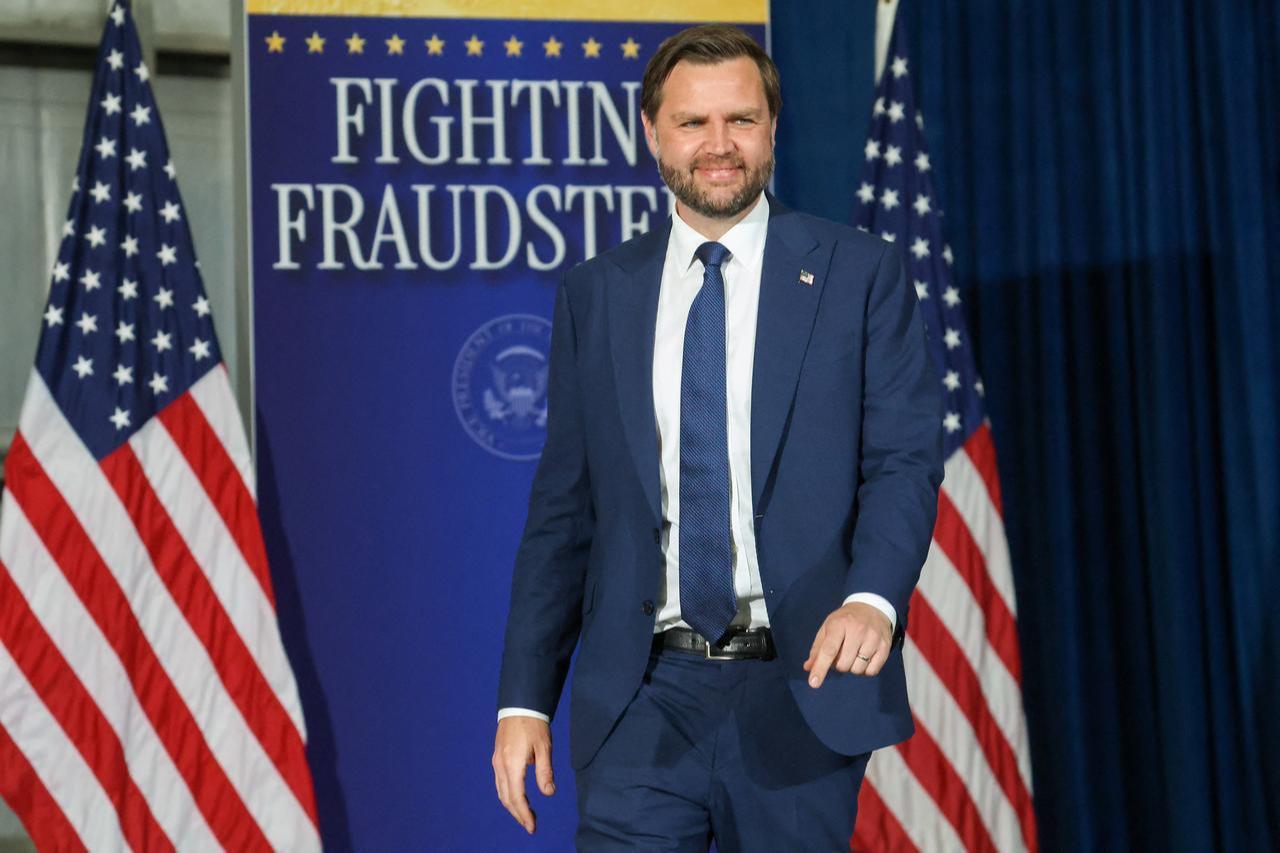
U.S. Vice President JD Vance said Wednesday that a foreign influence campaign had been funded to derail his negotiations with Iran, as a separate House vote the same day saw nearly half of Democrats support cutting U.S. aid to Israel in what analysts described as a stark shift within the party.
Speaking on "The Joe Rogan Experience," Vance said a foreign influence campaign had been funded to undermine the negotiations he was pursuing with Iran, citing a Time magazine investigation published that week.
"There's a literal foreign influence campaign being funded to tank the very deal that I was pursuing," Vance said.
"Many of the people who were receiving that money were actually attacking me in completely dishonest ways. You know, my response to that is, 'Well, go to hell.' I'm going to do what I have to do for the American people. I represent Americans first, and that's the way that I've tried to do this job," he added.
Vance said the objectives he was pursuing on behalf of President Trump were that "Iran doesn't have a nuclear weapon" and securing "the free flow of oil and gas."
He said he did not object to foreign governments, including Israel, attempting to influence U.S. policy in general, saying, "I don't even mind an effort to try to influence foreign governments to try to influence the United States all the time. You know, Israel does it; other countries do it. It's just sort of the nature of the beast."
"What bothers me is actually when American leadership allows that influence to affect their judgment and to affect what they are advocating for," Vance added.

According to the Time investigation, cited by Vance, Trump's 2020 campaign manager Brad Parscale was hired last September by global ad agency Havas on behalf of Israel to run a digital influence campaign worth $1.5 million a month.
The magazine reported the operation, run through Parscale's firm Clock Tower X and affiliated companies, aimed to generate at least 50 million digital impressions per month and shape how Israel and the Iran war were portrayed, including in outputs from AI systems such as ChatGPT, Claude and Gemini.
A senior U.S. official cited in the report traced a wave of MAGA-aligned social media posts criticizing the June 17 U.S.-Iran ceasefire back to the Parscale-linked network, based on similarities in language and timing across accounts. Parscale denied any role in undermining Trump's diplomacy, according to the report.
Vance also addressed allegations that he holds antisemitic or anti-Zionist views, calling them unfounded.
"I have a ton of respect for the Jewish religion... I've never heard a good compelling argument for why I'm an antisemite even though I've been accused of being antisemitic by many people," he said.
He described his position on Israel as centrist within what he called the "massive pro-Israel, anti-Israel debate in the U.S.," saying, "My attitude towards this is Israel is an ally like France or the U.K. We are going to have disagreements with them; we are going to have agreements with them."
Asked by Rogan about concerns that Israel spies on American politicians and funds efforts to influence them, Vance said, "I think some are better at it than others. I think Israel is definitely more effective at it than most. But I wouldn't say they're the only effective country trying to influence American politics."
He said he believed some people within the Israeli government were "manipulating and trying to change American public opinion to keep the war going on indefinitely," while adding he had good relationships with other Israeli officials, including the country's ambassador to Washington, whom he called "a really good guy."
Vance separately downplayed claims that Israel or any other country had influenced or "blackmailed" Trump into striking Iran, saying he was present for those decisions and that Trump made the call to strike independently.
He also downplayed reports that the U.S. was providing $300 billion to Iran, saying such reports referred only to the lifting of sanctions that would allow Gulf states like Saudi Arabia and the UAE to resume trade and investment with Iran.

Separately, the House of Representatives on Wednesday rejected an amendment introduced by Rep. Thomas Massie, R-Ky., that would have eliminated the full $3.3 billion in U.S. military and humanitarian aid to Israel from a foreign affairs spending bill.
The measure failed 104-314, with 10 lawmakers voting "present." Of the 104 votes in favor, 103 came from Democrats, while 98 Democrats voted against the measure alongside nearly all Republicans; only Massie voted for it among Republicans.
The vote split the Democratic leadership.
Minority Leader Hakeem Jeffries, D-N.Y., voted against the amendment, calling it "overly broad" and writing in a letter to colleagues that it "would restrict our country's ability to confront Hamas, Hezbollah and other terrorist organizations in the region."
Minority Whip Katherine Clark, D-Mass., broke with Jeffries and voted in favor, saying in a statement: "The Netanyahu government has failed to meet that standard. I will be voting yes, not because I agree with the entirety of the amendment or the GOP's cynical motivations for its consideration, but because I believe we must change course."
Former Speaker Nancy Pelosi, D-Calif., also voted for the measure, calling it an "unfortunate choice" she would support "for the message that it sends."

Rep. Greg Casar, D-Texas, chairperson of the Congressional Progressive Caucus, had urged members to support the measure in a letter beforehand, writing: "The American people are crying out for an end to U.S. tax dollars subsidizing Israel's military."
Casar has separately accused Israel of committing "war crimes" in Gaza. Rep. Joaquin Castro, D-Texas, said on the House floor that "self-defense does not include indiscriminately bombing homes," criticizing the Israeli government's response to the Oct. 7, 2023, attacks.
Rep. Seth Moulton, D-Mass., a onetime strong Israel supporter now running for Senate, said he backed cutting all aid, saying "we simply cannot continue to condone Netanyahu's actions" and that he would no longer accept donations from AIPAC.
Opponents of the measure included Rep. Brad Sherman, D-Calif., who said its purpose was "driving a wedge in the middle of the Democratic Party," and Rep. Steny Hoyer, D-Md., who called a vote for the amendment "a vote against American security and against American safety."
Rep. Josh Gottheimer, D-N.J., said in an interview that "supporting the U.S.-Israel relationship is quickly becoming a minority view among congressional Democrats, a shockingly seismic shift in a brief period of time."
Rep. Ami Bera, D-Calif., said he voted "present" because he supports the U.S.-Israel relationship but does not "condone the Netanyahu government's conduct of the war in Gaza and the resulting humanitarian crisis."
The vote came as U.S. public opinion on the Israeli-Palestinian conflict has shifted.
A Gallup tracking poll found that in February, Americans said for the first time they were more sympathetic to Palestinians (41%) than Israelis (36%), with the gap far wider among Democrats, 65% of whom said they sympathized more with Palestinians compared with 17% who favored Israelis.
Jeremy Ben-Ami, president of the center-left lobbying group J Street, called the shift possibly "the quickest 180-degree shift in public opinion on a policy issue since the legalization of same-sex marriage," saying, "The days of 'Israel, right or wrong' being the mainstream of American politics are over."


 Set as preferred source
 Set as preferred source



 3 min read