Newsletters


Ukrainian President Volodymyr Zelenskyy confirmed Tuesday that Ukrainian forces struck a Russian oil refinery in Syzran, along with a drone production facility in Taganrog and a drone launch site in Russia's Oryol region, hours after U.S. President Donald Trump claimed Russia and Ukraine had agreed to a mutual halt on energy-target strikes, a claim Zelenskyy has treated with skepticism.
"Russia continues its attacks on our energy infrastructure, regular logistics, and critical infrastructure. And our response to these attacks is significant," Zelenskyy said in a statement on X.
"There are new results from the Defense Forces of Ukraine regarding the refinery in Syzran. There was also a strike in Taganrog on a drone production facility, as well as on a drone preparation and launch site in the Oryol region. Targets were hit in the Black Sea as well," he added.
Rostov Governor Yury Slyusar wrote on Telegram that the region faced a "massive missile attack," with damage in Taganrog to an educational institution, a commercial building, a gas pipeline, agricultural warehouses, a grocery store and an Ozon e-commerce warehouse.
Taganrog Mayor Svetlana Kambaeva said five apartment buildings were also damaged, with no casualties reported.
Reports also indicated unconfirmed damage near the Taganrog Aviation Scientific and Technical Complex.
Ukraine's General Staff wrote on Telegram that it struck the Atlant Aero plant in Taganrog, which it said manufactures drones.
In Samara region, more than 40 drones were shot down overnight, according to Governor Vyacheslav Fedorishchev, who said an industrial facility and several residential buildings were damaged, with no deaths reported. Ukraine's General Staff said its forces struck the Syzran oil refinery, causing a fire and damage to a crude distillation unit and storage tanks.
In Voronezh region, Governor Alexander Gusev said the attack damaged windows at a municipal building and the roofs and facades of four private homes, with no casualties.
Ukraine's air force announced on Telegram that Russia launched 200 attack drones overnight, of which 187 were destroyed or suppressed, with confirmed strikes recorded at seven locations.
Russia's Defense Ministry said its own forces struck logistics centers and ports in Ukraine, including a facility storing military cargo in Odesa's Velyka Balka settlement and a dry cargo vessel and ferry at the port of Chornomorsk, as well as railway infrastructure in western Ukraine used to transport military cargo from Europe.
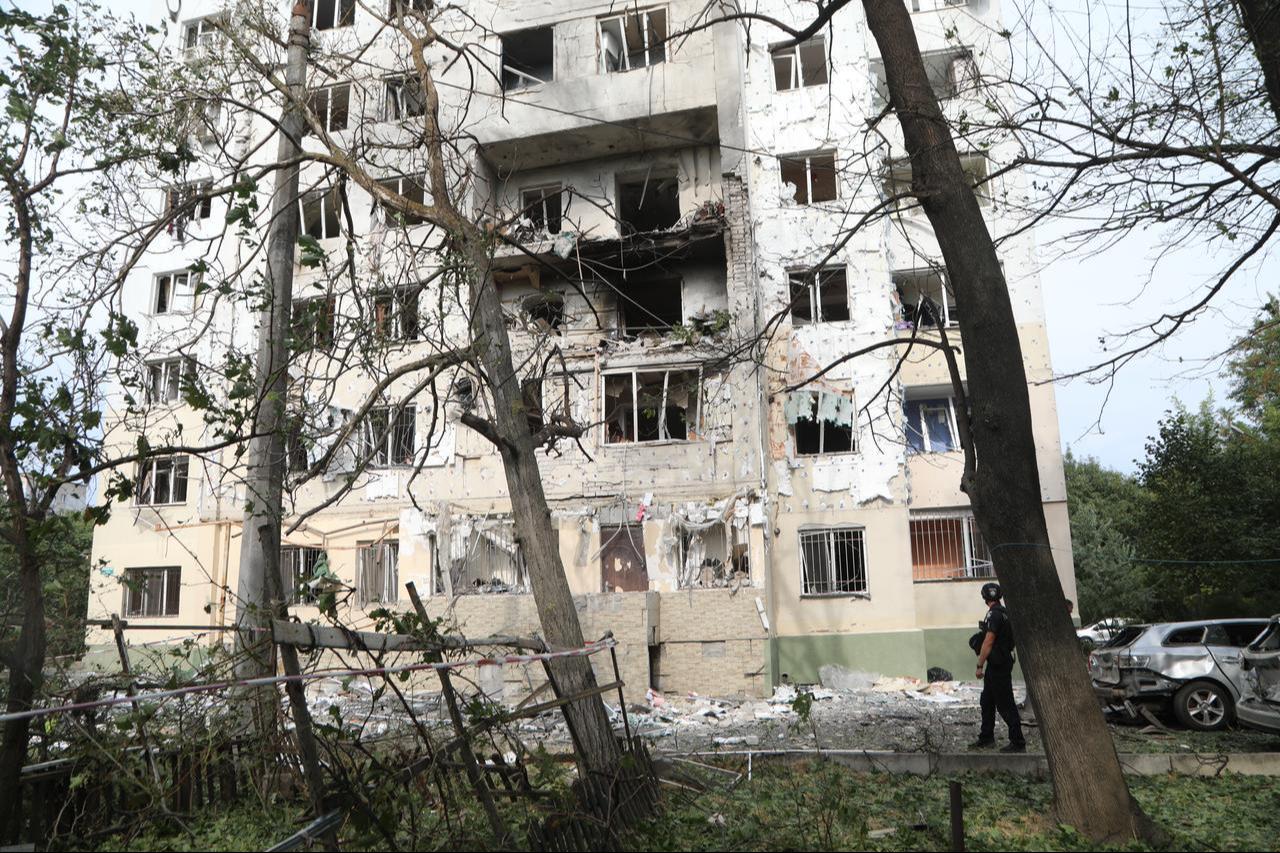
Separately in Ukraine, Kyiv Mayor Vitali Klitschko said a man died in hospital after a Russian strike on a petrol station in the Darnytskyi district, with a second strike hitting a garage in the Holosiivskyi district and warehouses in the Obolonskyi district.
In Zaporizhzhia, acting Governor Mykhailo Semikin said one person was killed and another injured in a drone attack that also knocked out power to part of the city.

Zelenskyy also thanked Washington for a separate decision targeting Russia's VTB Bank.
"I thank every one of our warriors for the effectiveness of our long-range sanctions! The day before, the United States also announced a significant decision regarding Russia's VTB Bank, one of Russia's systemic banks, which is heavily involved in schemes supporting Russia's war and, in particular, its relations with the Iranian regime," he said.
"All such schemes that work against peace truly need to be dismantled," the Ukrainian president added.
The strikes came a day after Trump wrote on Truth Social: "Ukraine has agreed not to hit Russian Energy targets. Russia has agreed to do, likewise!"
Trump also said global diesel price increases were "mostly caused by the Russia/Ukraine War, not Iran."
The claim followed Trump's weekend criticism of Ukraine's refinery strikes during his visit to Ireland, where he told Zelenskyy to "stop knocking out diesel fuel in Russia," calling the attacks "hurting the world."
Zelenskyy did not confirm Ukraine's participation in any formal truce, instead describing Washington's proposal as conditional.
"If this can become the first de-escalatory step, stopping Russian strikes on our critical infrastructure, and ours in response, then Ukraine is ready to support de-escalation," he said in his Monday address, adding that Ukraine had proposed its partners secure a genuine Russian commitment to halt attacks on critical infrastructure, food supply routes and the electricity system.
"So that it is reliable, long-term, has a real impact on people's lives, and does not fall apart after the Russians hold their 'elections' and get an easing of pressure on gasoline and diesel precisely for that period," Zelenskyy said.
"Every day, Ukrainian energy facilities, port infrastructure, logistics, and even warehouses storing food and pharmaceuticals are targeted. Ukraine is not convinced that Russia is willing to abide by any agreement," the Ukrainian president noted.
He added: "So far no one has seen any genuine desire from Russia to move toward ending the war," but said Ukraine would take its own de-escalatory steps if the US secures sincere, long-term Russian commitments.
The Kremlin, for its part, said it welcomed Trump's proposal.
"Any call on the Kyiv regime to stop attacks on civilian economic infrastructure can only be welcomed," Kremlin spokesman Dmitry Peskov told reporters, while attributing global energy market turmoil mainly to "instability and new rounds of escalation in the Persian Gulf region" rather than the war in Ukraine. Peskov separately confirmed that Ukraine "attempted to strike at one of the energy facilities on the territory of Russia" overnight.
Moscow has also called for sanctions on Russian energy exports to be lifted as part of any wider arrangement.

Separately, Ukrainian forces launched an offensive operation, code-named "Vivaldi," in the north of the Donetsk region, according to Brig. Gen. Andrii Biletskyi, who commands Ukraine's defense in the area.
Biletskyi said the Third Army Corps had cleared 75 square kilometers of Russian infiltration groups and recaptured a further 10 square kilometers, disrupting Russian military logistics and fully retaking the village of Serednie.
He said the offensive struck at the combat readiness of Russia's 20th and 25th armies, claiming Russian losses of roughly 1,500 soldiers, more than 12,000 drones and hundreds of armored vehicles, artillery systems and other equipment during this phase; figures cannot be independently verified.
Biletskyi said Russian forces had been forced to relocate fuel supply lines outside Ukraine into Russia's Voronezh region as a result of the operation.
He described the push as the first of four planned phases, saying: "Drones, robots and motivated infantry, that's what the first season of 'Vivaldi' sounds like."
The Donetsk region has seen some of the war's fiercest fighting, with Russia's capture of the entire region remaining Moscow's central territorial demand in stalled negotiations that the U.S. has sought to restart through envoys Jared Kushner and Steve Witkoff, who visited Moscow and Kyiv earlier this month.


 Set as preferred source
 Set as preferred source


 1 min read

 1 min read