Newsletters




Asian stock markets fell sharply on Tuesday as a broad sell-off in semiconductor shares gathered pace after reports that a Chinese state-backed company was developing immersion deep ultraviolet (DUV) lithography machines.
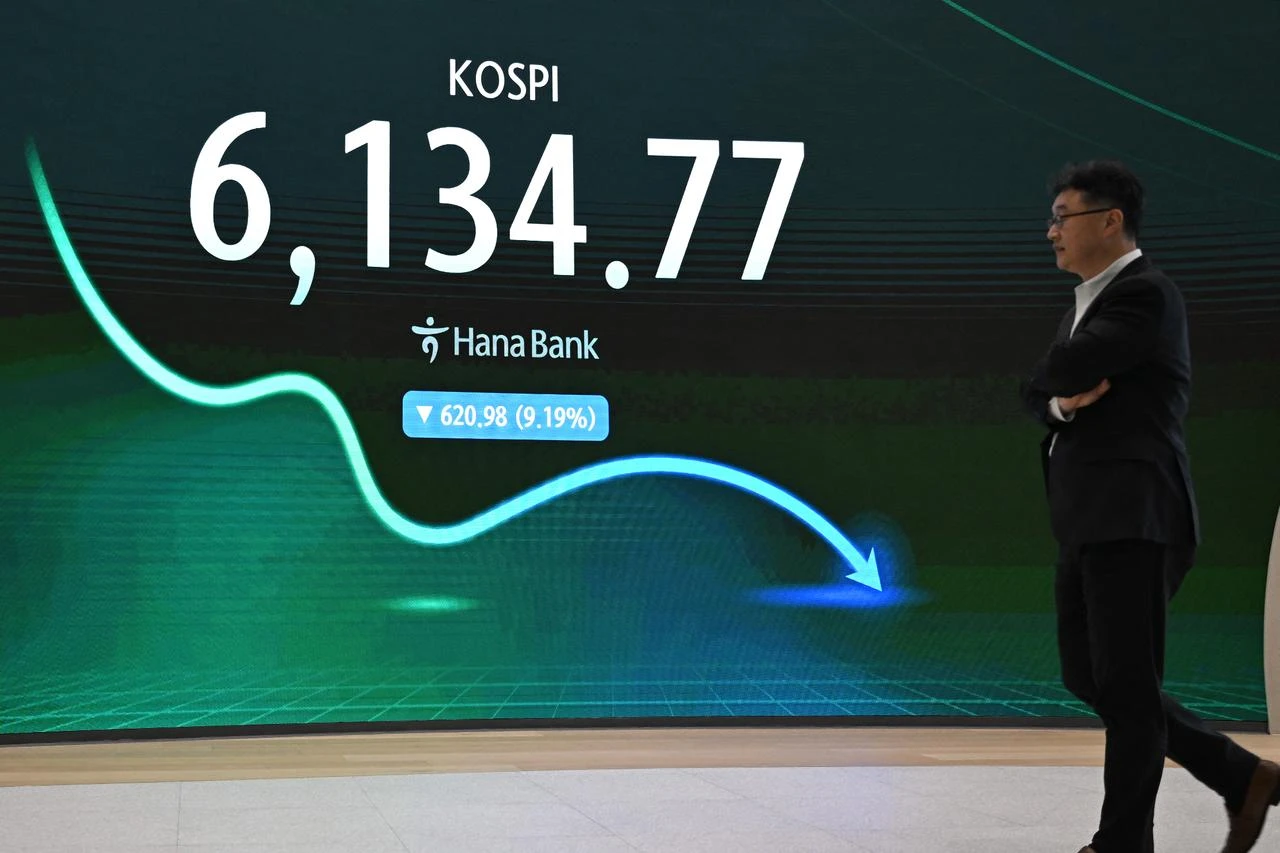
Both tech-heavy stock indices, Japan's Nikkei 225 and South Korea's Kospi, posted steep losses of 4% and 10.8%, respectively.
The decline marked the Kospi's worst day since early March, when surging oil prices fueled inflation fears across global markets, after the index had repeatedly hit record highs over the past year.
The market slide deepened after The Information reported that the Chinese firm was building immersion DUV lithography systems capable of etching microscopic circuits onto silicon wafers used to produce AI chips and a wide range of consumer electronics.
DUV technology is less advanced than extreme ultraviolet (EUV) lithography, which is currently mastered only by Dutch company ASML. Sales of ASML's EUV machines to China remain restricted under U.S. export controls, although China is reportedly in the early stages of developing its own EUV technology.
Investors also weighed reports that NVIDIA's AI-related funding commitments had exceeded $750 billion, adding to concerns that investment in AI infrastructure may be running ahead of future demand.
Technology shares bore the brunt of the sell-off across the region. In Japan, SoftBank lost 4.5%, while memory chip producer Kioxia slumped more than 18.3%.
South Korea's Samsung shed 13.4%, while chipmaker SK Hynix fell 7.5% after recently making its Nasdaq debut in the second-largest initial public offering of all time.
Chinese and Hong Kong tech stocks proved more resilient, with Hong Kong's Hang Seng flat and the Shanghai Composite down 1.2%.

U.S. stock futures also weakened, with Nasdaq futures down more than 1%, while major European markets opened slightly higher.
The Stoxx Europe 600 rose 0.1%, Germany's DAX gained 0.5%, France's CAC 40 climbed 0.5%, the U.K.'s FTSE 100 added 0.2%, and Spain's IBEX 35 advanced 0.7%. Türkiye's BIST 100 edged up 0.1% to 13,786.47 points.
International benchmark Brent crude and U.S. benchmark WTI extended losses, falling more than 2% to $86.4 and $81 per barrel, respectively, as of 6:50 a.m. GMT. The decline left oil prices down roughly 10% over two sessions after signs of easing U.S.-Iran tensions emerged, with neither side carrying out further strikes.
Gold slipped 0.7% to $4,050 an ounce, while silver fell 1.6% to $57.5. Palladium and platinum each lost 1%, trading at $1,600 and $1,260 per ounce, respectively.
Cryptocurrencies also came under pressure, with bitcoin dropping more than 2.8% to $63,540, ethereum falling 4.1% to $1,890, and the total cryptocurrency market capitalization declining 2.7% to $2.2 trillion.


 Set as preferred source
 Set as preferred source


 1 min read

 1 min read