Newsletters




Intel is facing a shareholder lawsuit accusing the U.S. chipmaker of misleading investors about weakening personal computer demand and excess inventory before its stock suffered a historic one-day decline.
The proposed class-action lawsuit, filed Friday in federal court in San Jose, California, claims Intel failed to disclose on time how the prolonged slowdown in PC sales and mounting inventory would hit its revenue.
Led by the City of Southfield Fire and Police Retirement System, the proposed class action argues that Intel's struggles in the PC market and excess inventory more than offset the benefits of expanding data center operations and other opportunities arising from the AI boom.
The plaintiffs also accuse Intel of having the motive and opportunity to defraud investors when it raised $23 billion through a share sale at $95 apiece in mid-August, halfway through what they described as a "disastrous" third quarter.
The fundraising came as the company was stepping up efforts to expand its contract chip manufacturing business, a key pillar of CEO Lip-Bu Tan's strategy.
The case seeks unspecified damages on behalf of investors who purchased Intel shares between July 23, 2026, and Oct. 29, 2026. Tan and Chief Financial Officer David Zinsner are also named as defendants.
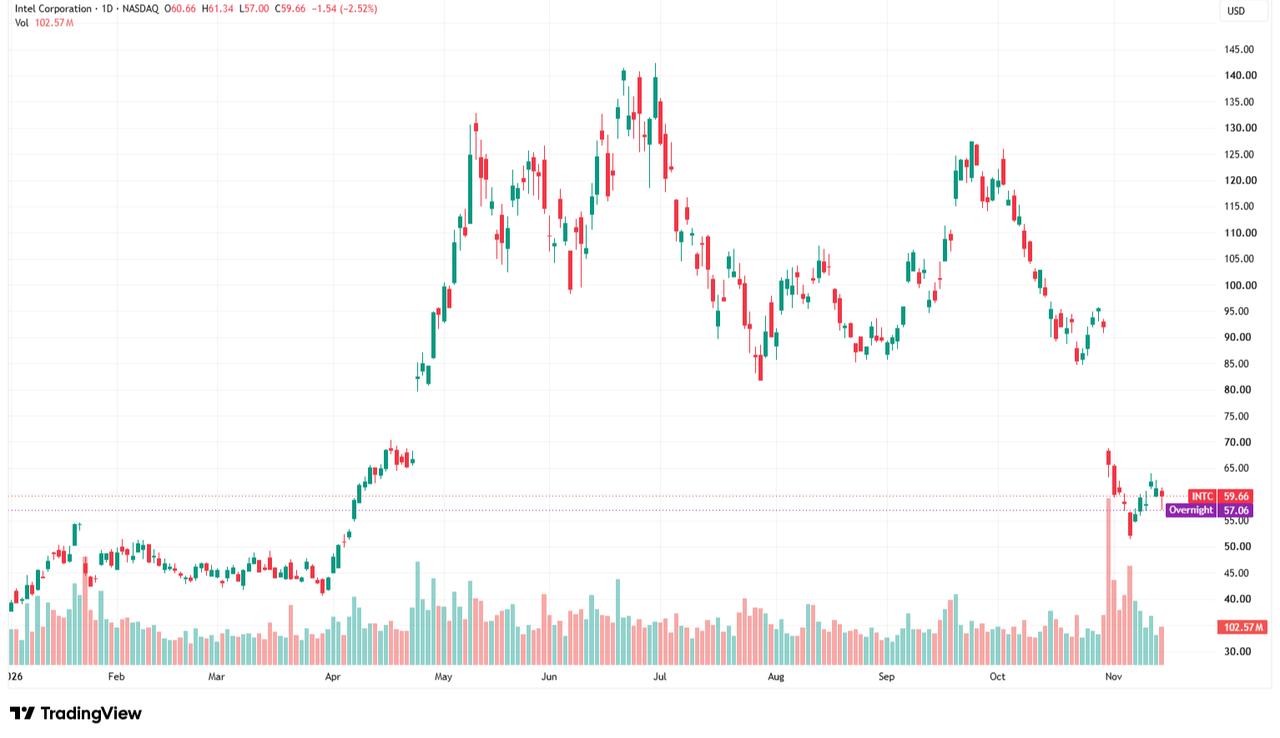

The legal action follows Intel's 28.6% plunge on Oct. 30, when the stock lost about $140 billion in market value in a single session.
The rout came a day after the company forecast lower-than-expected fourth-quarter revenue and profit and warned that weakness in PC sales would persist.
Speaking to analysts, CEO Lip-Bu Tan cited manufacturing supply shortages, an "unprecedented memory crunch" and the resulting softness in PC demand.
"We need to address these challenges with urgency," he added.
Like other major technology companies, Intel has invested heavily in manufacturing capacity to meet growing demand for data center chips. But supply disruptions have hampered its ability to capitalize on that demand, while rising memory prices have pushed up PC costs and weighed on sales.
The shares closed Friday at $59.66, down 2.6%. Despite the recent losses, they remain up 62% this year, although they have retreated from their recent peak of $142.35 on June 30.


 Set as preferred source
 Set as preferred source


 1 min read
 1 min read