Newsletters


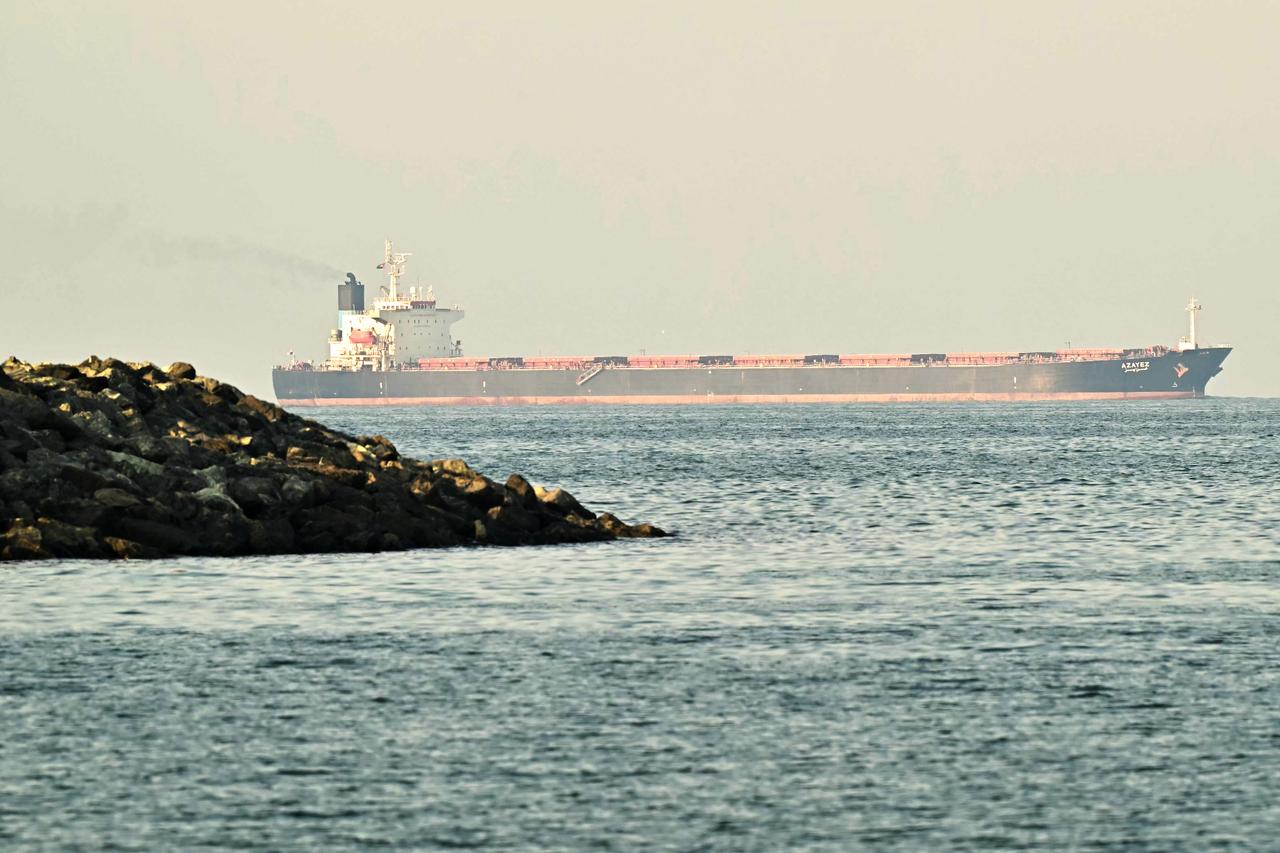


Global energy markets are bracing for turbulence after coordinated United States and Israeli airstrikes struck multiple Iranian cities early Saturday, putting at risk a maritime corridor that carries nearly one-fifth of the world’s oil supply.
The Strait of Hormuz, which links the Gulf to the Gulf of Oman, remains central to market concerns. Around 20 million barrels of crude transited the strait each day in 2024, according to the U.S. Energy Information Administration. At its narrowest point, the waterway is roughly 50 kilometers (30 miles) wide and no deeper than 60 meters (200 feet), and the route can transport a maximum of 2.6 million barrels per day.
Iran itself is also a significant producer. The country pumps about 3.1 million barrels per day, according to OPEC, placing it just inside the world’s top 10 oil producers, and it is believed to hold the third-largest crude reserves globally. Production costs are estimated at as little as $10 per barrel, compared with $40 to $60 per barrel in Canada and the United States.
Oil prices had already been trending higher as tensions intensified. On Friday, crude gained nearly 2.8% in both Brent and WTI, lifting prices to $72.9 and $67 per barrel, respectively, after talks between Iran and the United States in Switzerland ended without progress. Prices are now up more than 20% since the start of the year.
The latest airstrikes follow an earlier confrontation in June 2025, when U.S. aircraft targeted Iran’s nuclear facilities. During the 12-day conflict, Brent crude climbed about 7% to near $80 per barrel in the immediate aftermath, briefly touching multi-month highs before a ceasefire was reached.
Over the past five years, crude briefly moved above $100 per barrel during the first year of Russia’s invasion of Ukraine in 2022, showing there is still room for sharp price swings if tensions escalate again.
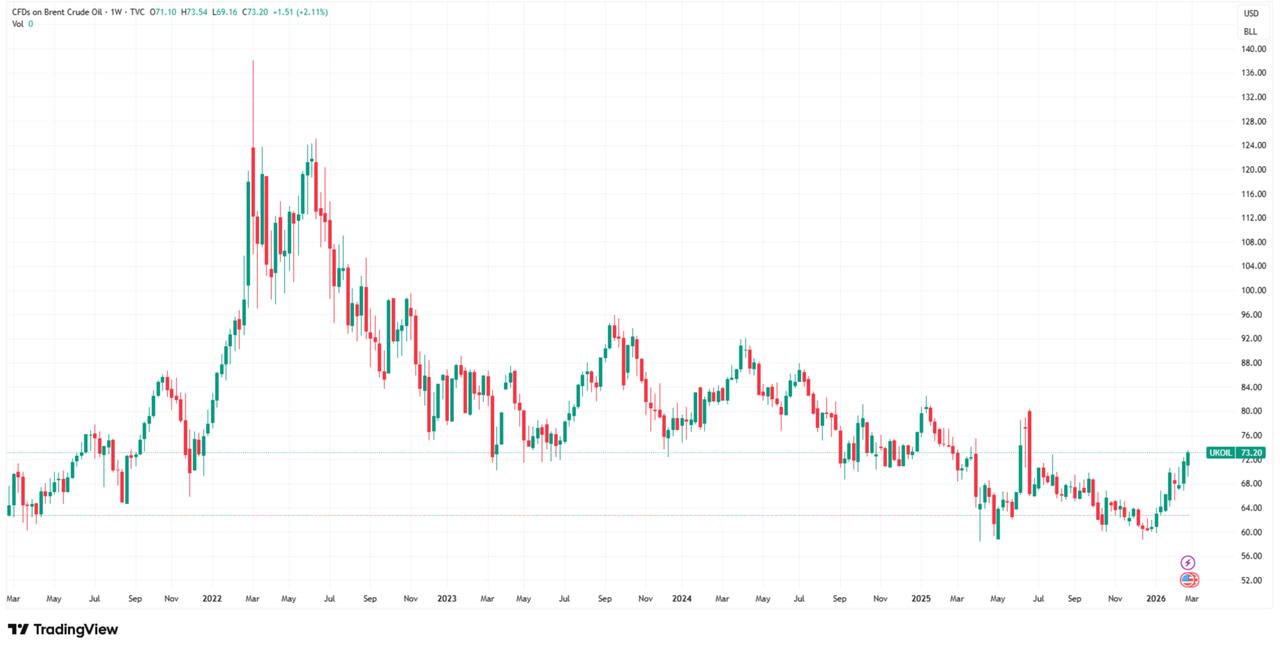

ING Global recently raised its 2026 average Brent forecast to $62 per barrel from $57, estimating that geopolitical tensions are adding up to $10 per barrel as supply risks tighten balances. The bank calculated that even with pipeline diversions, roughly 9 million barrels per day of crude and 6 million barrels per day of refined products would remain exposed if the Strait of Hormuz were disrupted. A prolonged blockage could lift Brent to $140 per barrel, while more limited disruptions could push prices toward $100 before easing into an $80–90 range.
Swiss lender UBS similarly projected Brent at $65 per barrel in June and $67 per barrel in December.
Although the 2025 spike proved short-lived, even temporary jumps in oil can lift inflation expectations and raise import costs, particularly in energy-importing economies such as Türkiye and China. Higher crude typically feeds through to gasoline, heating and freight expenses, adding pressure to headline inflation before policymakers can respond.
A 10% increase in global oil prices tends to raise domestic inflation by about 0.4 percentage point on impact, according to IMF research, while analysis by the Central Bank of the Republic of Türkiye (CBRT) suggests that a similar 10% rise in crude oil prices could ultimately lift consumer inflation in the country by about 1 percentage point.


 Set as preferred source
 Set as preferred source


 1 min read
 1 min read