Newsletters





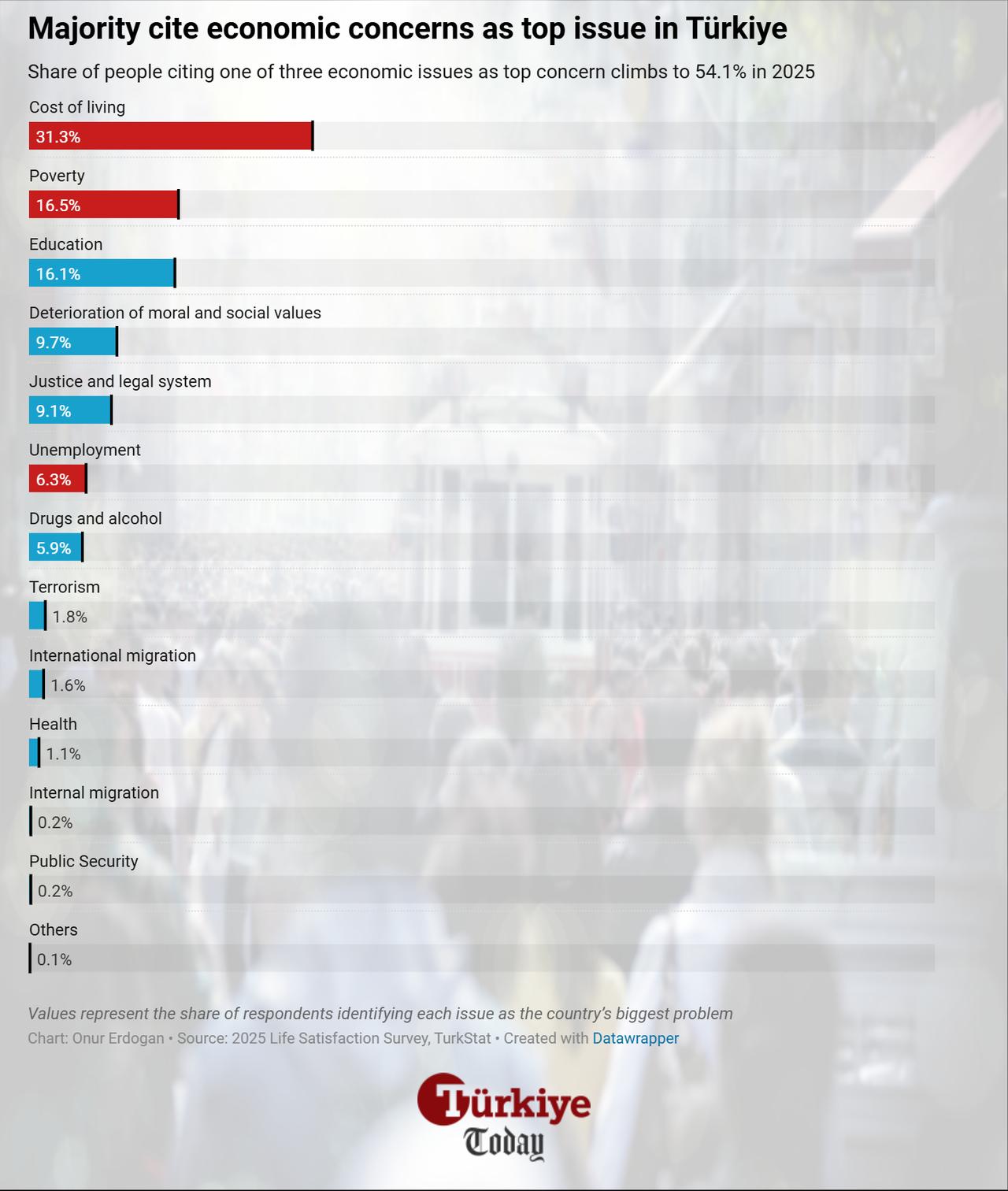
Hardening livelihood conditions top all concerns among Turkish citizens in 2025, as the Turkish Statistical Institute’s (TurkStat) Life Satisfaction Survey shows that 54.1% of respondents point to mounting pressure from three economy-related issues.
According to the data, the share of respondents naming the cost of living as the country’s biggest problem rises to 31.3%, up 2.1 percentage points year-over-year, while the proportion of those citing poverty increases by 2.5 percentage points to 16.5%.
The share of respondents identifying unemployment as the biggest problem also edges up by 1.8 percentage points to 6.3%, despite the country recording its lowest unemployment rate on record during the year.
Rising living costs, persistent inflationary pressure, and uneven income growth appear to play a central role in shaping these perceptions, as households face tighter budgets and reduced purchasing power along with limited access to stable jobs, particularly among young people.
Turkish citizens continue to grapple with elevated inflation, which remains the highest among OECD countries, closing 2025 at 30.9%, despite its continuous fall since peaking at 75.5% in May 2024.
The hunger threshold, defined as the minimum income required to meet the nutritional needs of a family of four, climbed to ₺30,143, marking a 43% annual increase.
Meanwhile, the country’s minimum wage was set at ₺22,104 throughout 2025, leaving a 26.67% gap compared with the hunger threshold, and was raised to ₺28,075 for 2026.
Around 14.49 million workers, or 83.1% of all paid employees, are estimated to earn no more than 50% above the minimum wage, according to the research center of the Confederation of Progressive Trade Unions of Türkiye (DISK-AR).
Meanwhile, according to the latest figures as of Q3 2025, around 7 million young people aged 15–34 were neither in education nor in employment, while labor underutilization, also known as broad unemployment, hovered around 28.6%.

Despite deepening economic concerns, overall happiness levels among adults in Türkiye increased in 2025.
The share of individuals aged 18 and over who reported being happy rose to 53.3%, up from 49.6% in 2024, while the proportion of those who said they were unhappy declined to 13%, compared with 14.5% a year earlier.
The share of men reporting happiness climbed from 46.9% to 51.4%, while among women it rose from 52.3% to 55.1%, maintaining higher overall happiness levels compared with men.
Family remained the primary source of happiness, with 69% of respondents identifying family relationships as their main source of well-being.
Personal health also played a central role, as 64.9% of individuals said being healthy was the most important factor contributing to their happiness.
Optimism about the future remained relatively strong despite economic pressures, with 67.1% of respondents saying they felt hopeful about their own future.


 Set as preferred source
 Set as preferred source


 2 min read

 1 min read