Newsletters




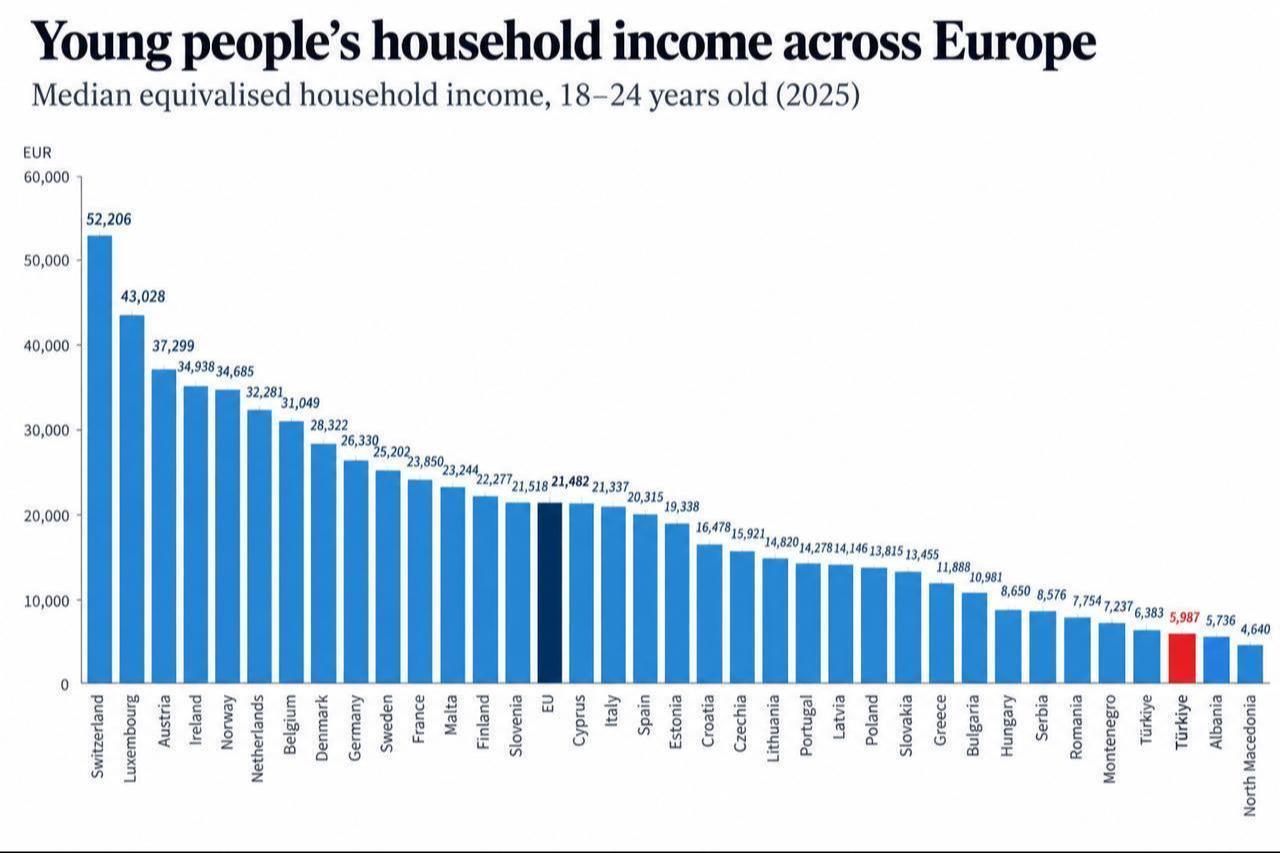
Young people in Türkiye rank third-lowest among 34 European countries for household income, ahead of only North Macedonia and Albania, as protests over living costs, housing and public services spread across the continent, according to a report.
The latest figures from Eurostat, the European Union's statistics office, put Türkiye's median equivalized household income for people aged 18 to 24 at €5,987 ($6,709), Euronews reported. The comparison measures the income of the households where young people live, rather than their personal earnings.
The comparison covers 34 European countries, including EU members, candidate countries and members of the European Free Trade Association (EFTA).
Switzerland leads the ranking with €52,206, followed by Luxembourg at €43,028 and Austria at €37,299. Among the EU’s four largest economies, Germany records the highest figure at €26,330, while Italy and Spain fall below the EU average of €21,482, at €20,315 and €19,338, respectively.
France ranks 11th, with young people’s household income reaching approximately €23,850 in 2025, above the EU average.
At the bottom of the ranking, North Macedonia records the lowest figure at €4,640, followed by Albania at €5,736. Household income also falls below half the EU average in Bulgaria (€8,680), Hungary (€8,576), Serbia (€7,754) and Romania (€7,237).
Adjusting for differences in price levels across Europe provides another perspective on young people's household resources. Purchasing power standards (PPS) account for these differences, making it easier to compare what household incomes can buy in different countries.
Austria tops the ranking, with median equivalized household income for people aged 18 to 24 reaching 33,052 PPS in 2025. Luxembourg follows at 32,391 PPS, while Switzerland ranks third at 29,989 PPS.
Norway ranks fourth at 27,965 PPS, followed by the Netherlands at 27,830 PPS and Belgium at 26,645 PPS. Germany stands ninth at 24,237 PPS, while France ranks 13th at 21,446 PPS, just above Spain at 21,275 PPS. The EU average is 21,077 PPS.
At the lower end, Albania records 8,175 PPS, followed by North Macedonia at 8,994 PPS and Montenegro at 9,955 PPS. Türkiye ranks 30th among the 34 countries shown, at 11,305 PPS, below Serbia (11,500 PPS), Hungary (11,665 PPS) and Romania (11,369 PPS).

Weeks of demonstrations have swept major cities across France, Spain, Portugal, Italy, Greece and other European countries, as students, workers and housing campaigners take to the streets over rising living costs, strained public services and a lack of affordable housing.
France has become a focal point of the unrest. Protests that began in September over teacher shortages, overcrowded classrooms and deteriorating school buildings have broadened into wider demonstrations over wages, living costs and public services.
Trade unions and workers have joined students in the protests, while some demonstrations have turned violent, prompting police deployments and arrests.
French protest groups and trade unions have called for further demonstrations on Oct. 31 and a nationwide strike on Nov. 5, seeking to keep pressure on President Emmanuel Macron's government over wages, rising expenses and public services.
The unrest extends beyond France, but the demands differ from country to country. In Spain and Portugal, housing affordability has become a major concern, with protesters highlighting soaring rents and the difficulty of finding accommodation. In Greece, students and teachers have rallied over underfunded education, inadequate school facilities, staff shortages and high housing costs.
Thousands of people took to the streets across Greece on Oct. 21, calling for better public services and more affordable living conditions.
Italy has also seen demonstrations over wages, housing, health care and education, while protests in Albania have focused in part on corruption and government accountability.
Although the protests stem from different national grievances, they reflect widespread frustration over the growing gap between household incomes and the cost of living, alongside concerns about access to essential services.


 Set as preferred source
 Set as preferred source


 1 min read
 1 min read