Newsletters


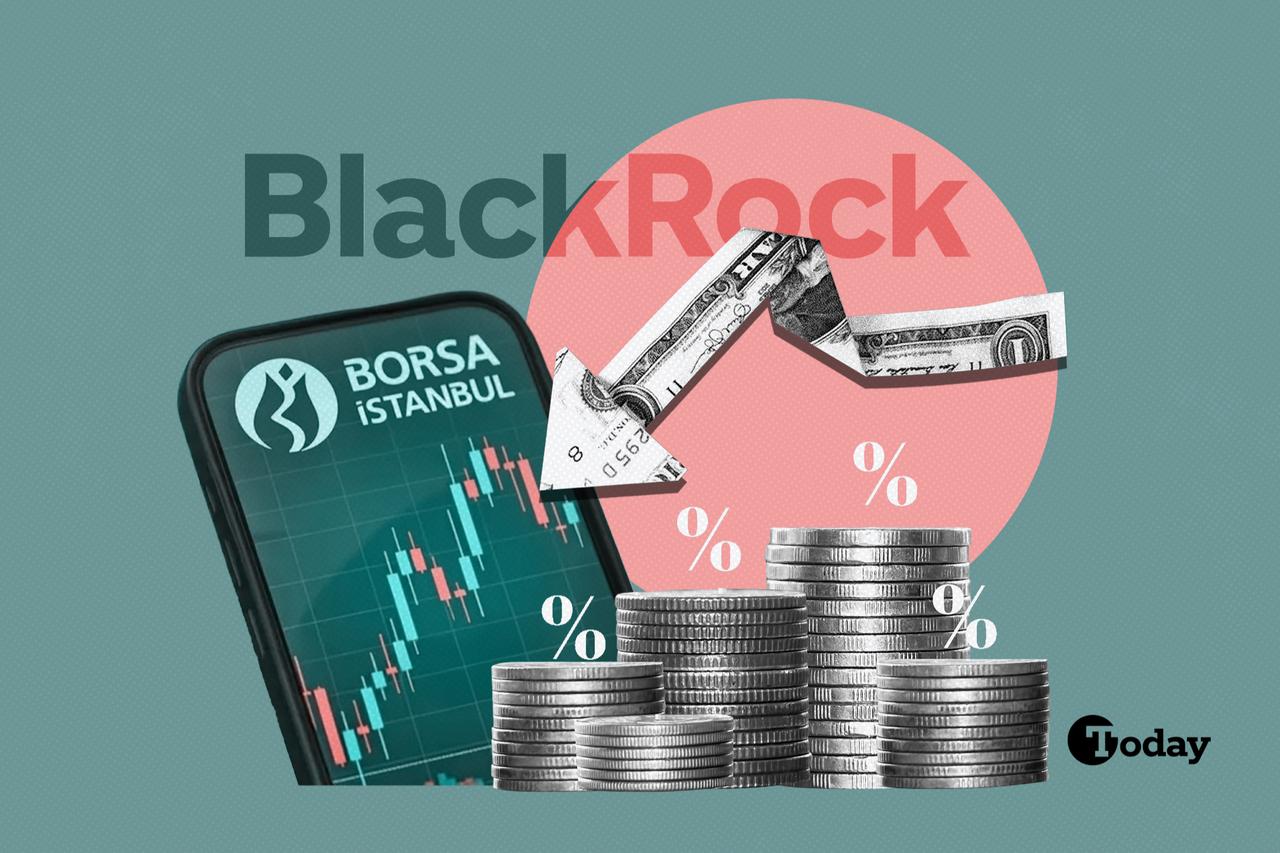


At the start of 2026, Türkiye was exactly the kind of turnaround story BlackRock wanted to own: inflation was slowing, interest rates were coming down, and Turkish banks looked cheap compared with their global peers, giving foreign investors a reason to reconsider a market they had largely shunned for years.
BlackRock’s Frontiers Investment Trust was not just dipping its toes in; it was building a sizeable position, making Türkiye its third-largest country exposure behind Saudi Arabia and the United Arab Emirates.
The London-listed investment trust seeks long-term capital growth by investing in companies across less-developed markets, targeting economies often overlooked by global investors.
The conviction was public, too. In a Jan. 28 Bloomberg report, co-manager Emily Fletcher described Türkiye as a market with strong potential, saying, "We feel there is opportunity, and hence you can see in our portfolio, we have a large allocation there."
She added that the fund would maintain its position as long as market conditions remained favorable.
Her colleague Samuel Vecht made the case for Turkish banks, which he considered "very attractive on a global basis" based on their price-to-earnings ratios.
The fund’s reported exposure told the same story, rising from 9.3% of net assets in October 2025 to 11% in February 2026, equivalent to roughly £36 million ($48 million) based on the trust’s reported £326.6 million in assets at the time.
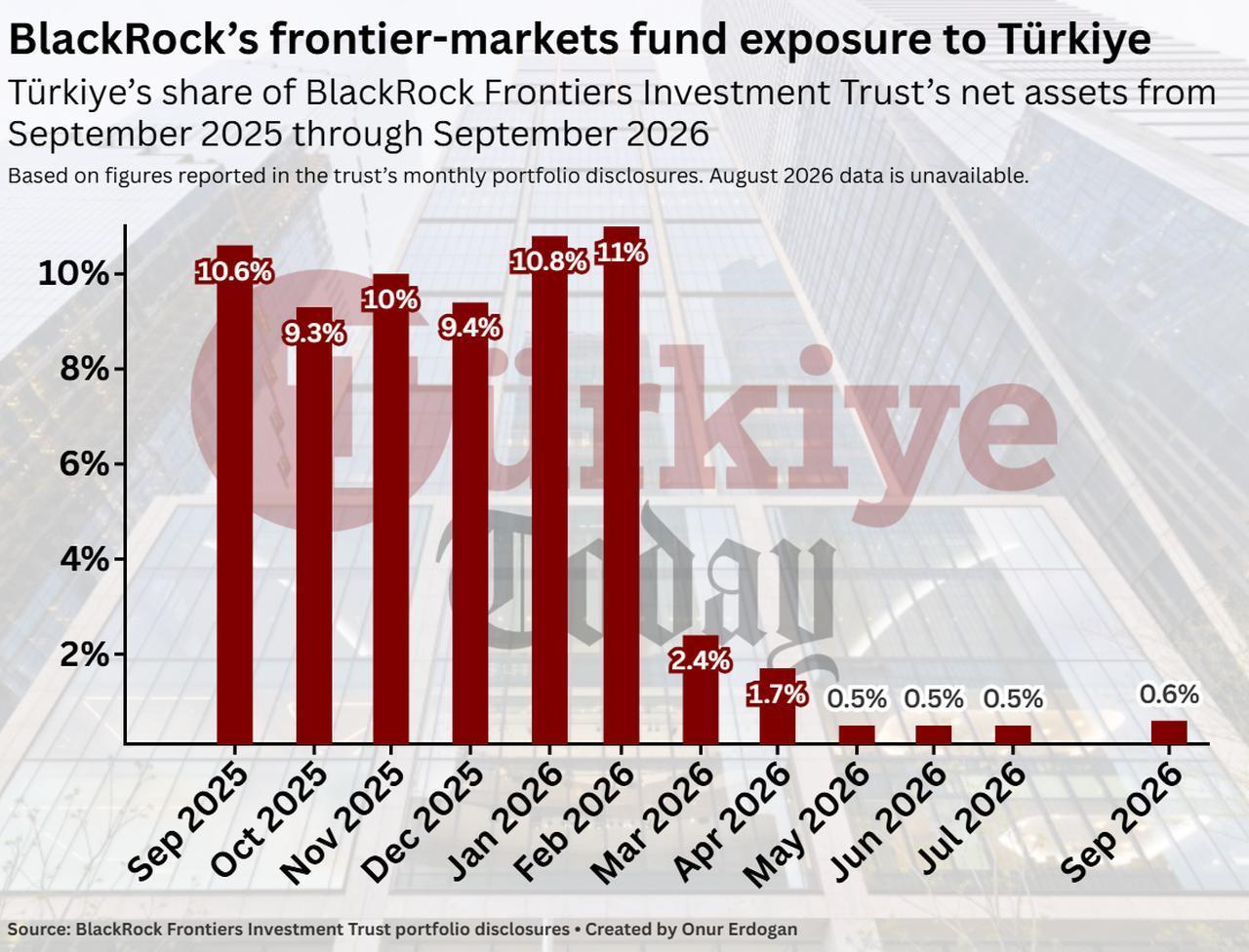

Then the mood changed: within three months, BlackRock slashed that exposure to just 0.5%, exited its positions in Akbank and Isbank, and, by the end of June, no longer listed the Turkish stocks in its holdings.
The reversal came as the fund’s managers grew increasingly concerned that surging oil prices and the Iran war could undercut the disinflation process their Turkish investment thesis depended on.
According to Türkiye Today’s review of portfolio updates released during the period, the bet appeared to be paying off for a while. In January, BlackRock’s monthly update recorded a 23.7% rise in the Turkish market, while Akbank shares gained 31.6% as investors looked toward lower inflation and further interest-rate cuts.
As tensions in the Middle East escalated, the prospect of a sustained energy-price shock raised questions about whether Türkiye could keep bringing inflation down without putting fresh pressure on its external balance, making the same macroeconomic outlook that had once attracted BlackRock look much less comfortable.
The fund responded in March by selling Isbank and cutting its Akbank position while also trimming healthcare company MLP to lock in profits. Explaining the bank trades in its monthly update, the managers warned that rising energy prices, which are linked to U.S.-Iran tensions, "could weigh on Türkiye’s ability to continue to see disinflation."
The market was moving against the portfolio at the same time: Akbank shares fell 25.8% in March, while Eldorado Gold, a foreign-listed miner with operations in Türkiye, dropped 26.1% amid weaker gold prices.
BlackRock’s reported Türkiye exposure plunged from 11% in February to 2.4% in March, as the fund’s once-sizeable position shrank quickly.
The retreat did not stop with the March trades. In May, BlackRock confirmed that it had exited Akbank entirely, again citing concerns that elevated oil prices could put Türkiye’s disinflation process under pressure and hurt the balance of payments.
By the end of that month, reported exposure to Türkiye had fallen to 0.5% of net assets—about 95% below its February peak.
The June 30 holdings disclosure listed neither Akbank nor Isbank, and MLP, which the managers had also trimmed in March, did not appear in the disclosed portfolio either.
The latest June holdings list still included Eldorado Gold, a Canadian-listed miner with operations in Türkiye, with a position worth about $1.9 million, or 0.4% of the portfolio.
Borsa Istanbul began 2026 with a strong rally, as the BIST 100 climbed around 25% to a record high by mid-February. Foreign investors poured $2.3 billion into Turkish equities by the week ending Feb. 27, matching their net purchases for all of 2025, the biggest annual buying spree since 2017.
The inflows reflected hopes that easing inflation, down from 42.1% in January 2025 to 30.7% in January 2026, would pave the way for further rate cuts.
The early-year euphoria, however, has since given way to a much rougher ride. After rebounding to another record above 15,000 in April as foreign investors returned to buying, the BIST 100 has suffered a sharp reversal, closing at 11,116.99 on Oct. 23, down nearly 27% from its 52-week high of around 15,205.
The benchmark has fallen 7% in October alone and is down 1.3% since the start of the year in lira terms; measured in dollars, the BIST 100 is down 14.7% year to date
September dealt the market its heaviest blow, with the BIST 100 losing 16.7%, its worst monthly performance since 2008, as problems at investment funds triggered forced sales and a broader investigation into suspected market manipulation added to investor anxiety.
BlackRock’s Frontiers Investment Trust, meanwhile, posted an 11.6% rise in dollar net asset value in the 12 months to Sept. 30, beating its benchmark’s 9.8% gain, while its share price climbed 17.8%. Its total assets reached £417.7 million.
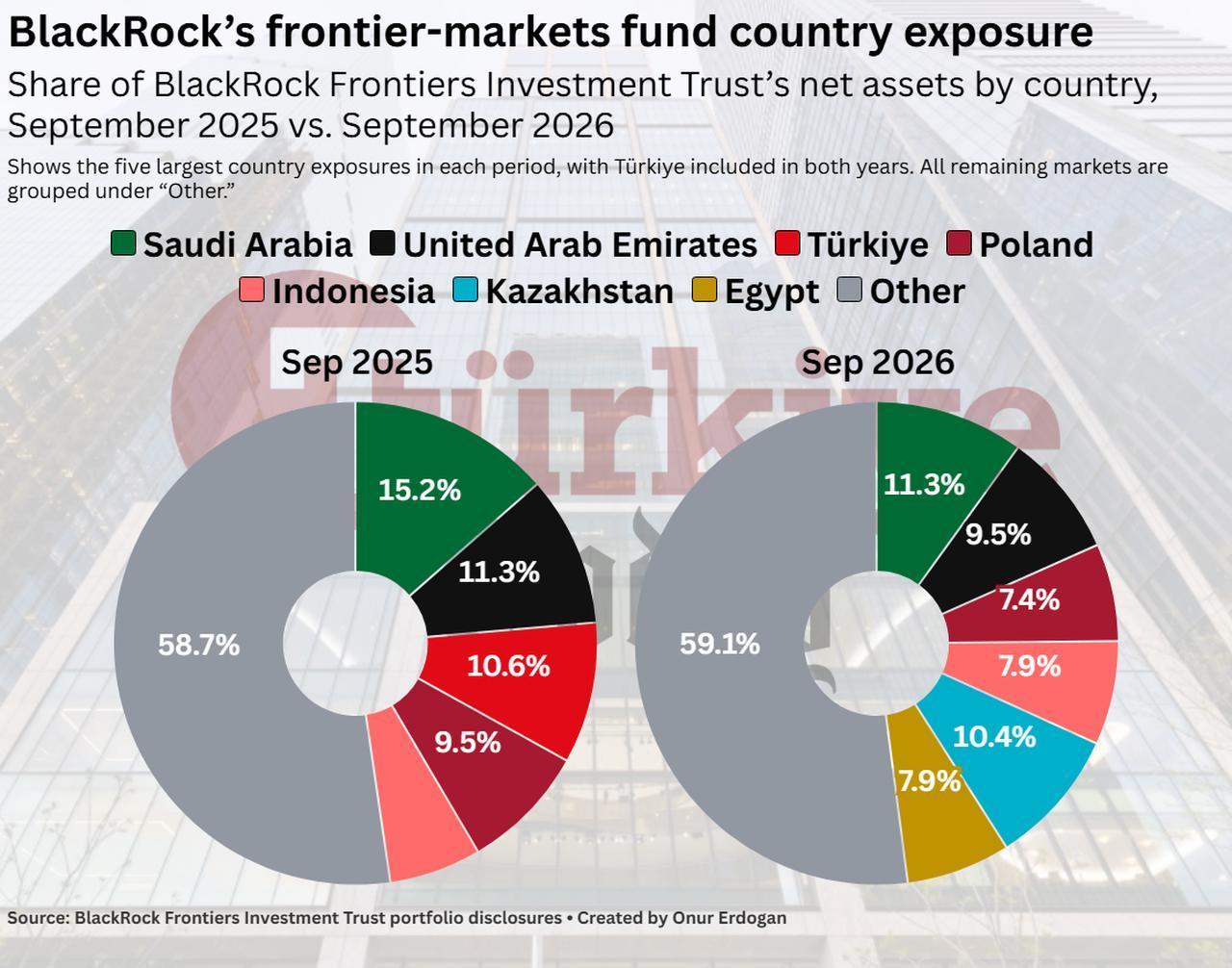
Saudi Arabia remained the fund’s largest country exposure in September at 11.3%, followed by Kazakhstan at 10.4% and the UAE at 9.5%. Indonesia, Egypt and Kenya each accounted for around 8%, while Poland represented 7.4%. Compared with a year earlier, Egypt’s share rose from 1.9% to 7.9% and Kenya’s from 4.2% to 7.8%.
Among individual holdings, Poland’s Bank Pekao led at 5% of net assets, followed by Kazakhstan’s Kaspi at 4.5% and Halyk Savings Bank at 4.4%.
A year earlier, UAE-based developer Emaar Properties was the largest holding at 4.7%, while Akbank accounted for 3.4% and Eldorado Gold, which operates a mine in Türkiye, for 3.1%.
BlackRock has since shifted capital into markets including Georgia, Saudi Arabia, Egypt, Pakistan, Argentina, Indonesia and Nigeria, citing attractive valuations, growth prospects and improving policy conditions.


 Set as preferred source
 Set as preferred source


 2 min read

 1 min read