Newsletters




Türkiye recorded Europe's lowest household electricity prices in the first half of 2026, while natural gas rates also remained among the continent's cheapest, according to Eurostat data.
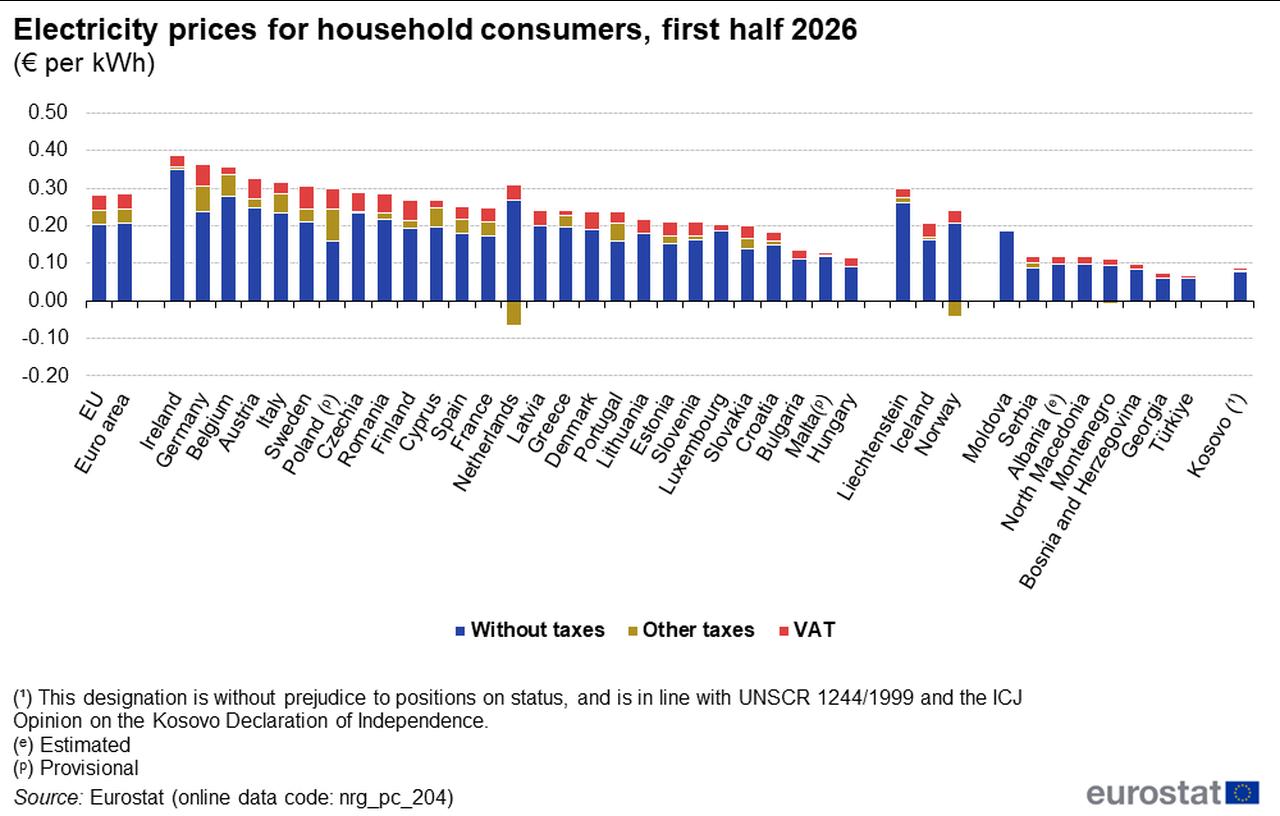
Households in Türkiye paid €6.6 ($7.3) per 100 kilowatt-hours (kWh) of electricity, including taxes, the lowest among 38 European countries in data compiled by Euronews.
Ireland recorded the highest price at €38.7, followed by Germany at €36.2 and Belgium at €35.8.
The European Union average stood at €28.3 per 100 kWh, more than four times Türkiye's level. Hungary recorded the lowest electricity price among EU members at €11.4.
Austria (€32.6), Italy (€31.4), and Sweden (€30.6) also ranked above €30 per 100 kWh, while Spain (€25.1) and France (€24.9) remained below the EU average.
On prices adjusted for local purchasing power, Romania recorded Europe's highest electricity prices at 46.9 PPS per 100 kWh, followed by Poland at 41.1 and Czechia at 34.3.
Türkiye ranked second-cheapest at 13.5 Purchasing Power Standard (PPS), behind Iceland at 12.6. Malta (13.8), Hungary (14.7) and Norway (15) followed.
The EU average stood at 28.4 PPS. Among the bloc's four largest economies, Italy recorded the highest price at 32.8, followed by Germany at 32.4. Spain stood at 28.0, while France was lower at 23.3.
Despite its low overall price level, Türkiye recorded one of Europe's sharpest increases. Electricity prices rose by 11.2% in the second half of 2025, the second-largest increase after Finland's 19.5%. Poland and Lithuania both posted 10.6% increases, followed by Sweden at 10.4%.
Across the EU, prices fell by an average of 2.2%. Denmark and Luxembourg recorded the steepest declines, at 28.2% and 24.1%, respectively.
On an annual basis, Türkiye's electricity prices climbed by 35%, the second-largest increase after Romania's 51.9%. Ireland and Finland followed with increases of 19.8% and 18.4%.
Prices, meanwhile, fell in all four of the EU's largest economies: France (-7%), Germany (-5.7%), Italy (-4.5%) and Spain (-3.9%).

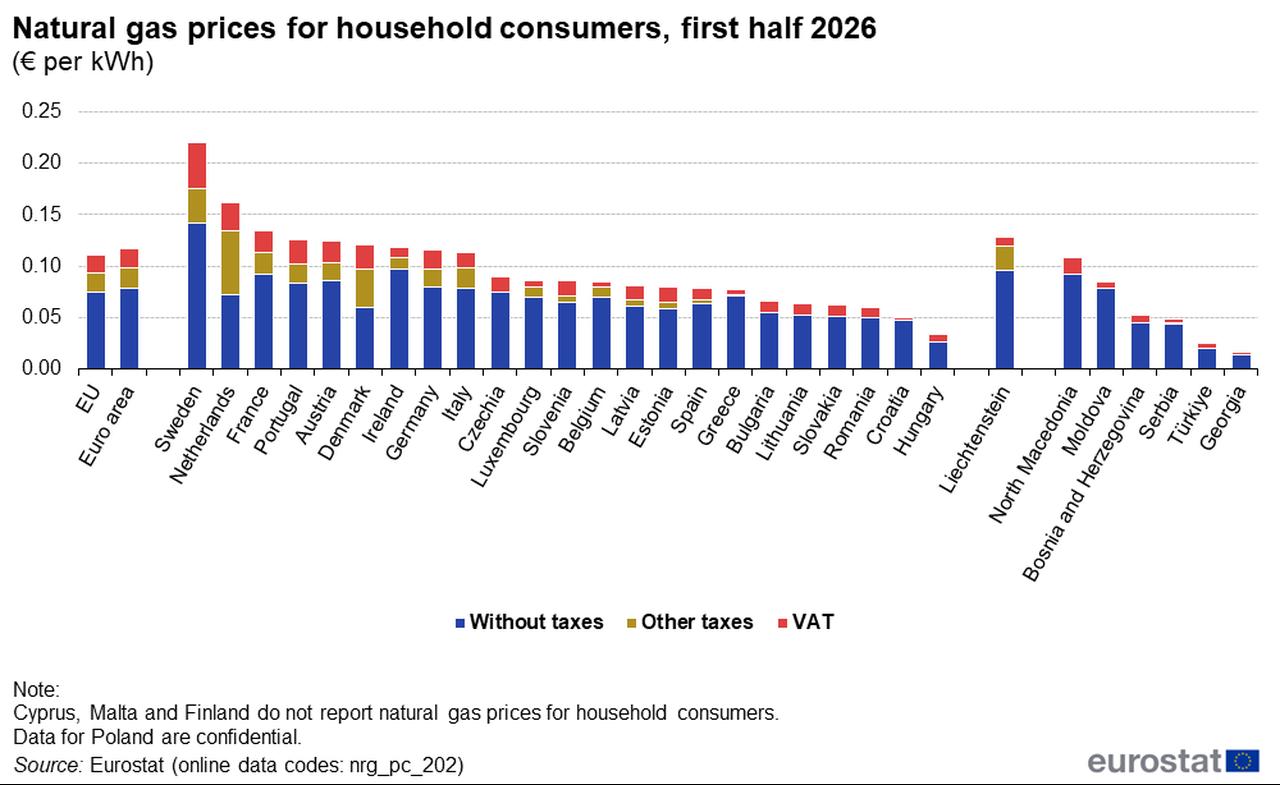
Households in Türkiye paid €2.4 per 100 kWh of natural gas, including taxes, in the first half of 2026, the third-lowest price among 29 European countries. Georgia recorded the lowest rate at €1.6, followed by Hungary at €3.3. The EU average stood at €11.
Sweden had the highest price at €22, followed by the Netherlands at €16.2, France at €13.5, Portugal at €12.6 and Austria at €12.4.
Germany (€11.6) and Italy (€11.4) also exceeded the EU average, while Spain recorded €7.9.
The ranking changed after adjusting for purchasing power. Hungary had the lowest natural gas price at 4.3 PPS per 100 kWh, followed by Türkiye at 5.0. Luxembourg (6.6) and Croatia (6.8) also ranked among the cheapest.
North Macedonia topped the list at 20.8 PPS, despite having a nominal price of €10.8, below the EU average. Sweden (17.7), Portugal (15.0) and the Netherlands (13.8) followed. The EU average stood at 10.7 PPS.
Natural gas prices fell by an average of 10.2% across the EU compared with the second half of 2025. Italy recorded the sharpest decline at 23.2%, followed by Spain at 17.6% and Greece at 16%.
Türkiye went against the trend, recording Europe's largest increase at 12.9%, ahead of Romania's 6.3% rise.
Government subsidies and regulated tariffs help keep household electricity and natural gas prices below European levels in Türkiye. The state covers a significant share of household energy bills, protecting consumers from fluctuations in international energy prices and exchange rates.
Energy and Natural Resources Minister Alparslan Bayraktar said on Nov. 8 that the government currently subsidizes 55% of household electricity bills and 63% of natural gas bills. In practical terms, the state covers ₺550 ($10.9) of a ₺1,000 electricity bill and ₺630 of a ₺1,000 natural gas bill.
The International Energy Agency (IEA), in its 2026 Türkiye review, also noted that regulated retail tariffs remained below levels implied by wholesale market prices, limiting the impact of international energy price fluctuations on households.
Beyond these broad subsidies, Türkiye provides targeted assistance to low-income households. Under the natural gas consumption support scheme, eligible households receive between ₺1,500 and ₺3,500 annually, depending on regional climate conditions. Electricity assistance is also available, with support levels varying according to household size and consumption.


 Set as preferred source
 Set as preferred source


 1 min read
 1 min read