Newsletters





Türkiye remains one of Europe's most affordable destinations for visitors from the European Union despite the Turkish lira's slower depreciation in recent years, even as the cost of living continues to climb for residents.
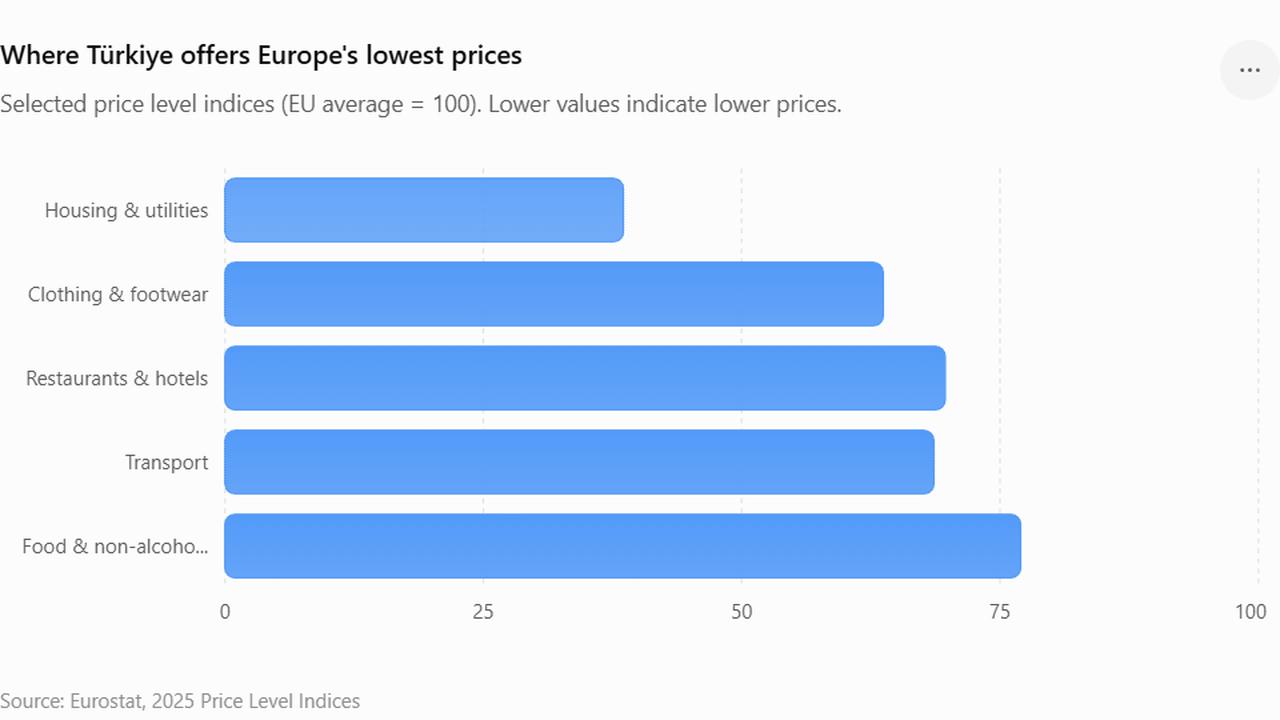
Eurostat's 2025 price level data, which uses the EU average as a benchmark of 100, show that foreign travelers still benefit from lower prices in Türkiye for accommodation, dining, groceries and other everyday expenses.
The data place Türkiye as Europe's third-cheapest country overall, with a gross domestic product price level index of 56.8, ahead of only North Macedonia (52.2) and Bosnia and Herzegovina (56.0).
Restaurants and hotels remain a major draw for foreign visitors, with Türkiye ranking as Europe's fourth-cheapest market at a restaurant and hotel price level index of 69.7, behind North Macedonia (52.5), Bosnia and Herzegovina (60.9) and Romania (65.5).
Restaurant services score 67.0, while hotel and accommodation services reach 81.2, keeping both well below the EU average.
In food and grocery spending, Türkiye ranks as Europe's second-cheapest market for food and non-alcoholic beverages, with an index of 77.0, while meat (65.0) and vegetables (51.7) are the cheapest on the continent.
It also ranks third-cheapest for bread and cereals (71.4) and remains among the least expensive markets for dairy products, fish and seafood, and ready-made food.
Housing is another area where Türkiye remains among Europe's least expensive countries, ranking third for housing, water, electricity, gas and other fuels with a price level index of 38.7, behind Bosnia and Herzegovina (29.5) and North Macedonia (36.5).
Shopping offers a similar advantage, with Türkiye posting Europe's lowest price level for clothing and footwear at 63.7, while clothing alone records the continent's lowest index at 62.0.
Healthcare also remains comparatively inexpensive, with a health price level index of 32.8 and inpatient care services at just 21.4.
Despite its generally low prices, Türkiye ranks among Europe's most expensive countries for alcoholic beverages, with a price level index of 210.2 that places it third after Iceland and Norway, largely due to high excise taxes, while tobacco remains Europe's cheapest at 25.4.
Imported goods, however, are generally more expensive than the EU average, particularly vehicles (156.2), transport equipment (119.3), information and communication equipment such as smartphones and computers (118.0), and durable household goods and appliances (117.8).

The country's competitive pricing continues to support visitor spending, although the pace of growth has eased as Türkiye gradually becomes more expensive in foreign currency terms.
Purchases made in Türkiye with foreign-issued payment cards reached ₺48.4 billion ($1 billion) in May 2026, up 18% from a year earlier, bringing spending in the first five months of the year to ₺174.5 billion, an annual increase of 8.8%, according to Interbank Card Center (BKM) data.
While Türkiye continues to offer strong value for European visitors, many residents face a different economic reality as wages struggle to keep up with the cost of living amid rising prices.
According to the Confederation of Turkish Trade Unions (Turk-Is), the monthly hunger threshold for a family of four stood at ₺30,143 ($661.9) in December 2025, while the poverty threshold, which covers food, housing, transport, clothing, education, healthcare and other essential expenses, reached ₺98,188 ($2,155.7).
The organization also estimated the monthly cost of living for a single worker at ₺39,123 ($858.50).
By comparison, data from the Turkish Statistical Institute (TurkStat) show average annual disposable household income reached ₺662,414 in 2025, equivalent to about ₺55,201 per month, while the 2026 net monthly minimum wage, a widely used benchmark for earnings, stands at ₺28,075.50.
The gap widened further by June 2026, with the monthly hunger threshold rising to ₺34,888, the poverty threshold reaching ₺113,587 and the cost of living for a single worker climbing to ₺45,686.
Annual inflation eased to 32.1% in June but remained well above the central bank's target, continuing to push up the cost of goods and services for households across Türkiye.
At the same time, the Turkish lira depreciated by just 9.1% against the U.S. dollar and 6.7% against the euro over the past year, well below the inflation rate, resulting in a 7.7% real appreciation in the real effective exchange rate (REER) and making Türkiye less of a bargain for visitors.


 Set as preferred source
 Set as preferred source


 1 min read


 1 min read