Newsletters





Türkiye’s five-year credit default swap premium fell to 217 basis points on Wednesday, its lowest level since Feb. 18, signaling easing pressure on the country’s financial outlook.
The country’s CDS reached 309 basis points at the peak of the Iran war on April 1, largely driven by capital outflows and renewed inflationary pressures stemming from higher energy prices.
Since then, the premium has continued to decline as the Central Bank of the Republic of Türkiye (CBRT) rebuilt its official reserves and capital outflows reversed into inflows in recent weeks, easing concerns over Türkiye’s economic outlook.
The improvement in the market’s assessment of Türkiye’s sovereign credit risk follows the central bank’s decision to restart one-week repo auctions, a key source of short-term bank funding, as it moved to normalize liquidity conditions.
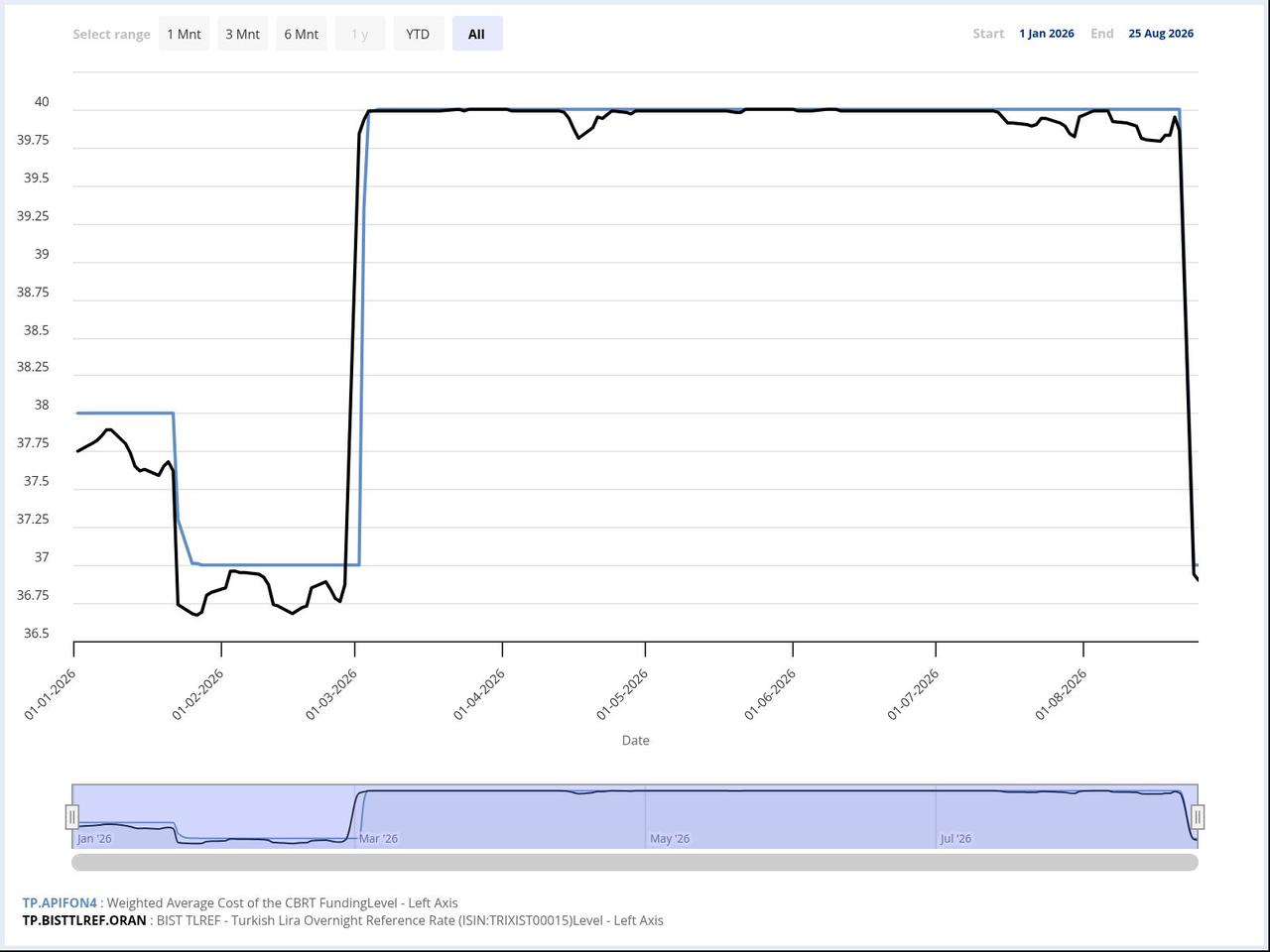
The CBRT had suspended the auctions on March 1 as it tightened monetary conditions amid pressure from the Iran war. Banks seeking liquidity were consequently forced to turn to overnight funding at 40%.
The return of the repo auctions paved the way for the central bank to bring its funding rate down to the 37% policy rate. The bank launched two one-week repo auctions on Monday and Tuesday, providing banks with a combined ₺2 billion ($41.6 million) in funding.
TLREF, the benchmark for overnight Turkish lira borrowing, fell to 36.9%, while the yield on the benchmark two-year government bond dropped to 40%.

The developments also supported expectations that Turkish policymakers could resume their easing cycle in the fourth quarter, potentially later than previously anticipated.
A Bank of America (BofA) note said the central bank is not expected to change rates at the Monetary Policy Committee meeting on Sept. 10. BofA forecasts a first cut of 100 basis points in October, with the policy rate falling to 36% by the end of the year.
Despite the easing in funding conditions, macroprudential measures remain tighter than in the previous period. BofA pointed to inflation remaining high, while the recovery in foreign-exchange reserves is largely complete and the slowdown in economic growth has become more pronounced.
Slower credit growth and high interest rates are weighing on domestic demand, while their indirect effects are also helping to contain inflationary pressure, the analysis says. At the same time, elevated inflation expectations and continued global and geopolitical uncertainty are limiting the CBRT’s room for direct interest-rate cuts.
Tighter macroprudential measures are expected to keep credit growth under control and limit dollarization. As a result, BofA does not expect the pace of Turkish lira depreciation to accelerate.
The analysis maintains its year-end inflation forecast at 29.5% and says the government’s Medium-Term Program will be a key factor in shaping the economic outlook for 2027.


 Set as preferred source
 Set as preferred source


 1 min read

 1 min read