Newsletters





Türkiye's current account deficit more than doubled to $4.2 billion in June from $2.3 billion a year earlier, as the goods deficit widened to $8.5 billion, according to central bank data.
Over the first six months of 2026, the current account deficit reached $34.5 billion, while the 12-month deficit climbed to $38.9 billion. Goods deficits were $43.7 billion and $76.5 billion, respectively, while services generated surpluses of $23.8 billion and $63.7 billion.
The services balance remained a major source of foreign-currency income in June, with transportation and travel generating $2.6 billion and $4.9 billion, respectively. Excluding gold and energy, the balance posted a $1.5 billion surplus in June, while services brought in $6.9 billion in net inflows, helping offset the shortfall in goods.
On the financing side, foreign direct investment recorded an $899 million net outflow in June, as non-residents brought in $210 million while residents’ external assets rose by $1.109 billion. In real estate, residents purchased $248 million of property abroad, while non-residents made $297 million in net purchases in Türkiye.
Portfolio investment, meanwhile, recorded a $2.5 billion net inflow, driven by non-resident purchases of $2.9 billion in equity securities and investment funds and $1.2 billion in government domestic debt securities.
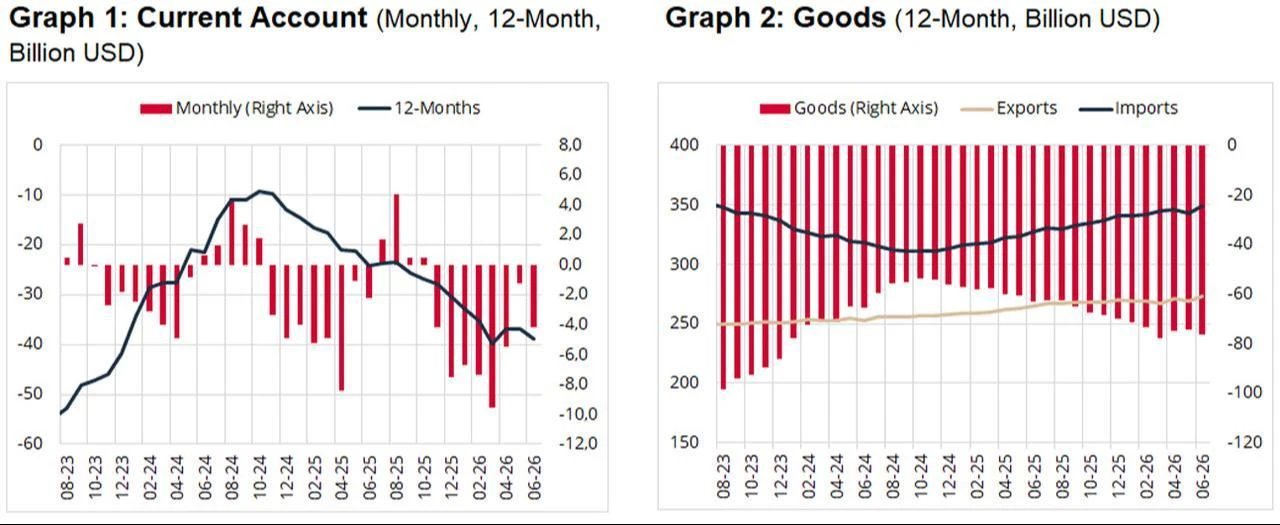

The figures came in below market expectations, with financial data platform Matriks putting the June current account deficit forecast at $5 billion, after the May deficit also exceeded expectations at $1.5 billion versus a $1.3 billion forecast.
The main driver of the widening deficit appears to be the deteriorating trade balance, as imports rose 22.7% to $33.0 billion in June, outpacing a 20.1% increase in exports to $24.4 billion and pushing the goods deficit up 30.9% to $8.5 billion, according to central bank data.
The energy import bill also climbed 28.8% to $5.9 billion, widening the energy deficit to $4.5 billion, as elevated global oil prices amid the regional conflict increased import costs.
Türkiye was targeting a $22.3 billion current account deficit for 2026 under its Medium Term Program, but the goal is already looking increasingly out of reach, with the latest market participants survey showing expectations of around $49.2 billion for the year.


 Set as preferred source
 Set as preferred source


 1 min read

 1 min read