Newsletters




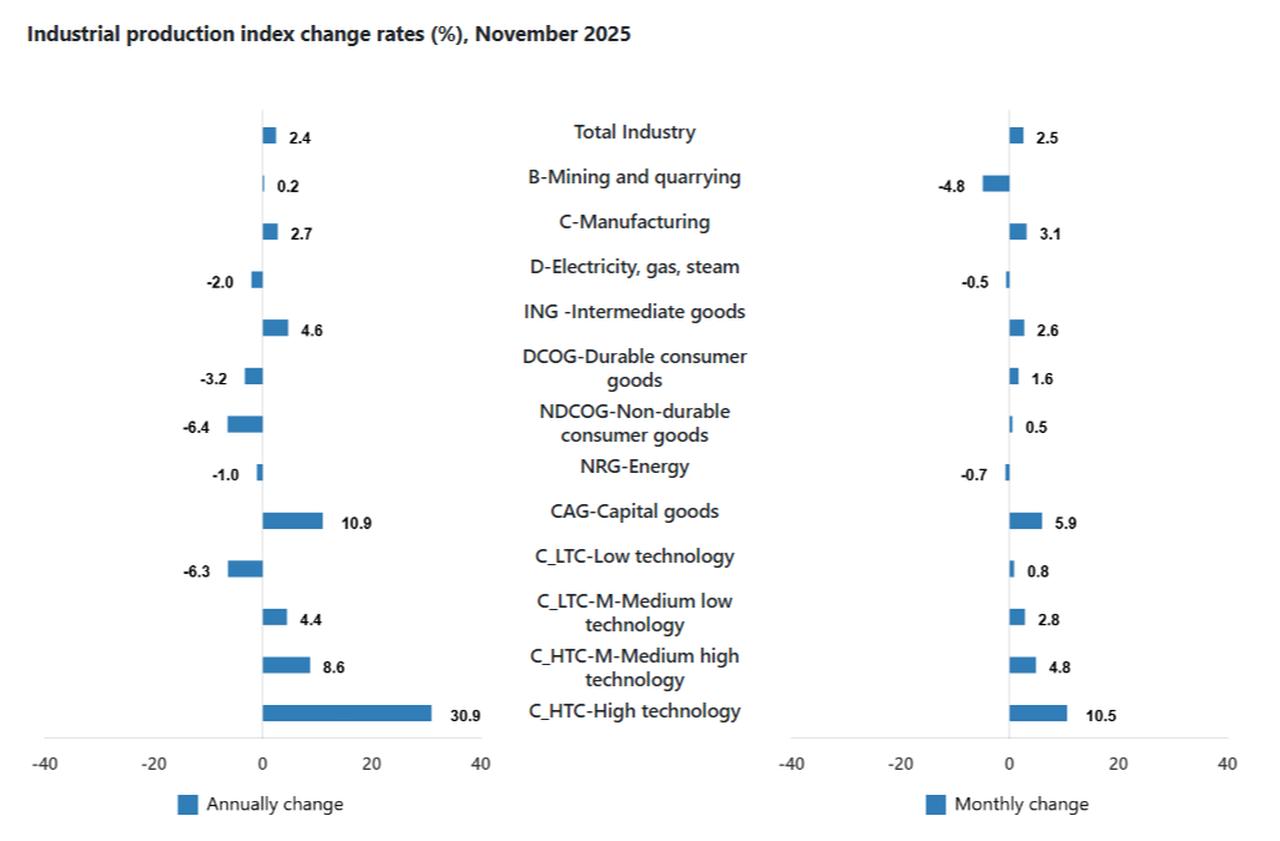
Türkiye’s industrial production rose by 2.4% year-over-year in November 2025, buoyed by sharp gains in high-tech manufacturing, according to official data.
On a monthly basis, the seasonally and calendar-adjusted industrial production index rose by 2.5%, offsetting the 0.8% contraction seen in October, the Turkish Statistical Institute (TurkStat) data showed. However, the unadjusted index registered a modest year-over-year decline of 0.5%.
Among industrial sub-sectors, the high-technology manufacturing segment stood out, registering an annual rise of 30.9% and a monthly increase of 10.5%, significantly higher than those in other major sectors.
The manufacturing sector as a whole expanded 2.7% annually and 3.1% month-over-month. In contrast, electricity, gas, steam and air conditioning supply fell by 2% annually and 0.5% monthly. The mining and quarrying index showed a 0.2% annual rise but a stronger 4.8% increase compared to the previous month.
Commenting on the figures, Industry and Technology Minister Mehmet Fatih Kacir underscored the role of high-tech production in driving overall industrial growth.
“High-tech product groups, which are the most important component of our National Technology Initiative, continue to serve as the driving force of growth in production," he said. "Our industrialists and workers are contributing to the country’s development with their value-added output."

In its assessment of the latest data, local brokerage Gedik Investment stated that November’s figures broadly matched expectations. Nevertheless, sectoral imbalances in the recovery stood out during the first 11 months of 2025.
The rebound through November was mainly concentrated in investment and energy-related sectors, while production based on consumer goods remained fragile.
"This outlook shows that industrial production continues to contribute to growth, but the momentum is uneven," analysts said.
"In the upcoming period, a potential easing in credit conditions could support output; however, uncertainties in global demand, weakness in export markets, and high financing costs continue to pose downside risks for industrial production."


 Set as preferred source
 Set as preferred source


 1 min read
 1 min read