Newsletters





The U.S. federal government's total outstanding debt blew past $40 trillion for the first time ever, as the Treasury Department moved quickly on Wednesday to steady jittery bond markets after borrowing costs spiked to levels not seen since 2007.
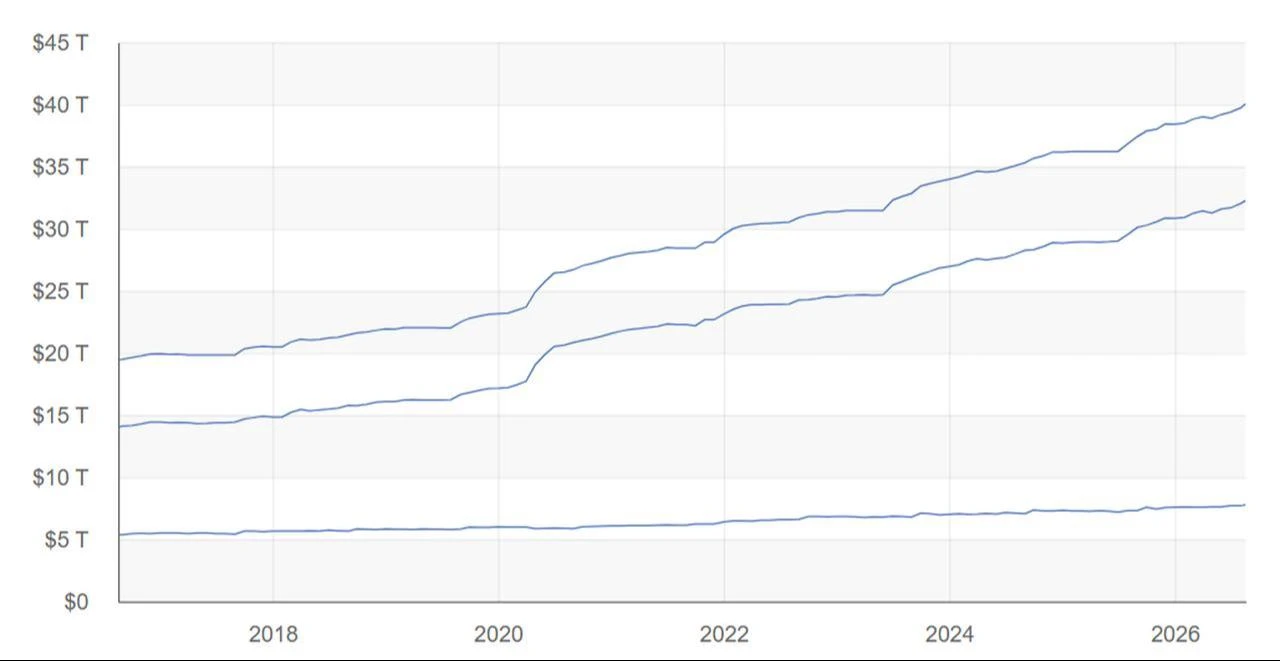
Total public debt outstanding settled at $40.05 trillion at Tuesday's close, according to Treasury data released Wednesday, up from $39.99 trillion a day earlier. That total breaks down into $32.27 trillion held by the public and $7.78 trillion in intragovernmental holdings.
When President Donald Trump first took office in January 2017, the federal debt stood at roughly $19.95 trillion. By the end of his first term, it had climbed to $27.75 trillion. It kept rolling higher through former President Joe Biden's four-year stint, hitting about $36.22 trillion.
Since Trump returned to the White House, the figure has jumped another $3.8 trillion. Across Trump's two terms, debt grew by approximately $11.6 trillion; during Biden's tenure, it grew by $8.5 trillion.
The latest reading overshoots earlier Congressional Budget Office projections, which had estimated total borrowing would hit $39.4 trillion by the end of fiscal year 2026.
Chronic deficits, pandemic borrowing, tax cuts, social spending and rising interest costs have driven the debt higher. The deficit hit $1.78 trillion in fiscal 2025, with $1.85 trillion projected for 2026. Interest payments alone cost $970 billion last year, 19 cents of every revenue dollar.
Meanwhile, the entitlement tab keeps growing: Social Security outlays are projected to climb from $1.6 trillion to $2.75 trillion by 2036, and Medicare from $1.2 trillion to $2.4 trillion. Together with interest, those three will consume nearly all federal revenue within a decade.

The debt report arrived at a sensitive juncture for financial markets. Yields on long-term Treasury bonds surged Tuesday to their highest level since 2007, driven by inflationary pressures stemming from Middle East tensions and mounting unease over U.S. deficit spending.
The elevated rates compel the government to refinance its outstanding debt at costs not seen since before the 2008 financial crisis.
The Treasury Department intervened early Wednesday to stabilize the long-term bond market, announcing it would double its buyback operations for 10- to 30-year securities to a minimum of $4 billion per transaction.
The increase from the previously scheduled $2 billion applies to both the 10- to 20-year and 20- to 30-year sectors and takes effect from Sept. 9 through Nov. 4.
The action followed a scheduled $2 billion buyback of 20- and 30-year bonds on Tuesday that failed to arrest the upward trajectory of yields. The 30-year yield reached a 19-year high of 5.34% that day before retreating.
Following the Treasury's announcement, it declined further, last trading at 5.184%.


 Set as preferred source
 Set as preferred source


 1 min read

 1 min read