Newsletters


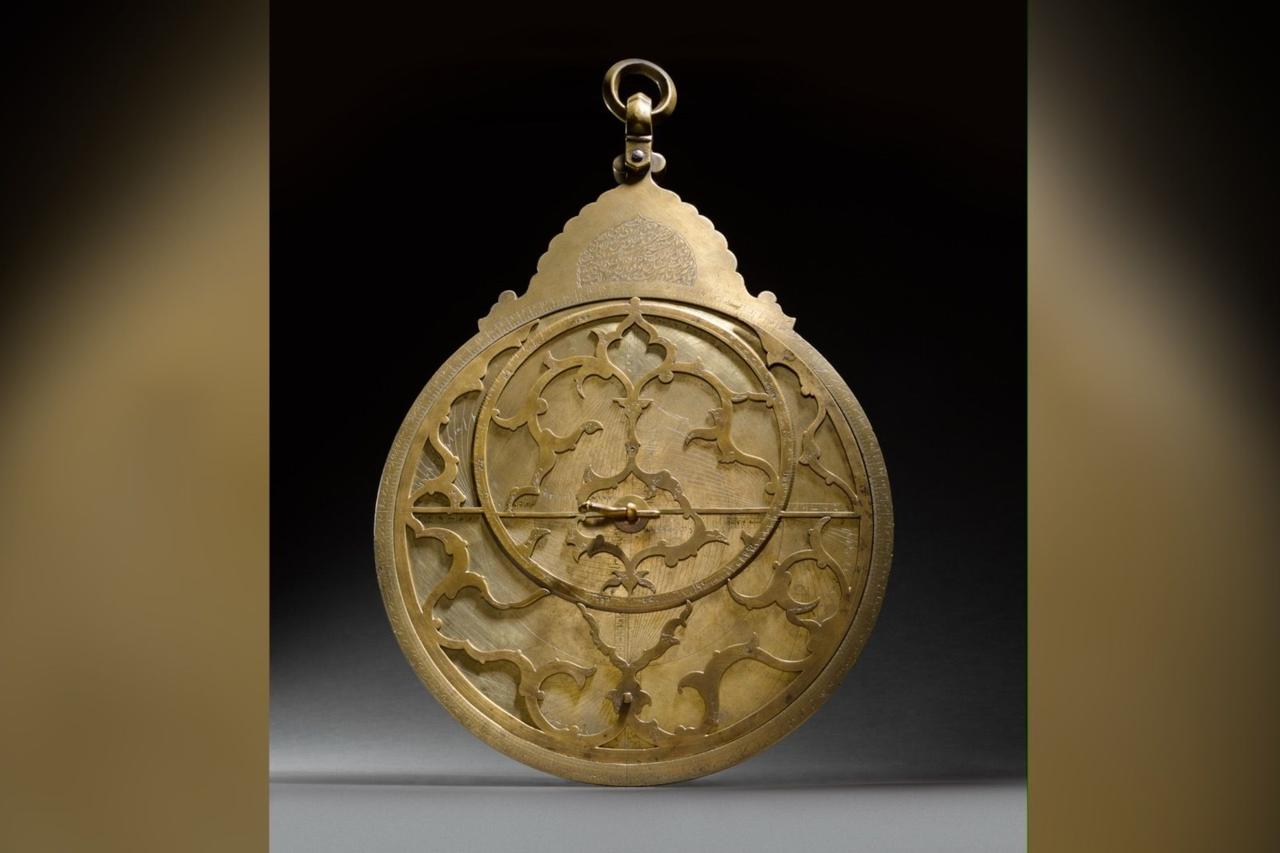


A rare 17th-century astrolabe once held in the royal collection of Jaipur is set to go under the hammer at Sotheby’s in London on April 29, with estimates suggesting it could fetch up to £2.5 million ($3.3 million), according to information provided by the auction house.
The intricately crafted brass instrument previously belonged to Sawai Man Singh II, the maharaja of Jaipur in western India. After his death, it passed to his wife, Gayatri Devi, who was widely regarded as one of the most elegant women of her time.
The piece was later transferred into a private collection during her lifetime, linking it to both royal heritage and modern collecting history.
An astrolabe is a sophisticated scientific instrument made up of layered metal disks that allow users to measure time, map the stars, and track celestial movements. Historically, it was also used to determine the direction of Mecca for prayer, calculate distances or heights, and even assist in horoscope-making when paired with an almanac.
First developed by ancient Greek astronomers around the second century BCE, the device later spread into the Islamic world by the eighth century, where it underwent significant refinement. Over time, major centers of production emerged across regions such as Iraq, Iran, North Africa, and al-Andalus in present-day Spain.
Federica Gigante described the instrument to the BBC as a two-dimensional projection of a three-dimensional universe, noting that it could perform a wide range of functions comparable to modern tools. “They are essentially a two-dimensional projection of a three-dimensional universe.
I compare them to modern-day smartphones because you can do so many things with them,” she said, adding that the device could calculate sunrise and sunset, measure structures, and even be used to predict the future.
The astrolabe was produced in the early 17th century in Lahore, now in present-day Pakistan, which was then a major production center within the Mughal Empire.
It was crafted by brothers Qa'im Muhammad and Muhammad Muqim and commissioned by Mughal official Aqa Afzal, who served under emperors Jahangir and Shah Jahan.
According to Benedict Carter, head of the Islamic and Indian Art department at Sotheby’s, the instrument stands out for its unusual size and precision.
Weighing more than 8 kilograms (17.6 pounds) and measuring nearly 30 centimeters in diameter, it is significantly larger than most astrolabes from the same period. The piece also features inscriptions listing 94 cities with their geographic coordinates, alongside detailed star pointers and decorative patterns.
Its inscriptions in both Persian and Sanskrit point to cross-cultural influences within the Mughal court, while its finely calibrated components enable highly accurate astronomical measurements. Gigante emphasized its precision, stating, “It is not only big, beautiful and heavy, it is also so incredibly accurate that it will give you the exact degree of altitude (of a celestial body).”
Sotheby’s has valued the astrolabe at between £1.5 million and £2.5 million, underlining its rarity, craftsmanship, and historical significance. Ahead of the sale, the instrument is being exhibited in London from April 24, allowing potential buyers and the public to view the piece before it goes up for auction.


 Set as preferred source
 Set as preferred source


 3 min read