Newsletters


Nearly 2,000 years after they were carved beneath Alexandria, the Catacombs of Kom El Shoqafa continue to offer visitors a rare look at how ancient Egyptian and Roman traditions came together in burial architecture, decoration and beliefs about the afterlife.
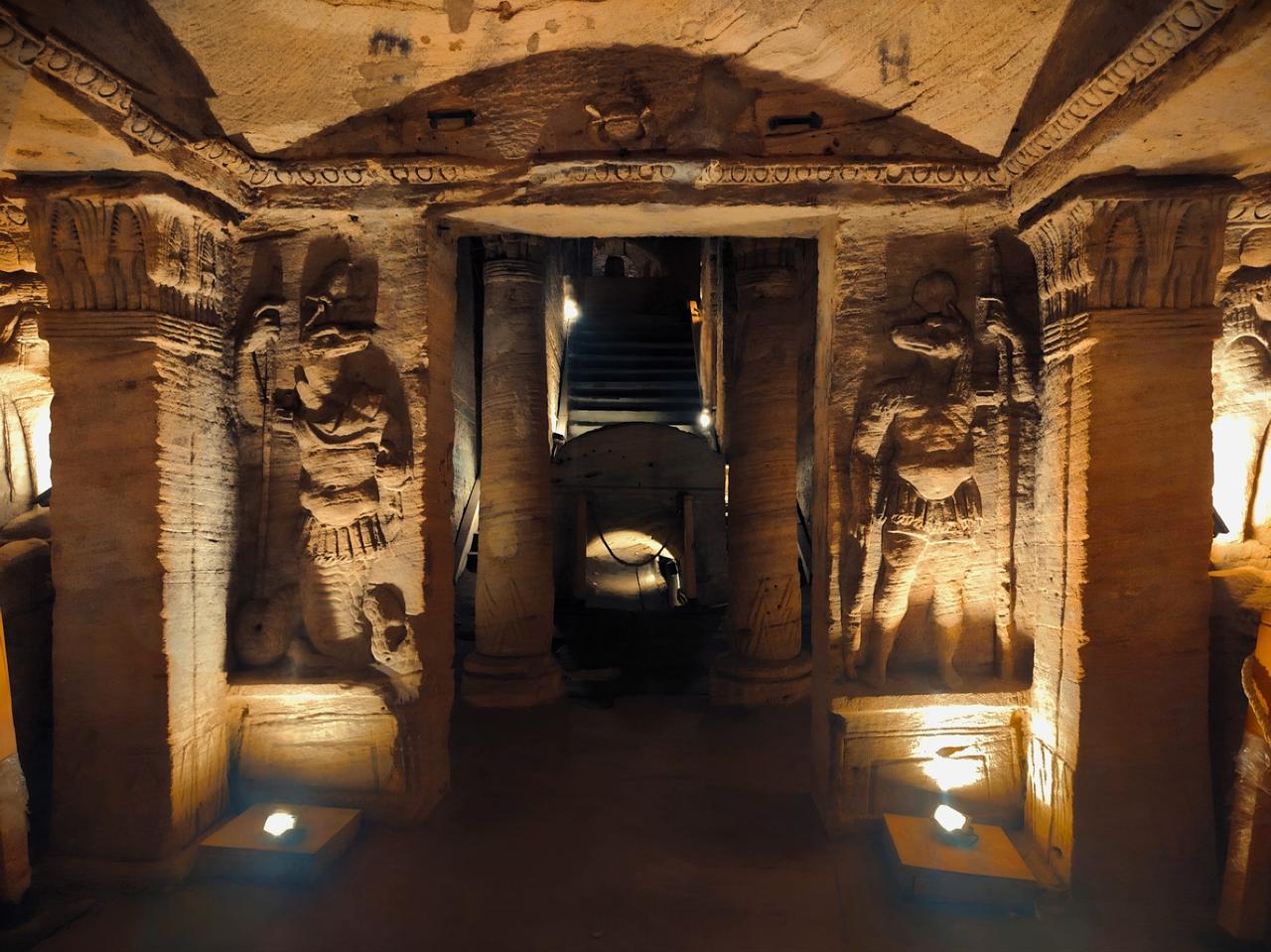
Dating back to the second century A.D., the underground complex extends more than 10 meters, or about 33 feet, below ground and consists of three rock-cut levels connected by a spiral staircase.
Its burial chambers, corridors, reception halls and decorated walls combine elements associated with both Egyptian and Roman civilizations, making the site one of Alexandria's most distinctive surviving ancient monuments.
According to information from Egyptian antiquities authorities, the complex was originally built as a private tomb for a wealthy Roman family living in ancient Alexandria.
As burial space became more limited, however, the site was gradually opened up to wider use, particularly during the third and fourth centuries, and remained in use until the end of the fourth century.
Egyptian archaeologist Magdi Shaker described Kom El Shoqafa as one of Alexandria's most important and well-preserved historic structures, pointing to its spiral staircases, visitor halls and spaces used for funerary banquets.
He said the reliefs and decorations found throughout the complex reflect Egyptian and Roman ideas surrounding death and immortality.

The name Kom El Shoqafa means "mound of broken pottery," referring to the large amount of pottery fragments that built up around the site.
Shaker said people visiting the tombs during the Roman period would leave behind the earthenware vessels they had used during burial ceremonies, with the discarded pieces eventually giving the area its name.
He also argued that the site could draw even greater international attention through modern presentation methods, suggesting interactive three-dimensional lighting, sound, music and artificial intelligence technologies to tell the story of its discovery and history.
After remaining hidden underground for centuries, the catacombs were accidentally discovered in 1900.
The site's lower levels later faced a long-running groundwater problem, which threatened parts of the structure and limited access.
Egyptian authorities completed a groundwater reduction project in March 2019 at a reported cost of $5.7 million. The work allowed the lowest level of the complex to open to visitors for the first time since its discovery 119 years earlier.
The project had been launched after a roughly two-centimeter section of a tomb wall broke away in May 2016 because of groundwater, according to then-Antiquities Minister Khaled El-Anany.
Following the work, authorities said the lower level could be seen in dry conditions for the first time since the catacombs were uncovered.


 Set as preferred source
 Set as preferred source


 2 min read