Newsletters


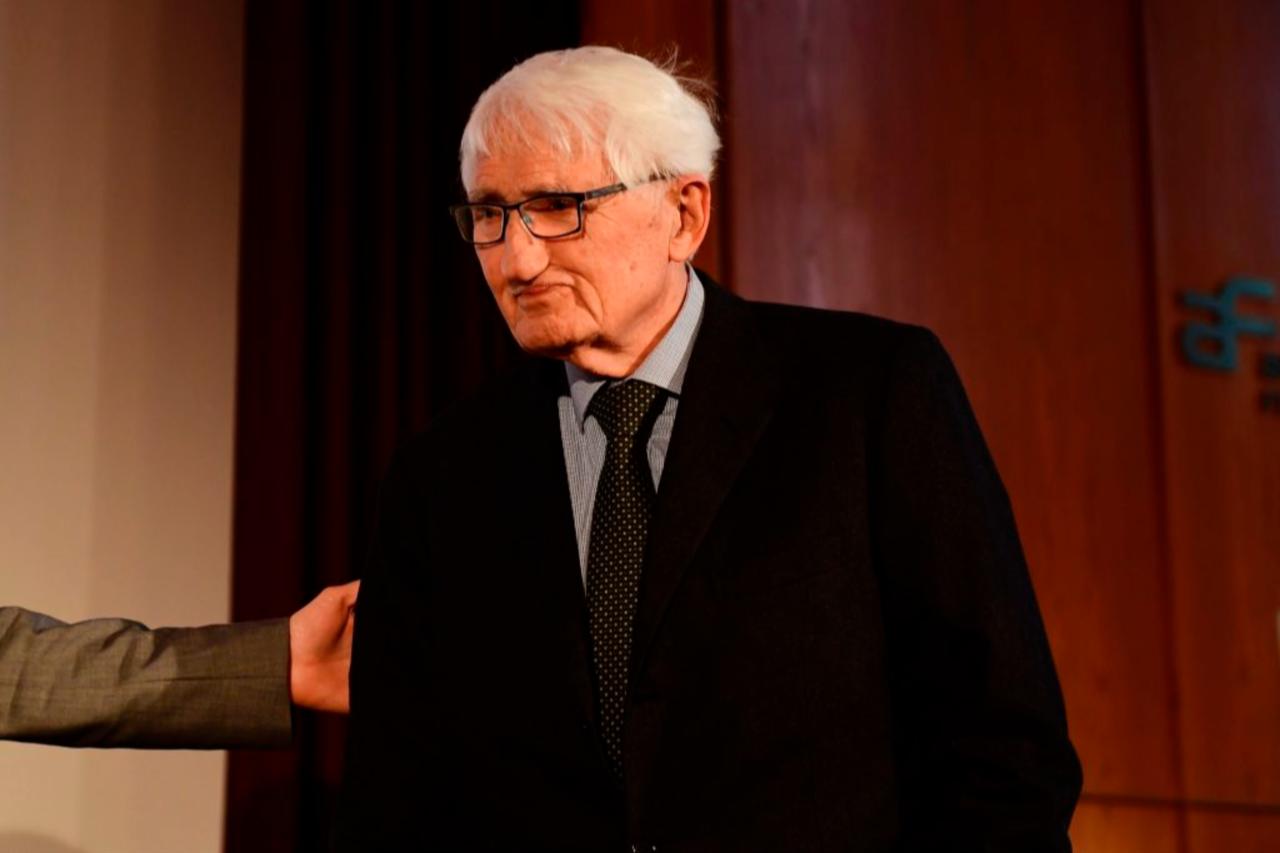


Jurgen Habermas, the German philosopher whose work on communication, rationality and sociology made him one of the most influential intellectual figures of the modern era, has died at the age of 96.
His publisher, Suhrkamp, said Habermas died Saturday in Starnberg, near Munich.
Habermas was widely known for his extensive writing on modern society and social interaction, often crossing the boundaries of academic and philosophical disciplines.
Among his most prominent works was the two-volume Theory of Communicative Action, which explored the role of communication and rational debate in shaping democratic societies.
Over several decades, Habermas frequently commented on political issues and public life in Germany and Europe.
German Chancellor Friedrich Merz said Germany and Europe had lost one of the most significant thinkers of the era.
“Germany and Europe have lost one of the most significant thinkers of our time,” Merz said, praising Habermas’ intellectual influence and saying his work impacted generations of researchers and thinkers.
Habermas was 15 when Nazi Germany collapsed in 1945 and later described that moment as shaping his path toward philosophy and social theory.
He said realizing the crimes of the Nazi regime marked the beginning of a new era and deeply influenced his intellectual development.
During the late 1960s, Habermas had an ambivalent relationship with the left-wing student movement in Germany and elsewhere.
He engaged with the movement but warned about the danger of what he called “left-wing fascism,” a reaction to a speech by a student leader that he later said had been “slightly out of place.”
Later, he acknowledged that the student movement helped drive what he described as a “fundamental liberalization” of German society.
In the 1980s, Habermas became a prominent figure in the so-called Historians’ Dispute, a debate among German scholars about how to interpret the legacy of the Third Reich.
Some historians sought to compare the crimes of Nazi Germany under Adolf Hitler with atrocities committed by other regimes, including the Soviet Union under Joseph Stalin.
Habermas and others opposed those comparisons, arguing they risked minimizing the scale of Nazi crimes.
Habermas continued to influence political debate in Germany for decades.
He supported the election of center-left Chancellor Gerhard Schroder in 1998.
At the same time, he criticized the approach of Schroder’s conservative successor Angela Merkel, describing her policies in 2016 as a “technocratic” approach that he said had a paralyzing effect on public debate.
He also criticized what he described as a limited interest among German politicians, business leaders and media in shaping a politically effective Europe.
In 2017, Habermas praised French President Emmanuel Macron for presenting proposals for European reform, saying Macron’s way of speaking about Europe made a difference.
Habermas was born on June 18, 1929, in Duesseldorf and grew up in nearby Gummersbach, where his father headed the local chamber of commerce.
At age 10 he joined the Deutsches Jungvolk, a section of the Hitler Youth for younger boys.
He was born with a cleft palate that required multiple surgeries during childhood, an experience that later influenced his thinking about language and communication.
Habermas said spoken language represented “a layer of commonality without which we as individuals cannot exist,” while also noting what he described as the “superiority of the written word.”
His wife, Ute Habermas-Wesselhoeft, died last year.
The couple had three children: Tilmann, Judith and Rebekka, who died in 2023.


 Set as preferred source
 Set as preferred source


 1 min read
 1 min read