Newsletters


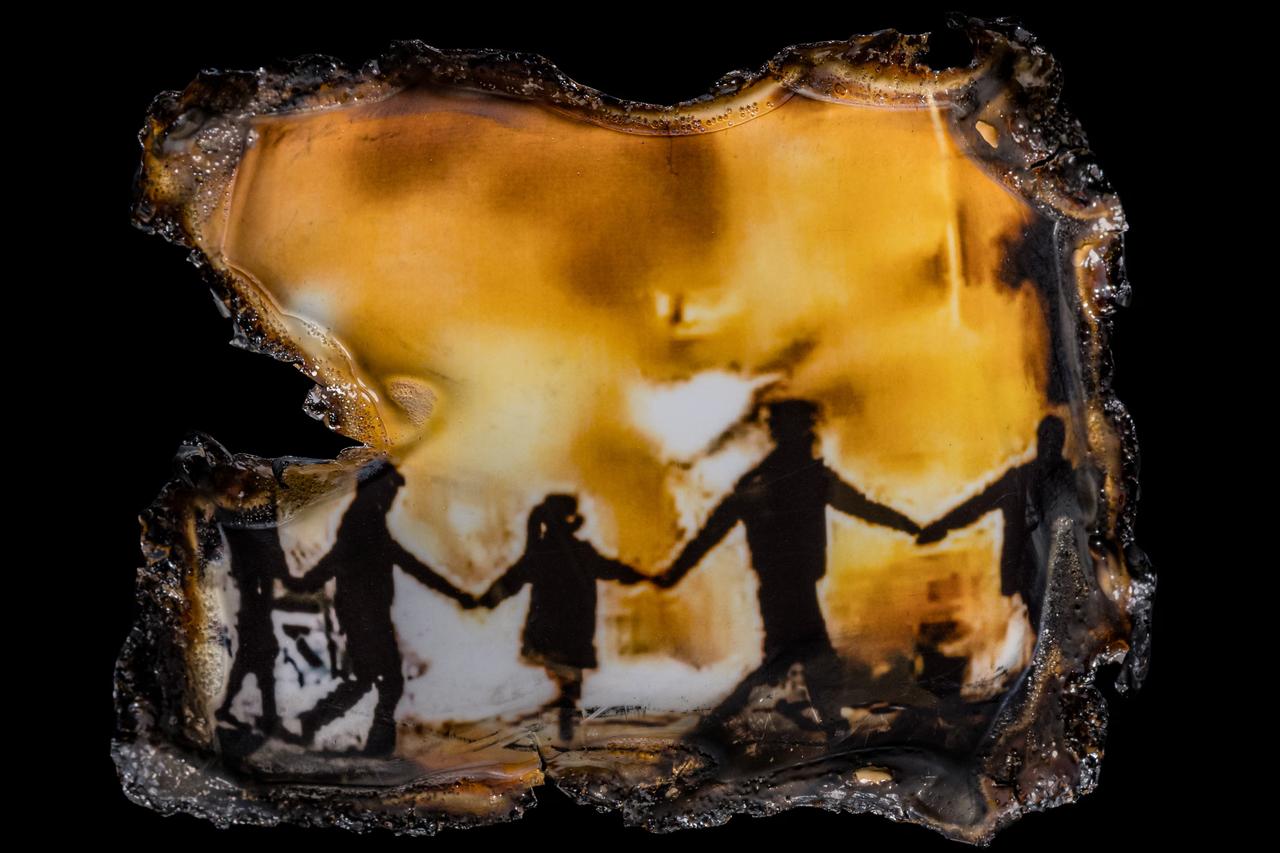


Iranian Canadian visual journalist and artist Parisa Azadi has taken images from Iran’s protest movement and set them on fire.
She did not burn them to erase what they showed. She burned them to make grief visible, mark the violence carried by the images, and turn them into objects of mourning, anger, and refusal.
The work draws on footage from the “Woman, Life, Freedom” uprising, which began in Iran in September 2022 after the death of Mahsa Amini in police custody. The movement became one of the most powerful challenges to the Islamic Republic’s control over women’s bodies, public space, and everyday life.
Parisa Azadi, who had spent six years documenting life under repression in Iran, said she witnessed the uprising from Dubai through videos circulating on phone screens.
In a piece published by The Guardian as part of its “Women behind the lens” series, she described seeing raw footage of women burning hijabs, young men injured by metal pellets, and teenagers dragged into unmarked vans before internet blackouts disrupted the flow of images.
Unable to safely return to Iran, Azadi said the project emerged from “pain” and became “both testimony and absence,” capturing the public violence of the state as well as the private experience of bearing witness from afar.
Parisa Azadi began working with open-source protest footage by isolating frames from videos shared on social media and photographing them directly from her computer screen using a Fujifilm Instax camera, which produces immediate physical prints.
She said the method allowed her to interrupt the speed and disappearance of digital images, turning temporary pixels into tangible objects.
“I wanted to interrupt the relentless flow of digital images—to arrest their movement, turning ephemeral pixels into solid physical objects,” Azadi wrote in The Guardian.
The practice is also connected to her earlier documentary work in Iran, where she carried an Instax camera and gave portraits to strangers as “yadegari,” meaning “something to remember me by.”
Those small prints functioned as personal keepsakes, but during the uprising, the same format took on a more urgent political meaning.
Azadi said the medium became a response to rebellion and censorship, shaped by both intimacy and risk.
One of the images in the series comes from a protest video in Tehran, where crowds circle a fire in the street while holding hands and chanting: “You’re the pervert. You’re the w***e. I’m a free woman.”
The chant reverses misogynistic language and turns it into a declaration of defiance against the state. For Azadi, the body becomes the central site of conflict under repression, refusing what she described as a return to the old way of life.
In January 2026, after what she described as state massacres and executions, Azadi began burning the Instax prints as an act of mourning.
The gesture gave the work its most forceful visual language. Fire damaged the surfaces of the images, echoing the violence shown in the footage itself, but Azadi said the act was not intended to erase the photographs.
“This was not erasure, but a way to push against the stillness of the image, allowing it to convey and to carry rage, grief, and refusal,” she explained.
The work departs from Azadi’s more carefully composed documentary style. Instead, she embraces grainy, unstable, and low-resolution imagery, linking it to German artist Hito Steyerl’s idea of the “poor image” as a politically charged form of testimony.
In one frame, Azadi photographed the silhouette of a young woman, possibly an adolescent, with a high ponytail moving through smoke and fluorescent light.
The image does not seek visual perfection. Its force lies in its instability, its trace of danger, and its insistence that fragile images can still carry historical weight.


 Set as preferred source
 Set as preferred source


 3 min read