Newsletters





The Turkish Statistical Institute (TUIK) released its "Statistics on Youth 2025" report on May 19.
Drawing on census results, household surveys and administrative records, the report presents a comprehensive statistical portrait of Türkiye's 15-to-24-year-old population, covering employment, education, migration, marriage, well-being, and digital habits.
Türkiye's total population reached 86,092,168 by the end of 2025. Within that figure, the 15-to-24 age group numbered 12,708,348, accounting for 14.8% of the total.
Males make up 51.2% of the youth population, while females make up 48.8%.
The youth share has fallen sharply over the decades. In 1950, young people accounted for 20.8% of the population; by 2025, that figure had dropped to 14.8%.
TUİK projections indicate the decline will continue: under the baseline scenario, the youth share is expected to hold at 14.8% in 2030, then fall to 12.2% in 2040, 10.3% in 2060, and 8.8% in 2080.
Türkiye's youth share remains above the European Union average of 10.7%, though it falls below the global average of 15.6%.
Among EU member states, Ireland recorded the highest youth share at 12.7%, while Malta posted the lowest at 9.4%.
Within Türkiye, the southeastern province of Sirnak had the highest youth share at 20.4%, followed by Hakkari at 20.0% and Siirt at 19.8%. Balikesir had the lowest at 11.7%.


The report's most prominent finding concerns the NEET rate, which is the share of young people who are neither in employment, education, nor training.
That figure rose from 22.9% in 2024 to 23.3% in 2025, meaning roughly one in four young people in Türkiye falls into this category.
The gender gap is pronounced.
Among young men, the NEET rate edged up marginally from 16.2% to 16.3%. Among young women, it climbed from 30.1% to 30.9%, which is nearly double the rate for men.
Overall, youth labor force participation rose slightly, from 47.2% in 2024 to 47.6% in 2025. The rate among young men was 60.1%, compared with 34.3% among young women.
Youth unemployment, by contrast, improved: the rate fell from 16.3% to 15.3% year over year. Male youth unemployment fell from 13.1% to 11.7%, while young women's unemployment declined marginally from 22.3% to 22.1%.
Among those employed, the vast majority work in the services sector. In 2025, 57.9% of employed young people were in services, 30.5% in industry and 11.6% in agriculture.
The share of services was notably higher for young women at 69.5%, compared with 52.4% for young men.

The net enrollment rate in higher education stood at 46.3% for the 2024–2025 academic year. The figure shows a significant gender gap in favor of women: female enrollment reached 53.0%, while male enrollment stood at 39.9%.
Internal migration data for 2024 shows that the 15-to-24 age group was the most mobile segment of the population.
Education was the leading driver of relocation, accounting for 448,826 young migrants. Job-seeking came second at 102,660, followed by family-related moves at 79,831.
Data on marital status exposes a significant disparity between young men and women. Among young men, 96.8% had never married, 3.1% were married and 0.1% were divorced.
Among young women, the married share was 10.7%, which is 3.5 times higher than the rate for young men, while 88.9% had never married and 0.4% were divorced.
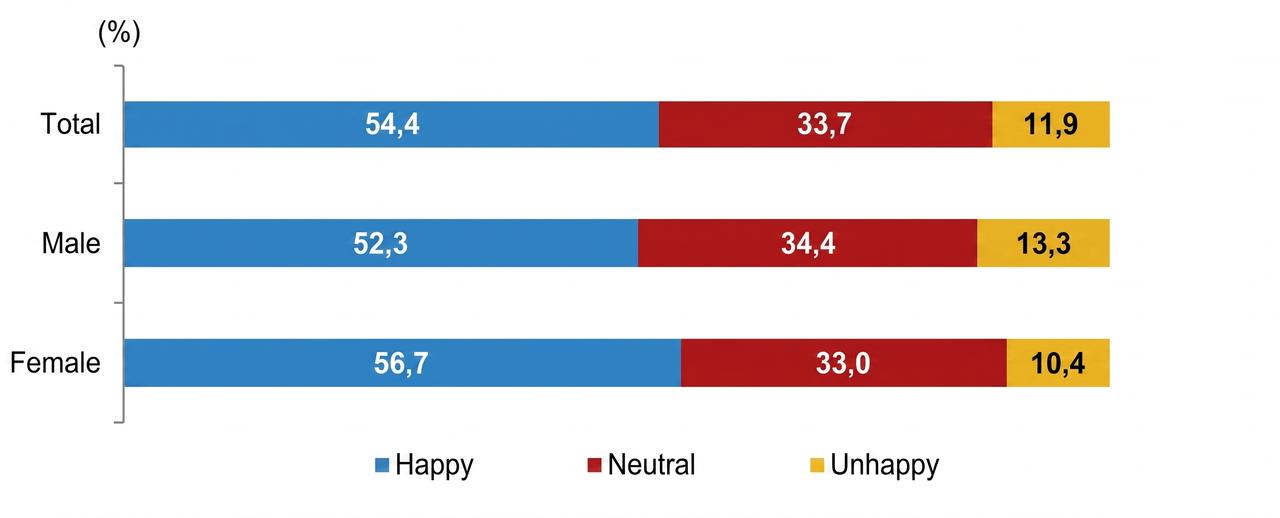
Türkiye's Life Satisfaction Survey found that 54.4% of people aged 18 to 24 reported being happy in 2025, slightly above the overall adult rate of 53.3%.
Young women reported higher levels of happiness (56.7%) than young men (52.3%). Health was cited as the primary source of happiness by 38.8% of respondents in that age group, followed by achievement at 22.8% and money at 16.6%.
Satisfaction levels were high across several domains. 87.2% of young people said they were satisfied with their general health, 75.5% with their job, and 73.0% with their education to date.
A separate survey on violence against women found that young women aged 15 to 24 were the group most frequently exposed to violence in the past 12 months.
Psychological violence was the most common form at 15.2%, followed by digital violence at 7.3% and stalking at 5.8%.
TUİK's artificial intelligence statistics show that 39.4% of internet users aged 16 to 24 reported using generative AI in 2025.
Young women recorded a slightly higher usage rate at 40.5%, compared with 38.3% for young men. Among those who use AI, 75.3% said they use it for personal purposes, 53.9% for formal education and 19.7% for professional or work-related tasks. Among non-users, 80.7% said they simply did not need it.


 Set as preferred source
 Set as preferred source



 2 min read