Newsletters


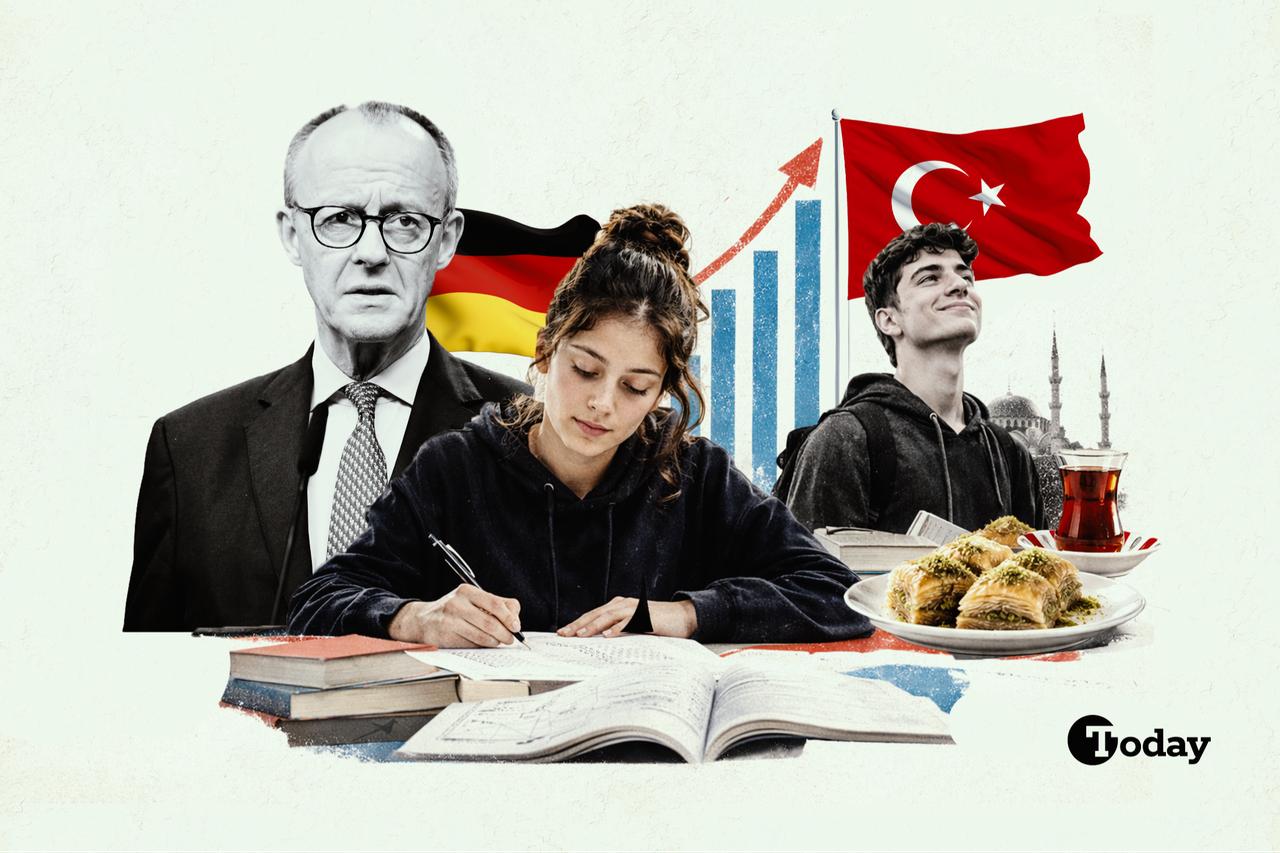


German authorities reportedly convened an emergency meeting this week after Programme for International Student Assessment (PISA) results revealed Turkish high schoolers are close to catching up with their German counterparts and might pose some tough competition in the future.
As the news made the rounds on social media, Germans descended into a collective, heavily punctuated panic attack.
“If they can calculate the hypotenuse faster than us, what is left of the German spirit? Just bureaucracy and Deutsche Bahn?” tweeted @HanselandGretel, a mechanical engineer who was just laid off by Volkswagen due to cost-cutting measures.
"I just don't understand; my Turkish-German neighbors do not look that good. What is wrong with the Turks in Türkiye?" he continued.
Another demanded immediate government funding to subsidize "strategic bratwurst consumption" to stimulate adolescent brain cells, warning that “at this rate, our children will be asking Turkish teenagers for help with their calculus homework by 2028.”
Anxious Germans found plenty of allies at home, as well as domestic critics who've spent years puncturing the myth of German educational superiority.
Inside Türkiye, the unprecedented leap in PISA scores sparked a different kind of frenzy.
Instead of popping champagne over Türkiye's best-ever PISA results, some from the opposition and influencers convened briefings to announce what everyone already suspected. The numbers had to be fake. Dark arts were implied. Trickery was assumed.
“We have absolutely no proof, which is exactly why we know it’s a highly sophisticated cover-up,” said opposition spokesperson Hicbirseyle Yetinmez during a three-hour PowerPoint presentation.
According to the entirely evidence-free theory, the Turkish state secretly replaced the nation's curriculum with a covert subliminal messaging program hidden inside the protective plastic covers of standardized test booklets.
A secondary, slightly more popular theory suggests the Ministry of Education has been engaged in "baklava doping"—systematically giving bright Turkish citizens three baklavas a day for two months straight before the exams.
“Look at these kids. They are answering algebraic word problems without even sweating,” warned one prominent pundit on a morning opposition talk show, frantically tapping a pen against his desk.
“A normal Turkish teenager should be deeply distracted by TikTok, football referee conspiracies, and sunflower seeds. Something is wrong with these PISA results."
Meanwhile, at the Ministry of Education in Ankara, officials steadfastly denied the allegations of foul play, crediting the historic triumph to a revolutionary new pedagogical philosophy.
"We just stopped telling kids the exams mattered," said one senior curriculum director, who requested anonymity on the grounds that his mother-in-law hadn't approved the quote yet.
“Modern education is entirely too focused on pressure. Once we convinced the kids that the PISA test was just a meaningless, ungraded survey about their feelings, their stress levels plummeted. They started solving complex geometric equations out of sheer, unadulterated boredom.”
Back in Europe, Chancellor Merz’s cabinet has reportedly convened a crisis committee to investigate whether German students can be taught to adopt a more "Mediterranean" approach to trigonometry.
Until a solution is found, German border officers have been instructed to remain on high alert for any Turkish exchange students attempting to smuggle unauthorizedly high test scores into the European Union.


 Set as preferred source
 Set as preferred source


 3 min read