Newsletters


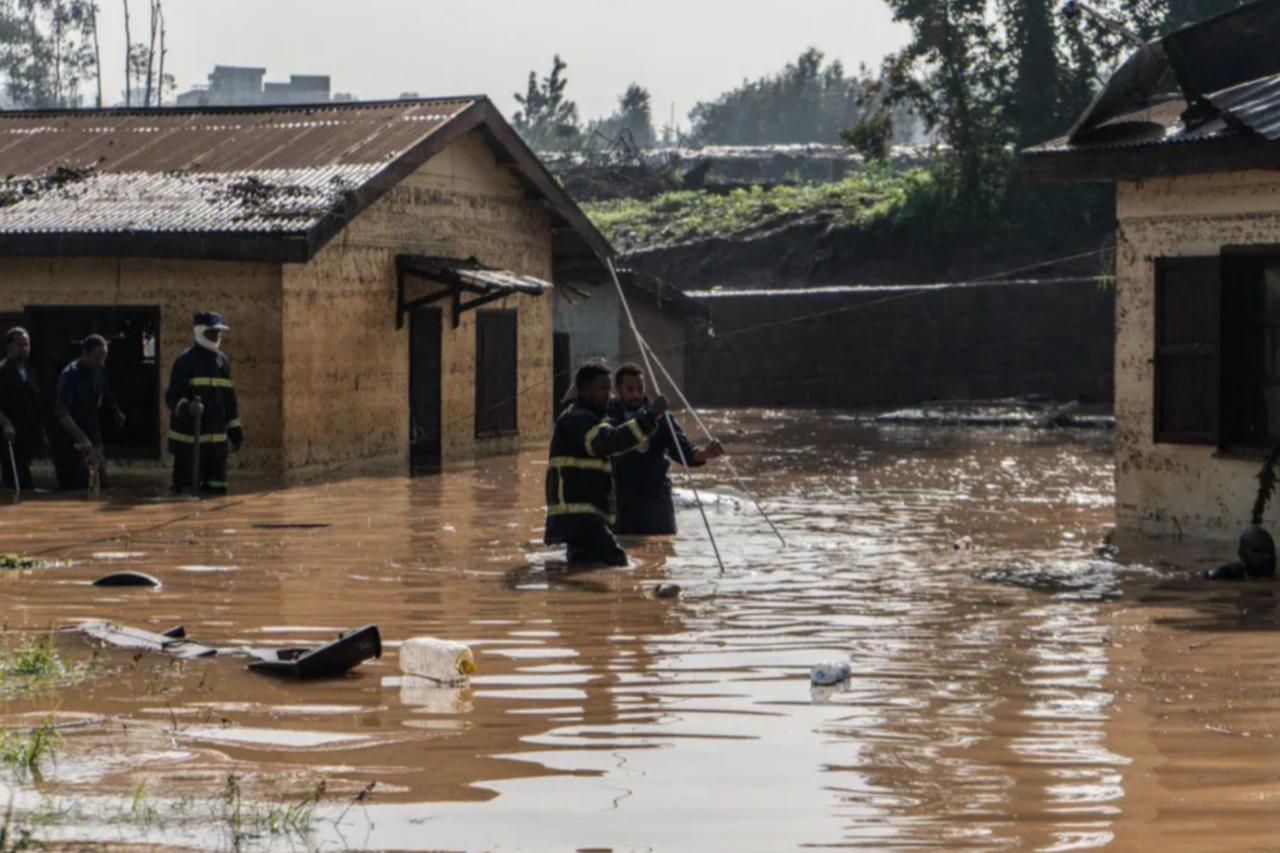


In Ethiopia, a research team has produced evidence showing that the ground rises and falls elastically as surface loads change, most notably with shifts in the mass of water generated by seasonal monsoon rains.
The discussion concerns a subtle motion that does not exceed a few millimeters, yet it carries significant scientific implications in a country that sits atop one of the world’s most tectonically active regions, the Great African Rift.
The study, led by Assistant Professor Abdisa Kawo Koji and his team at the College of Natural and Computational Sciences at Mada Walabu University in Ethiopia and published in the Journal of African Earth Sciences, offers a model of how modern techniques can distinguish between “natural signals” and the “human footprint” in crustal motion, particularly in the context of major large-scale projects such as the Grand Ethiopian Renaissance Dam.
Kawo Koji explains the phenomenon through a simple analogy, saying in remarks to Al Jazeera, “If we imagine the Earth’s crust as a sponge mattress, and seasonal water as a person sitting down on it or getting up, then during a season of heavy rainfall rivers, lakes, soils, and groundwater fill up, increasing the mass of water above the crust and causing it to sink slightly (ground subsidence).
After the rainy season ends, water begins to seep away, evaporate, or flow off, reducing the weight on the crust, which then rebounds upward again (elastic uplift).”
Scientifically, this process is known as elastic surface loading. The Earth’s lithosphere behaves like a flexible plate over a mantle that is more viscous and ductile, and any change in surface mass, especially the mass of water, leaves a mechanical imprint that can be detected.
The changes become most apparent during Ethiopia’s rainy seasons, especially Kiremt (June to September) and Belg (February to May).
In these two seasons, rainfall drives major seasonal increases in water storage: reservoirs and lakes fill, river discharge rises, soil moisture accumulates, and groundwater is recharged. The result is an added load that produces a downward vertical displacement, limited in magnitude but measurable.
The researchers relied on a joint analysis of data from the Global Positioning System (GPS) and the GRACE satellites. GPS measures crustal motion directly and responds rapidly, almost in real time, after rainfall because the added water load affects the surface immediately.
GRACE, by contrast, does not measure crustal movement itself. It detects large-scale changes in gravity caused by increases or decreases in water mass, and its signal typically appears with a delay after the rainy season ends (such as in October and November), since part of the rainfall needs time to infiltrate the soil, recharge groundwater reservoirs, and accumulate in basins.
By integrating the two signals, the team was able to link the “motion” recorded by GPS to the “water mass” confirmed by GRACE, strengthening the explanatory power of the findings.
The team also proposes a systematic way to disentangle the effects of seasonal rainfall from those of human activities, such as dams or groundwater pumping.
According to Kawo Koji, the process begins by establishing the crust’s natural movement pattern before any human intervention. Rainfall records and satellite observations, most notably GRACE, are used to build a “baseline” that reflects the expected natural response to rainfall alone.
Those expectations are compared against real measurements from GPS stations. Any unusual change, such as a sudden drop or a rise beyond the norm, may indicate human influence.
The approach is not limited to monitoring. It also includes hydrological modeling that simulates how water moves through soils and rivers based on climate alone. If real-world measurements diverge from what the models predict, that divergence strengthens the case for a human-driven effect.
It also includes spatial fingerprinting. Rain tends to produce broad, geographically distributed deformation, whereas human impacts are often more localized and concentrated, such as around a major dam site.
In the final step, the expected contribution of human activities is estimated and subtracted from the GPS record, leaving the signal linked to natural rainfall.
A few millimeters may sound small, but they matter greatly for Earth scientists, hydrologists, and risk managers.
The ability to distinguish crustal motion driven by rainfall from motion driven by human intervention can sharpen understanding of tectonic behavior in a sensitive region, improve interpretation of how water changes reshape the ground, and provide scientific tools to strengthen water-resource management and assess geological hazards.
Ultimately, the Ethiopian case offers a striking lesson: the Earth is not as rigid as we imagine. It is elastic, responsive to what rests upon it, and shaped by the seasons. Nowadays, science can hear that breath, analyze it, and even tell apart what nature does from what humans add.


 Set as preferred source
 Set as preferred source


 3 min read