Newsletters


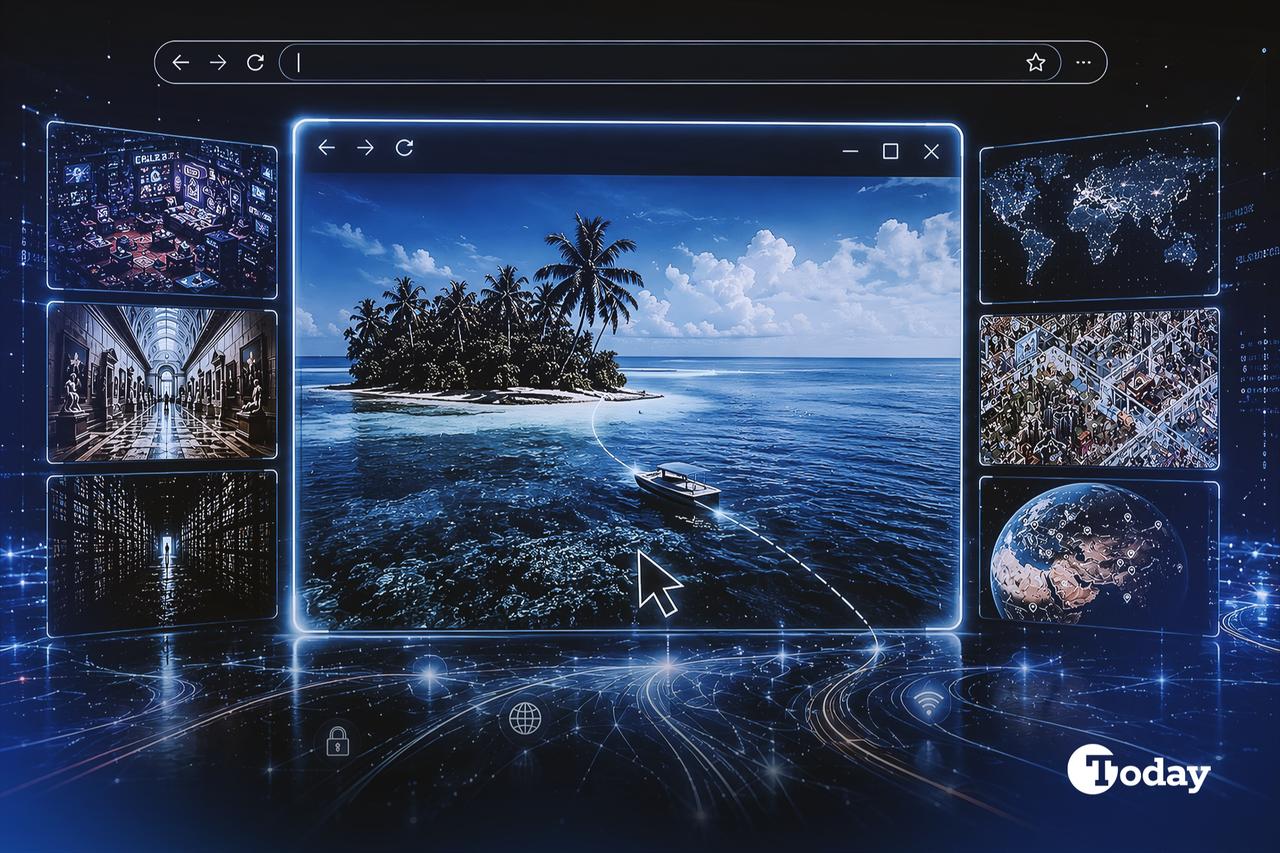


The original Seven Wonders of the Ancient World were, at their core, a travel guide.
Greek scholars, newly connected to Egypt, Babylon, and Mesopotamia after Alexander's conquests, asked a simple question: what is worth seeing? The list that emerged was not a ranking. It was an invitation.
This is the same question, asked of a different world.
Almost none of the original wonders remain. The Colossus of Rhodes, the Hanging Gardens, and the Lighthouse of Alexandria are gone; only the pyramids survived.
In 2001, the New Seven Wonders Foundation launched a global vote to select their successors: Chichen Itza, the Colosseum, the Taj Mahal, and four others. These are marvels of human engineering—places that demonstrate what we can achieve when we commit to building something meaningful.
For the past decade, virtual reality companies have tried to recreate these sites in headsets. This approach has not succeeded, not due to technological limitations, but because the premise is flawed.
The German philosopher Walter Benjamin, writing in 1935, described this aura as the felt uniqueness and authenticity of a work of art, bound to its singular presence in time and space, which is destroyed the moment it is reproduced.
A photograph of the Taj Mahal is not the Taj Mahal. A render of Petra is not Petra. You can always remove the headset. The terror and vastness that the eighteenth-century philosopher Edmund Burke called the sublime, which makes standing at the edge of a canyon fundamentally different from viewing a picture, cannot survive the camera. The camera is always a human mediation.
This is why VR tourism continues to fail. It attempts to replicate an experience that depends on presence, using a medium that is inherently a reproduction.
Cyberspace is different. Wonders that exist only online cannot be reproduced, as they are already digital. They have no physical original to compromise. Their aura remains intact; you simply have to visit them.
So, what is worth seeing?
The original seven wonders list was not arbitrary. There was a framework, implicit but consistent. The structures had to represent an extraordinary feat of human labor, demonstrate unique architectural achievement, carry cultural significance beyond their physical presence, and be worth the journey.
The same criteria apply here. A wonder of cyberspace is not simply a useful website or a clever interface. It is a place, built by humans for humans, in a medium that did not exist a generation ago, that you should see in your lifetime.
Here are seven:
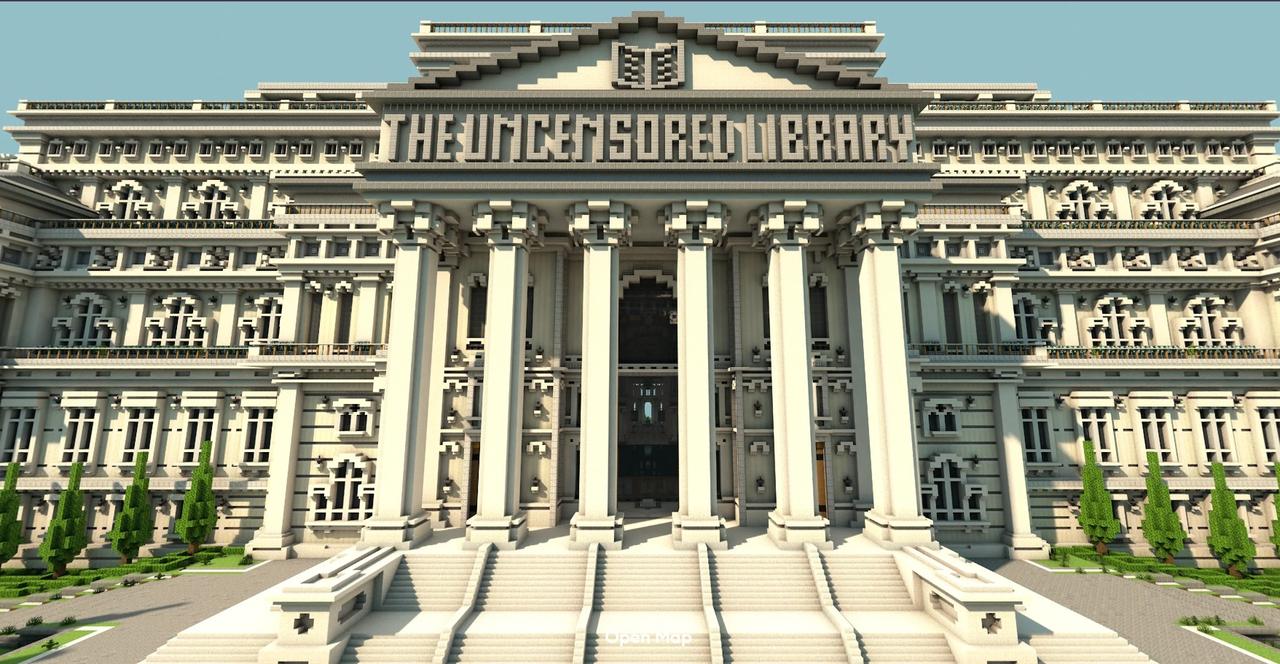
In 2020, Reporters Without Borders partnered with the Minecraft design collective Blockworks to construct a library inside a video game.
This is not a metaphorical library, but an actual neoclassical structure: 12.5 million blocks, 24 builders from 16 countries, and approximately three months of collaborative work, built within one of the most widely played games in the world.
Inside, arranged by nation, are articles from journalists who have been silenced, imprisoned, or killed for reporting the truth. These articles, blocked in their countries of origin, are available here in full, in both English and the original language, presented as books you can open and take with you.
In many of these countries, including Russia, Egypt, Mexico, Saudi Arabia, and Vietnam, the press is filtered, social media is monitored, and certain websites are inaccessible.
However, Minecraft is not restricted. The server acts as a legal loophole, a digital speakeasy within a children's sandbox game. The censors did not think to ban it.
When discussing the pyramids, we focus on the labor: who built them, how many people, over how many years, and at what cost. The Uncensored Library deserves the same recognition. It represents a collective human effort dedicated to protecting something essential: the idea that what has been written should not be erased.

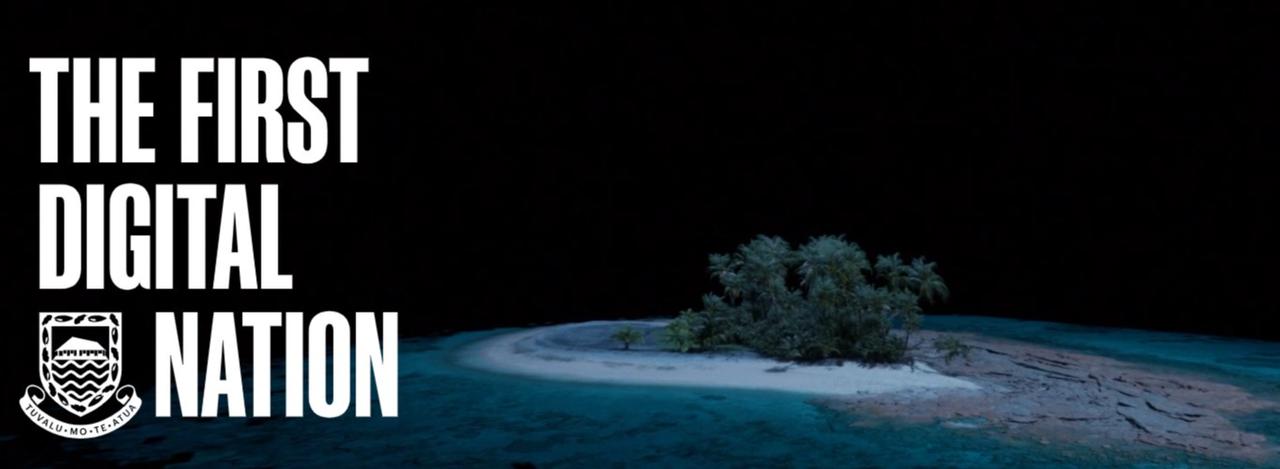
Tuvalu is a chain of low-lying Pacific atolls with approximately 11,000 citizens. In the coming decades, it is expected to be underwater. International law requires a defined territory for a nation to exist. Tuvalu may become the first country in history to lose its sovereignty not to war or occupation, but to climate change.
In response, its government is taking an unprecedented step: building a complete digital twin of the country in cyberspace.
The plan is already underway. A 3D LiDAR scan of all 124 islands has been completed, forming the foundation of a detailed digital replica. A living cultural archive is being assembled from objects and stories contributed by citizens.
Key government functions are migrating to online infrastructure. Eventually, the experience may be accessible through virtual reality, with hardware provided free to all citizens.
This is not a backup. It is a nation deciding to survive its own disappearance, asserting that sovereignty, culture, and identity can persist without land, coastline, or a physical place to stand.
Visiting tuvalu.tv feels less like browsing and more like bearing witness. It offers something no ancient wonder could: a monument still being built in real time by people with no other option.
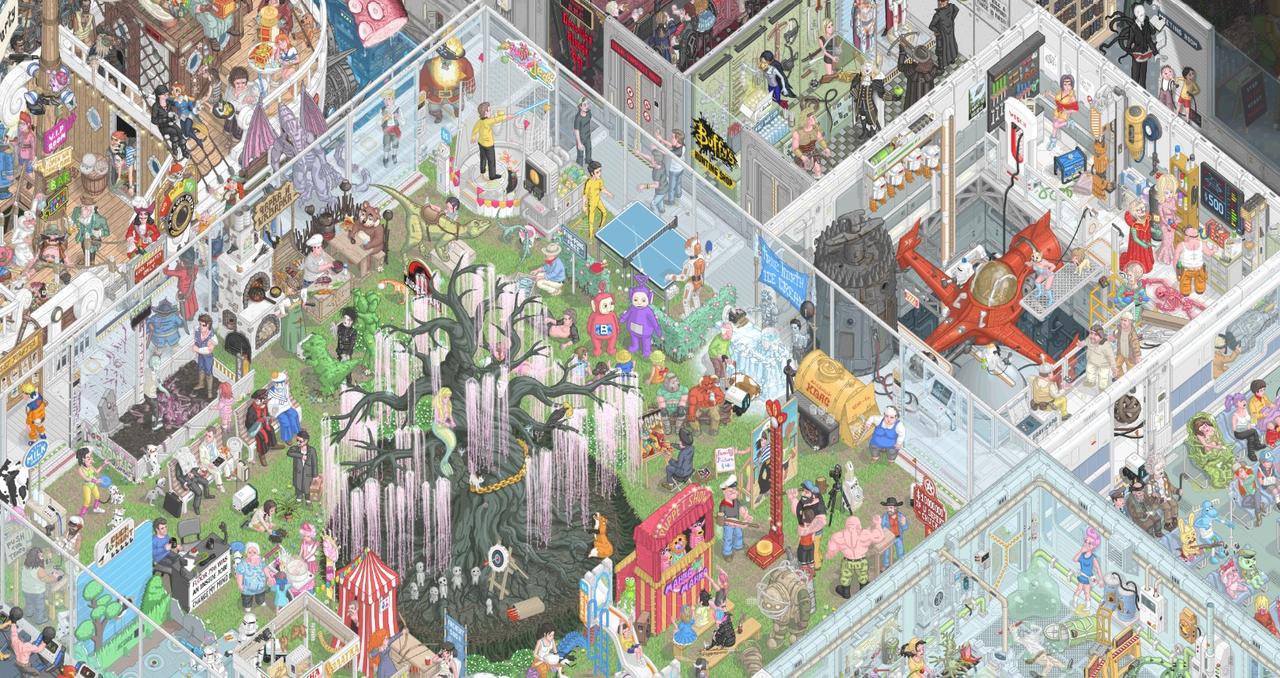
There is a space station. It goes on forever. And every few meters, something is happening.
Floor796 is a single, endlessly scrolling pixel art animation: a cross-section of an imaginary station populated by hundreds of characters, each referencing gaming, film, or the shared cultural memory of those who have spent significant time online.
It was built by a single person and is continuously updated. Zooming in reveals more detail; zooming out reveals greater scale.
By every criterion on this list, it qualifies. The labor is evident in every frame. The architecture is native to the screen; it could not exist in any other medium, nor be printed, hung, or staged. The reason to visit is clear: you could spend an hour exploring and still not see everything.
It is also the most honest portrait of internet culture I have encountered: not an analysis or critique, but a true depiction. It is chaotic, obsessive, referential, and unexpectedly moving in its quieter moments.
Familiarity has made us blind to how strange this is.
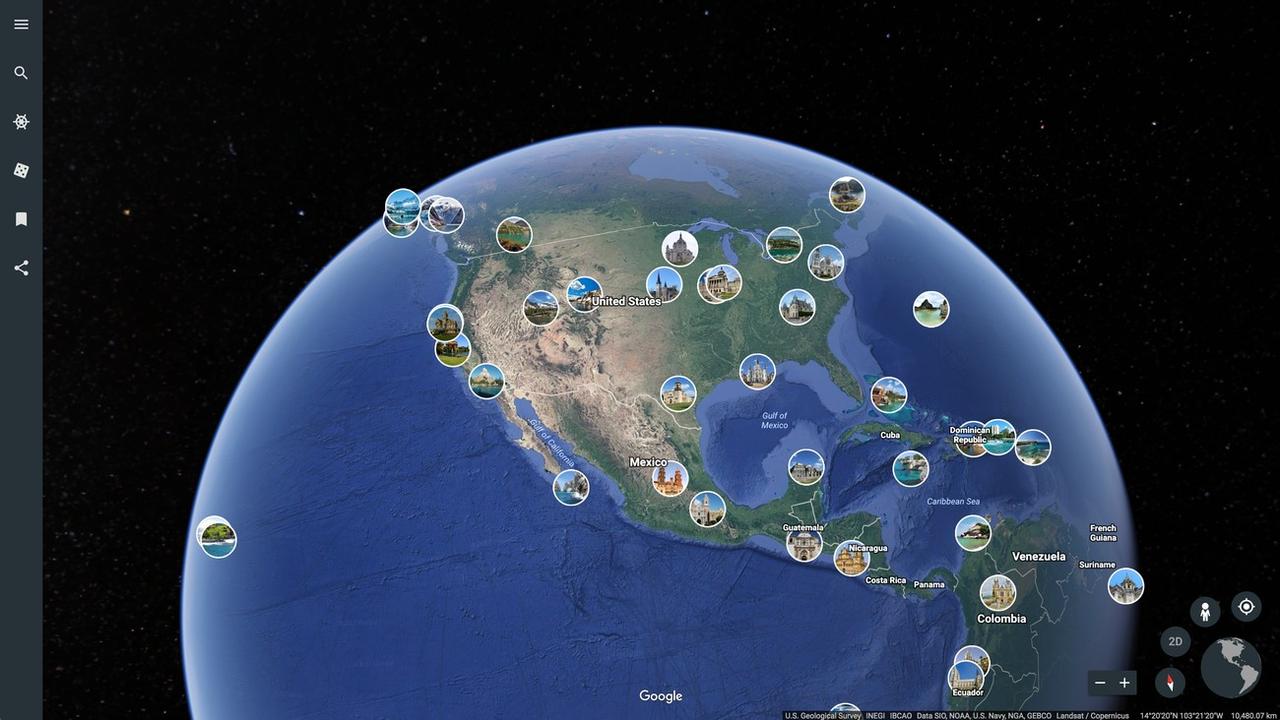
The web version of Google Earth allows you to hold the entire planet in your hands, rotate it, and zoom from orbit to a single rooftop in seconds. It includes a time machine feature that lets you watch the Aral Sea disappear over decades, observe the Amazon contract, and see Dubai emerge from the desert.
These are not projections or models, but satellite footage of real events layered over time. Discuss the aura of the art object being lost in reproduction. But Google Earth is not a reproduction of the world—it is a new way of seeing the world that has no physical equivalent.
You cannot stand somewhere and perceive 50 years of change layered simultaneously. You cannot orbit your own house. The experience does not exist outside this medium, which means the medium has produced something genuinely new.
Its familiarity is not a reason to stop calling it extraordinary. Instead, it is a reason to look again.
Some wonders are beautiful. This one is necessary.
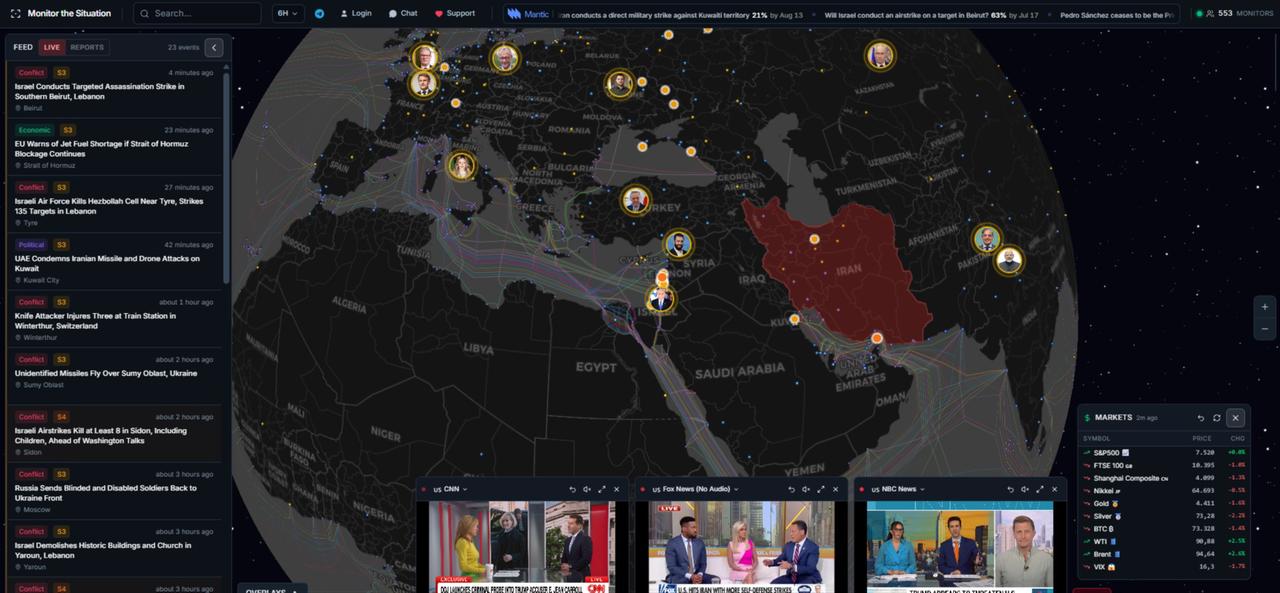
Monitor the Situation is a real-time conflict tracking platform. It is a map with continuously updated dots, each representing a verified report of military activity, a strike, or a geopolitical incident in the Middle East. There is no narrative, no framing, and no correspondent interpreting the events. Only timestamped events placed on a map.
At a time when airports in the region are closing and airspace is being rerouted, and when the consequences of conflict affect people thousands of miles away, this tool does what most journalism cannot: it shows you what is happening before assigning meaning.
The internet was intended to democratize information. In most cases, that promise has become complicated. This is one place where it is still being fulfilled.
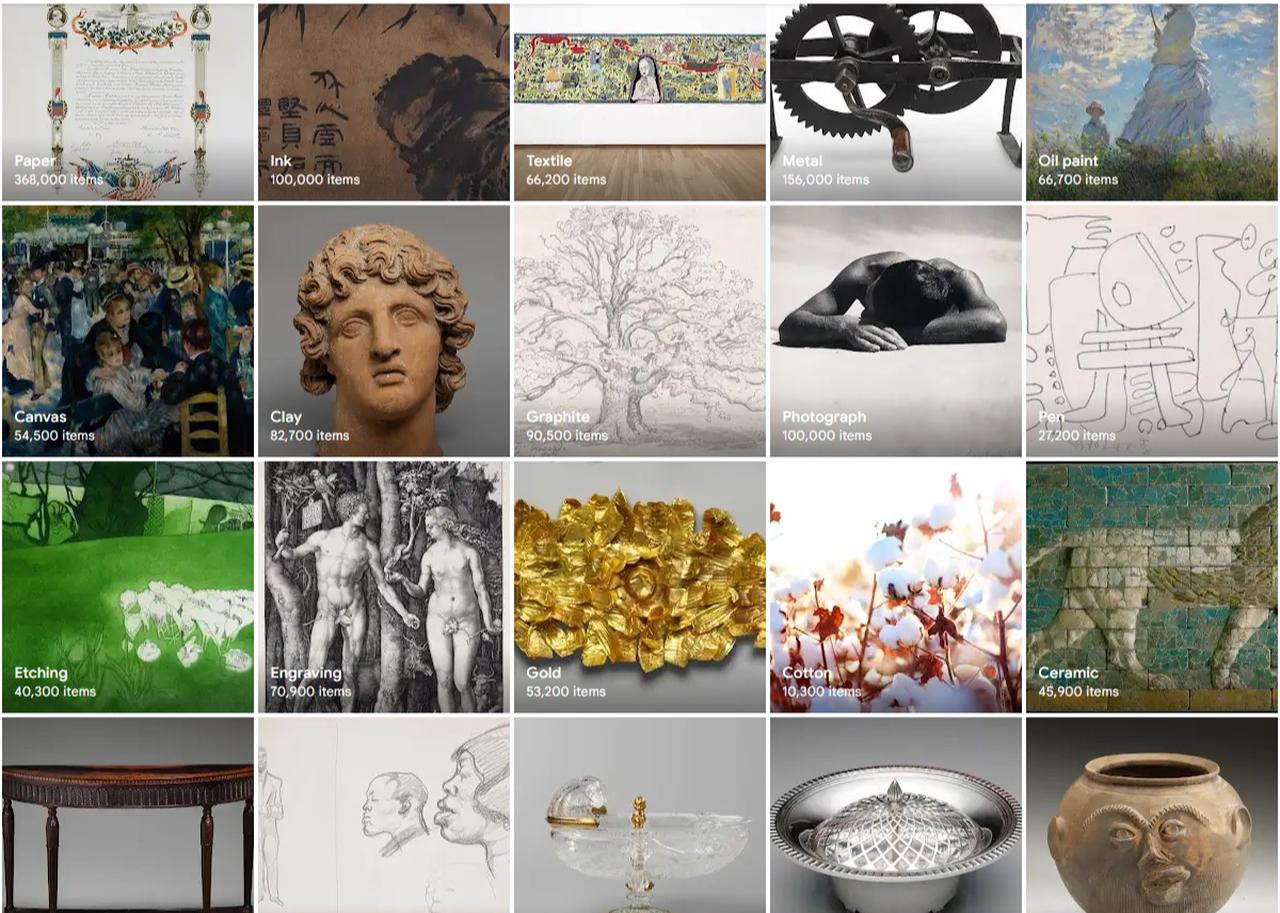
Two thousand museums in one browser tab.
Google Arts & Culture is an archive of human civilization, built in partnership with institutions that once required significant resources and travel to access. You can now zoom into the individual brushstrokes of a Vermeer, walk through Pompeii in street view, find your art-historical doppelgänger using your phone's camera, and watch a timelapse of the Eiffel Tower's construction, floor by floor.
The wonder here is not the technology, but the access. A teenager in a city without a museum can now stand inside the Louvre. This was once impossible; now it is reality.
This last entry has no single URL. It is a phenomenon.
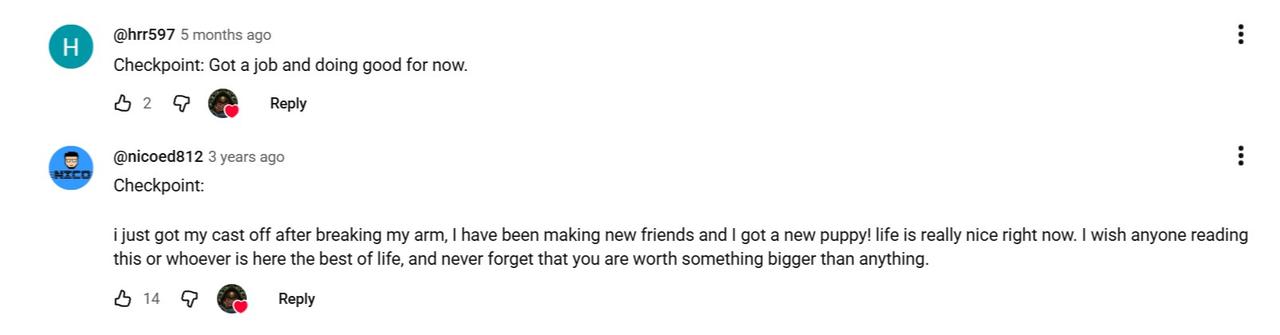
An internet checkpoint is a YouTube video, typically featuring lo-fi music, hours long and set to loop, whose comment section has become a rare space for genuine, unironic reflection.
This convention began around 2012 and has continued since. People leave comments beginning with the word "checkpoint," borrowed from video game culture, where checkpoints are moments the game saves your progress and places you can return to.
The comments describe where individuals were when they first found the video, what they were feeling, and what they have since lost or found. They read like messages in bottles or entries in a collective diary that no one planned to keep, but that everyone, in some way, needed.
Scrolling through one of these videos reveals people who were seventeen and frightened, sitting in bedrooms they no longer occupy, people who were grieving, and people who were falling in love.
The internet is an attention economy, engineered for urgency, outrage, and the compulsive pull of the next thing. Checkpoint videos are the opposite: places people visit quietly, without announcement, to be still. Their existence and the honesty they contain are worth calling a wonder.
The Greek scholars who compiled the original list were not trying to rank the world. They aimed to share it, to tell anyone who would listen that there are things worth going out of your way to see.
The internet is the most connected place humans have ever built, yet most of us barely explore it. We have our routines, our feeds, and our familiar spaces. The lobby is well-lit and comfortable.
However, the building extends endlessly. Some of what is inside, built by real people at real cost in a medium still young enough to surprise us, is genuinely and verifiably worth the journey.


 Set as preferred source
 Set as preferred source



 3 min read