Newsletters


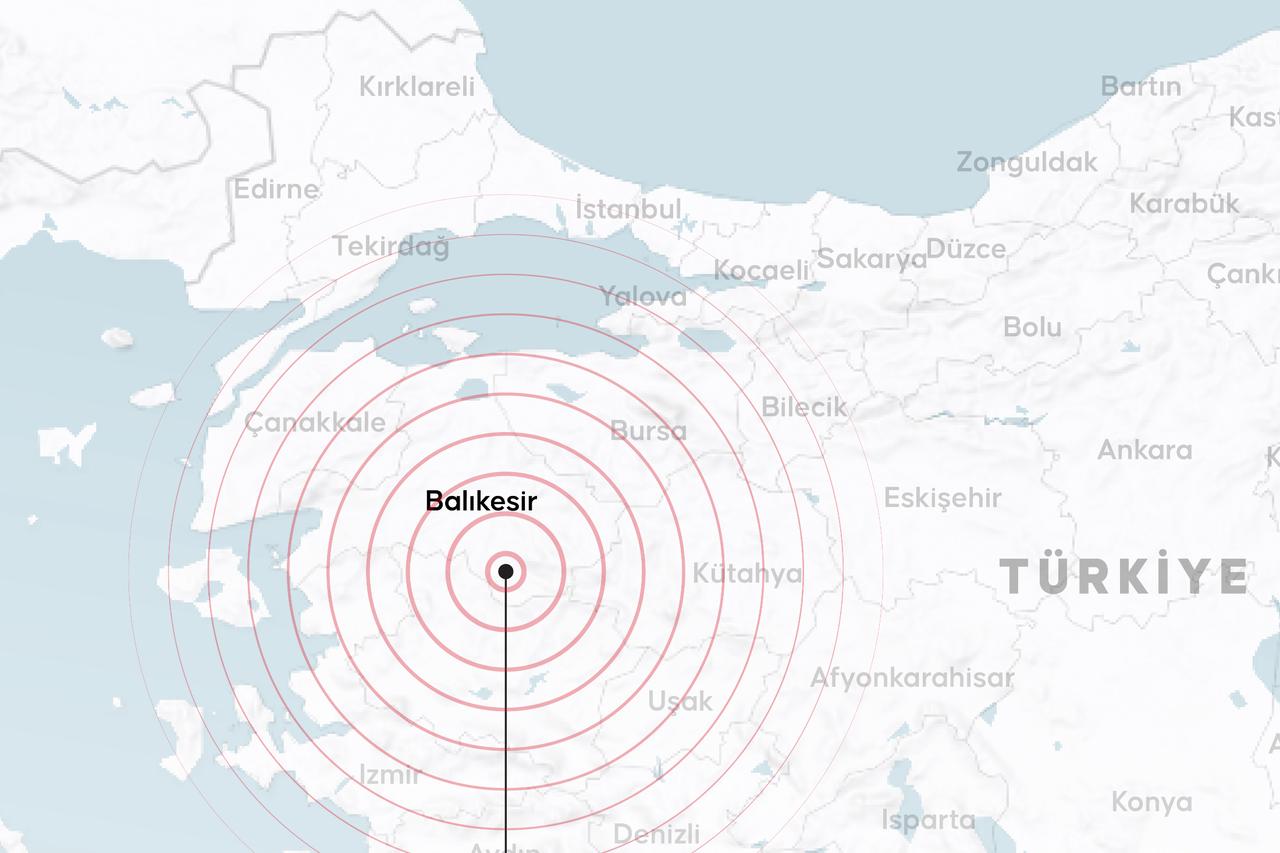


A 4.9-magnitude earthquake struck the Sindirgi district of Balikesir in Türkiye, shaking the region on Thursday morning.
According to preliminary data from Türkiye’s Disaster and Emergency Management Authority (AFAD), the quake was recorded at 10:06 a.m. local time with its epicenter in Sindirgi and occurred at a depth of about 7 kilometers (4.34 miles).
The tremor was felt in surrounding provinces, including Izmir and Istanbul, where residents reported short but noticeable shaking.
Thursday’s earthquake comes after a months-long sequence of seismic activity centered around Sindirgi, where two 6.1-magnitude earthquakes on Aug. 10 and Oct. 27 triggered what scientists describe as a “storm” of aftershocks.
Professor Hasan Sozbilir, director of the Earthquake Research and Application Center at Dokuz Eylul University and a member of AFAD’s Earthquake Science Board, told Anadolu Agency (AA) on Dec. 10, 2025, that researchers have been monitoring the region closely since those major events. He said that over roughly four months, about 23,000 earthquakes of varying magnitudes were recorded in the wider area.
Sozbilir noted that the aftershocks appeared to migrate towards the southeast over time and that, in the early stages, they continued for days as part of an intense seismic sequence.
In the last 15 to 20 days, however, both the number of daily earthquakes and their magnitudes have declined, indicating a calmer phase in the sequence.

Fieldwork carried out after the main shocks allowed scientists to map a large number of previously unidentified “dead faults” in the region—faults that had not been considered active.
Sozbilir said many of these structures have now broken and that this rupture appears to have released much of the accumulated tectonic energy.
“Looking at the region on a broader scale, we see that the concentration of earthquakes around Balikesir and Simav has largely occurred on these so-called dead faults,” he explained, adding that they currently estimate that close to 30 kilometers of fault length has ruptured.
Daily earthquake numbers in the sequence have now fallen below 100, and the magnitudes are also lower than in the early stages of the activity.
Based on these observations, Sozbilir assessed that the likelihood of a new major fault rupture in the immediate future is low, saying that most of the energy in this segment of the crust “has already been released” and that a large earthquake “should not be expected in the near future” in this specific area.
Sozbilir underlined that the region has already been declared a disaster area by AFAD and that emergency plans remain active. He recalled that AFAD’s decision to evacuate damaged houses after the first main shock was crucial in preventing loss of life during the second large earthquake.
He stressed that, while monitoring and scientific studies in the field are still ongoing, there is currently “no situation that should cause residents to panic.”
Balikesir Governor Ismail Ustaoglu also posted a message on X, saying that there was “no adverse situation at the moment” following the latest quake.
He offered his “get well soon” wishes to residents affected by the tremor and added a prayer “that our country and nation will be protected from disasters.”


 Set as preferred source
 Set as preferred source



 6 min read