Close
newsletters Newsletters
X Instagram Youtube

All hands on deck: US, Türkiye in talks to build more warships

The Distinguished Observer Day activities of the SeaWolf-II/2025 Exercise, conducted by the Turkish Naval Forces Command in Antalya, Türkiye on May 14, 2025. (AA Photo)
Photo
BigPhoto
The Distinguished Observer Day activities of the SeaWolf-II/2025 Exercise, conducted by the Turkish Naval Forces Command in Antalya, Türkiye on May 14, 2025. (AA Photo)
February 03, 2026 06:09 PM GMT+03:00

The United States and Türkiye have been holding talks since last year on naval shipbuilding cooperation as the U.S. Navy seeks to expand its fleet amid growing competition with China, with discussions including ship components and possible frigate construction, officials told Middle East Eye (MEE) on Tuesday.

A delegation from the U.S. Naval Sea Systems Command (NAVSEA) visited Istanbul Naval Shipyard Command on January 25.

U.S. representatives explored whether Türkiye could supply ship components, while discussions also floated the possibility of Ankara helping the U.S. Navy build additional frigates.

"The U.S. and Turkish navies have a strong partnership at sea and are always looking for ways to expand that partnership," a U.S. spokesperson told MEE, describing Türkiye as a longstanding and "deeply valued NATO ally."

Turkish officials and officials from US Naval Sea Systems Command (NAVSEA) at the Istanbul Naval Shipyard Command in Istanbul, Türkiye, Jan. 25, 2026. (Photo via X/@tcsavunma)

US official: 'Shipbuilding industry in real crisis'

A U.S. official told MEE that early discussions with Türkiye underscored the severity of America's shipbuilding problem.

"The U.S. shipbuilding industry is in a real crisis, and the Trump administration has talked with Türkiye about meeting its needs," the official said.

"The Department of Defense has already been looking for alternative production sites," a U.S. State Department official added.

The Trump administration wants to revive U.S. shipbuilding and enlarge the Navy's fleet, having so far leaned on Asian allies Japan and South Korea for know-how after decades of U.S. underinvestment.

Any deeper defense cooperation with Türkiye could face scrutiny in Congress, which imposed sanctions on Ankara over its 2019 purchase of the Russian S-400 air defense system under CAATSA.

"Among advocates of closer cooperation with Türkiye in the administration, shipbuilding is viewed as a way to strengthen ties while working around the sanctions," a former U.S. official told MEE.

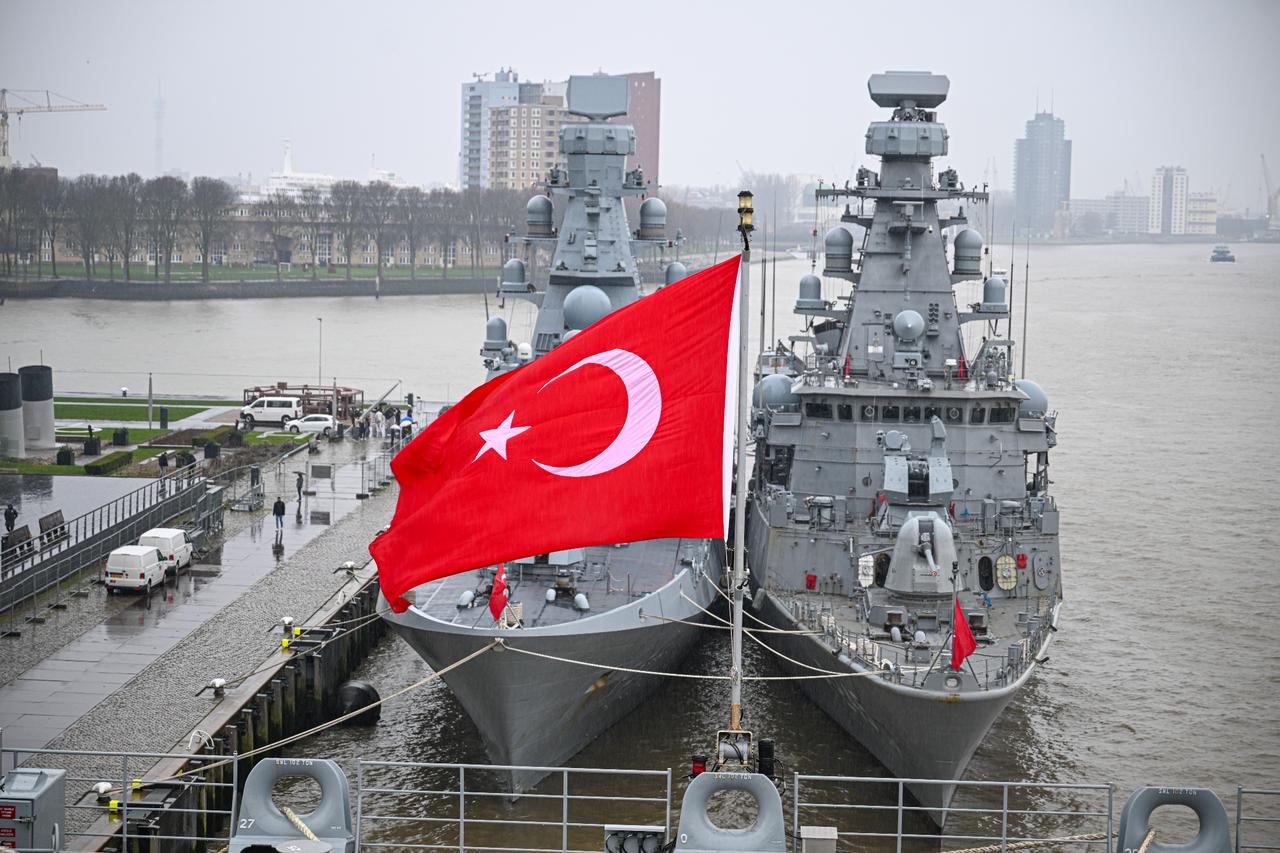
TCG Istanbul (F-515), TCG Kinaliada (F-514) of the Anatolian Turkish Maritime Task Force during a ceremony held in Foca, Izmir, Türkiye, January 20, 2026. (AA Photo)

'Strong culture of collaborative work'

Ankara has emerged as a naval powerhouse in recent years. Its shipyards are capable of producing at least 39 ships simultaneously for the Turkish and other navies.

Turkish defense firms have developed indigenous designs for a wide range of vessels under the MILGEM project, Türkiye's national warship program.

Kubilay Yildirim, a Türkiye-based defense industry expert, who spoke to MEE stated that Ankara can help the Washington with "production volume, timelines, risk sharing and workload distribution."

"There is a serious mobilization underway in the United States to build ships," he said, adding that, "They are pushing vessels through a kind of production bottleneck at a fixed output rate."

"America's biggest challenge is increasing ship production while simultaneously developing new designs and addressing the overhaul and modernization needs of an aging fleet," he noted.

"For these processes, the U.S. lacks sufficient manpower, shipyards and dry docks," Yildirim said.

Turkish naval assets salute at the end of Distinguished Observer Day activities of the SeaWolf-I/2025 exercise, conducted by the Turkish Naval Forces Command in Antalya, Türkiye, Oct. 10, 2025. (AA Photo)

Turkish shipyards 'highly innovative,' geographically concentrated

Unlike in the U.S., Turkish shipyards are geographically concentrated around Pendik and Tuzla near Istanbul and across the water in the Yalova region, allowing them to adapt to new projects quickly, Yildirim noted.

A Turkish source familiar with the country's shipyards told MEE that Istanbul Naval Shipyard has spare capacity that could help the U.S. build additional vessels.

Yildirim noted that Türkiye has sufficient welders and skilled personnel, access to multiple steel and component suppliers, and shipyards well accustomed to military shipbuilding projects.

Under the leadership of Turkish defense company STM, multiple civilian and military shipyards have jointly bid on numerous programs, with one yard producing specific modules that are then transported to another yard's dry dock for integration, fitting and delivery.

"There is a strong culture of collaborative work," he added, highlighting that the Pendik Naval Shipyard Command's Design Project Office as particularly notable.

"They design the ship, build it on their own slipways, conduct testing and sea trials, implement necessary modifications, freeze the design, issue outfitting and work orders, and then distribute the workload to different civilian shipyards," Yildirim said.

Turkish shipyards are "highly innovative," routinely automating parts of the production process, whereas many U.S. yards still rely heavily on manual labor, he noted.

"These technologies are now beginning to mature, and Türkiye is one of the countries where they are being developed and incubated," he said.

The Washington's efforts to expand shipbuilding face headwinds. In December 2025, U.S. Secretary of the Navy John Phelan announced the Pentagon had cancelled the Constellation-class frigate program with Italian shipbuilder Fincantieri.

The frigates were supposed to be built at a shipyard in Wisconsin.

February 03, 2026 06:09 PM GMT+03:00
More From Türkiye Today