Newsletters


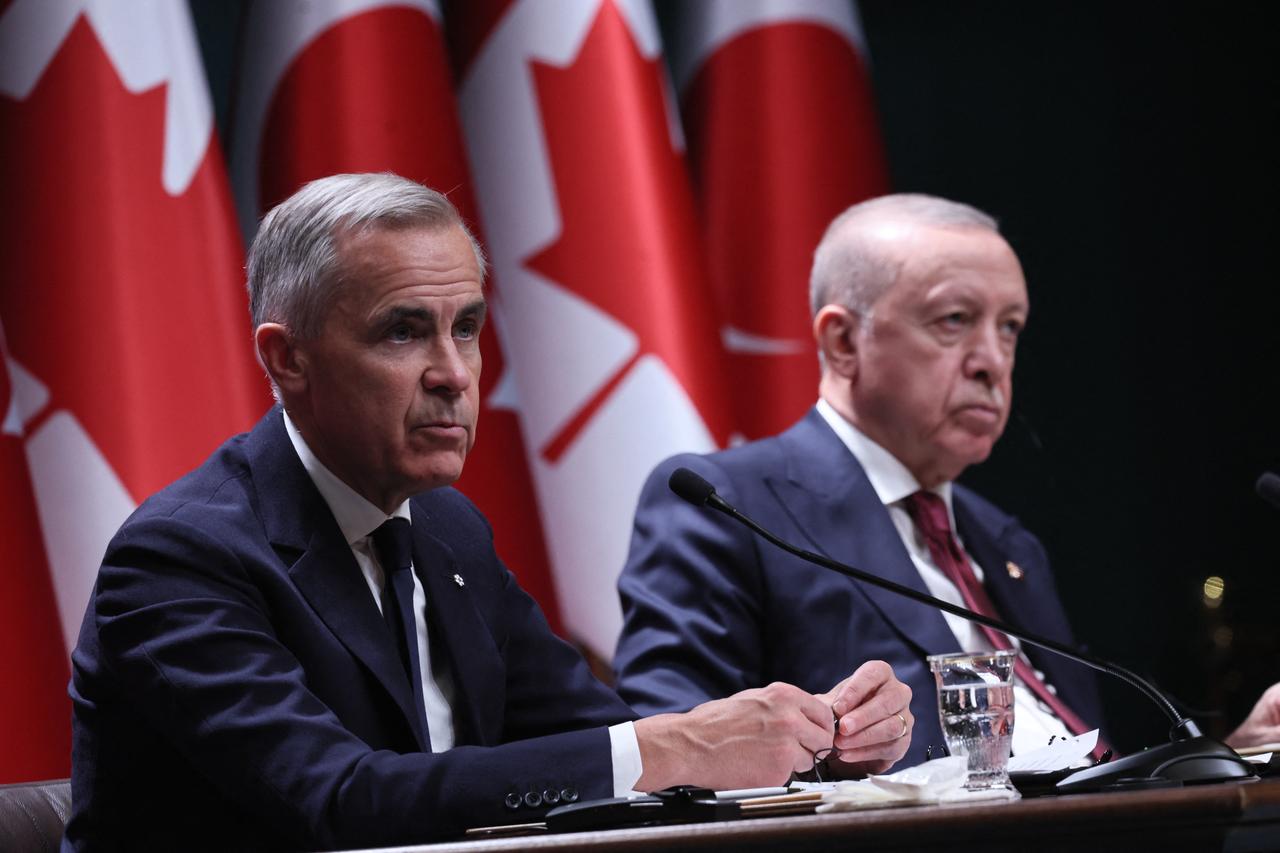


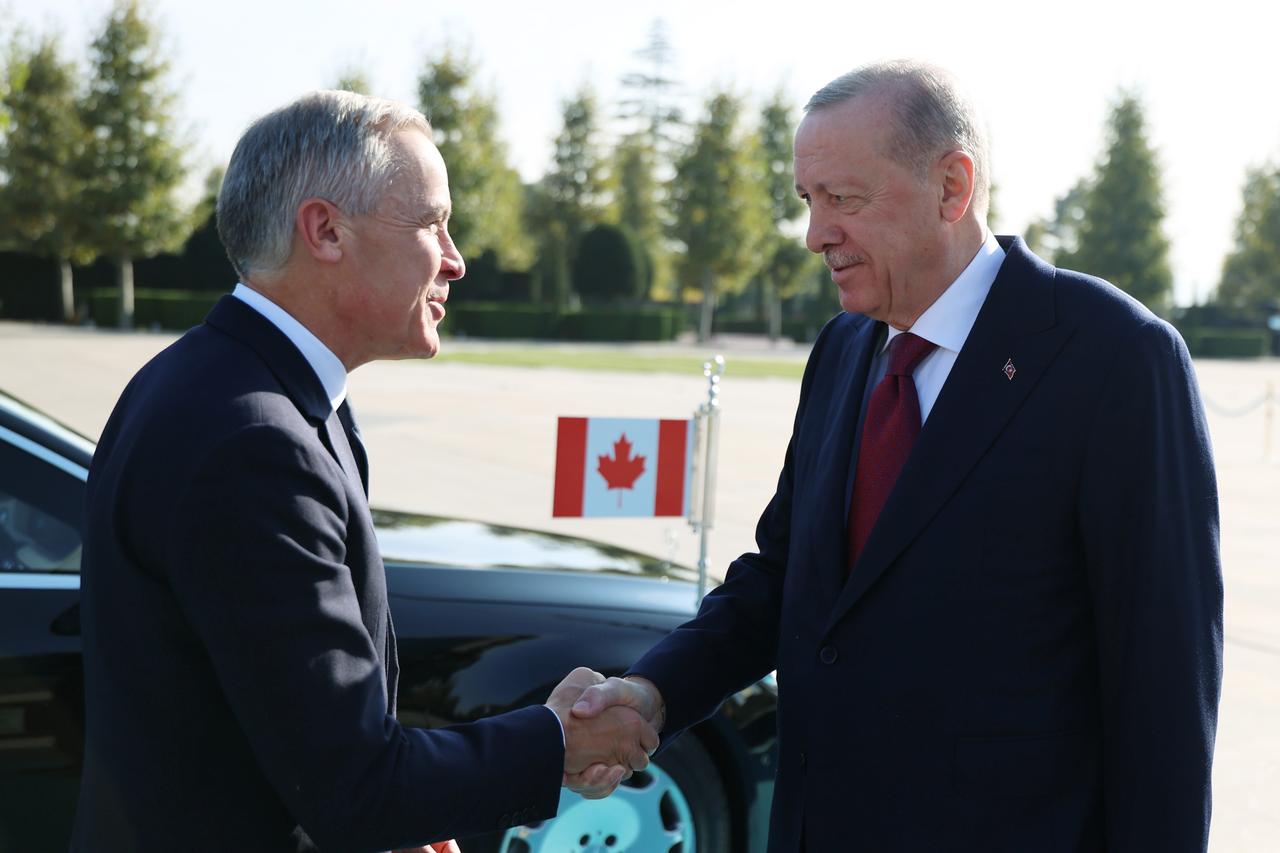
A 21-gun salute reverberates across the Presidential Complex in Ankara. Cavalry has escorted the Canadian prime minister’s car to the gate, and an honor guard flanked by flags of 16 historical Turkish states stands at attention.
Mark Carney walks the line, pausing to offer two words in Turkish: "Merhaba asker." (Hello, soldier).
It is now a standard diplomatic courtesy in Ankara, yet unprecedented for a Canadian premier. Still, Carney has built up frequent-flyer miles, testing out foreign pleasantries lately.
In January, he flew to Beijing to hammer out a deal slashing tariffs on electric vehicles and canola. The following month marked his maiden official visit to India.
By September, he was in Strasbourg pressing European lawmakers for an alliance "strong enough so that no one can dictate our choices."
Months earlier, in July, he touched down in Ankara for the NATO summit.
Canada’s prime minister is collecting diplomatic greetings the way seasoned executives rack up frequent-flyer miles.
The catalyst behind this whirlwind tour is cold, hard arithmetic. Canada still funnels nearly 70% of its exports southward to the United States.
Yet Washington spent the past year levying steep tariffs, questioning Canadian sovereignty, and floating the notion of making Canada the 51st state. In response, Ottawa has inked over 20 trade agreements within twelve months, aiming to double its non-U.S. exports over the decade. Carney put it more bluntly at Davos: "If you are not at the table, you are on the menu."
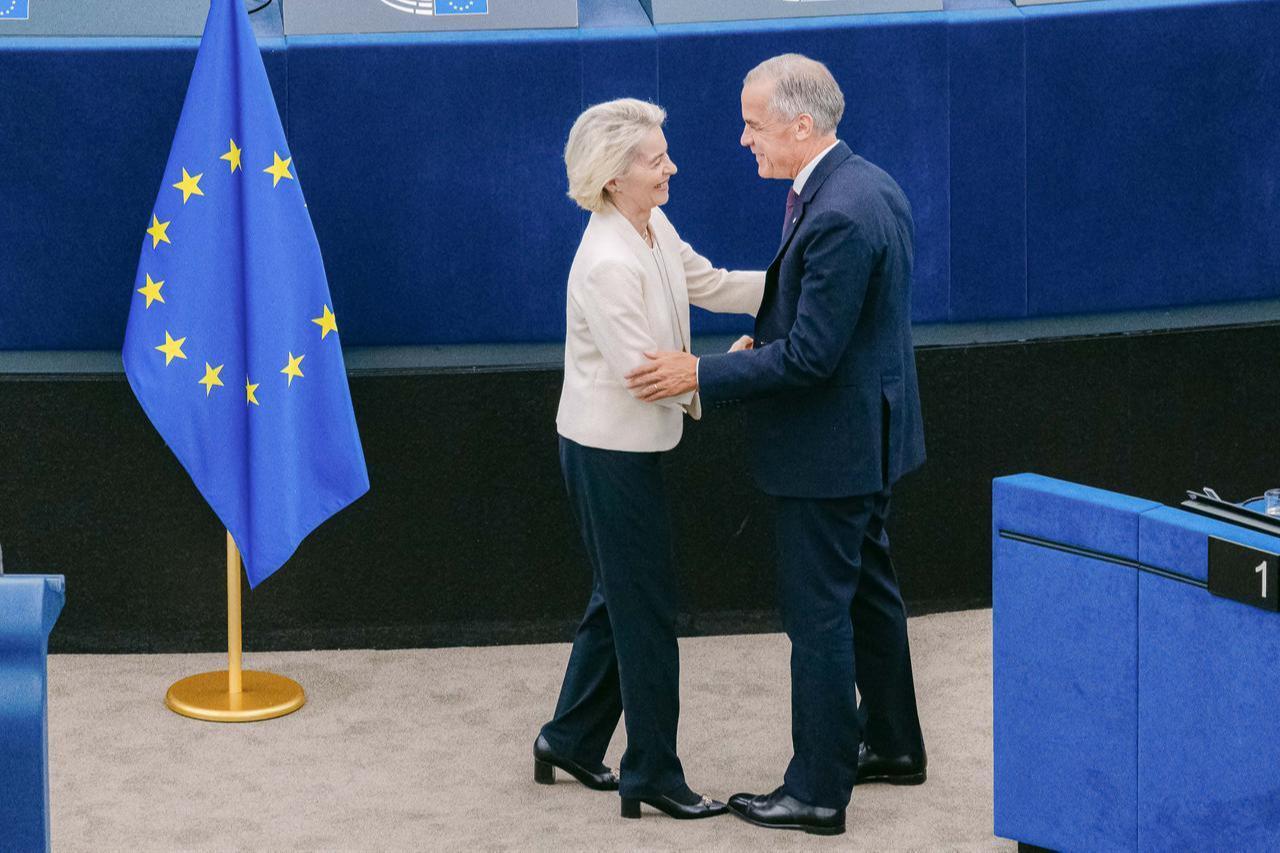

Europe was the natural first port of call for Canadian leadership, given deep ideological alignments with Brussels.
On Sept. 17, European Commission President Ursula von der Leyen floated the idea of making Canada the EU’s first "associate member," a diplomatic status that does not exist.
Donald Trump called the idea "laughable" and threatened heavy tariffs on Europe. Carney, for his part, said Canada is "not in a position, nor seeking, to become a full member," and that "what matters is the substance."
Germany's government spokesperson suggested the label needs rethinking. The two sides meet next week in Montreal to find out what the substance is.
While Europe represents a club Canada already half-belongs to, Türkiye is a more interesting sale. Julian Karaguesian, a former special adviser at Canada's Finance Ministry who now teaches economics at McGill University, told Türkiye Today that the logic is bigger than any single treaty to explain Türkiye’s position in Canada’s new foreign policy strategy.
"As a G-20 and NATO member, with critically strategic geography and nearly 90 million people, Türkiye could be a vital link in a chain of middle powers that shores up the rules-based global economic and political order," he said, one "that has been remarkably successful in allowing countries to achieve sustained growth and prosperity."
That strategic chain, he argues, rests on a solid philosophical foundation. "While certain countries have broken away from the rules-based global order, the overwhelming majority of countries have not," Karaguesian said.
"It is this belief in the need for a rules-based international order comprised of the United Nations and its range of organizations, such as the WTO, IMF, World Bank and WHO, that provides the philosophical backbone of an alliance of middle powers."
The current trade figures are modest. Türkiye accounts for less than 0.3 percent of Canada's merchandise trade, and President Erdogan's stated goal is to move the total from roughly $3 billion to $5 billion, then $10 billion.
Karaguesian is careful not to oversell it, and his caution is the most interesting line in the story. "It is not that Canada cannot do without Türkiye," he noted, "but rather that Türkiye's location between Europe, Russia, the Middle East and the Mediterranean makes it a critically strategic country."
Beyond NATO and the G-20, he added, Türkiye "is a strong member of the community of nations and could provide an important counterweight to any adverse forces that are currently in motion or in the future."
The commercial case, in his telling, is where the room to grow is. "As an economic partner, trade and investment have the potential to grow very rapidly under a new strategic partnership, particularly given the size of the country's population and economy, as well as the complementary nature of our two countries' economic structures, and resource endowments."
The paperwork on Thursday matched that appetite. Leaders watched three signings: a defense industry memorandum, an air transport agreement and a joint energy declaration covering nuclear power, LNG, renewables and mining.
Energy Minister Alparslan Bayraktar said the talks centered on whether Canada's CANDU reactor technology fits Türkiye's nuclear plans. Ankara is building a Rosatom plant on the Mediterranean coast and plans a second on the Black Sea.
Canada wants in, though South Korea's KEPCO and China's State Power Investment Corporation are also in talks.
Defense is the warmest file. Canada lifted its weapons embargo in 2024, after years of friction over Türkiye's Syria incursions and its support for Azerbaijan. Carney now says it plainly: "Candidly, we're in a position where we're more in need of Turkish expertise in terms of reinforcing what we need to do to protect Canadians." He pointed to Ukraine's Starlink disruptions as proof that depending on one supplier is a security risk.
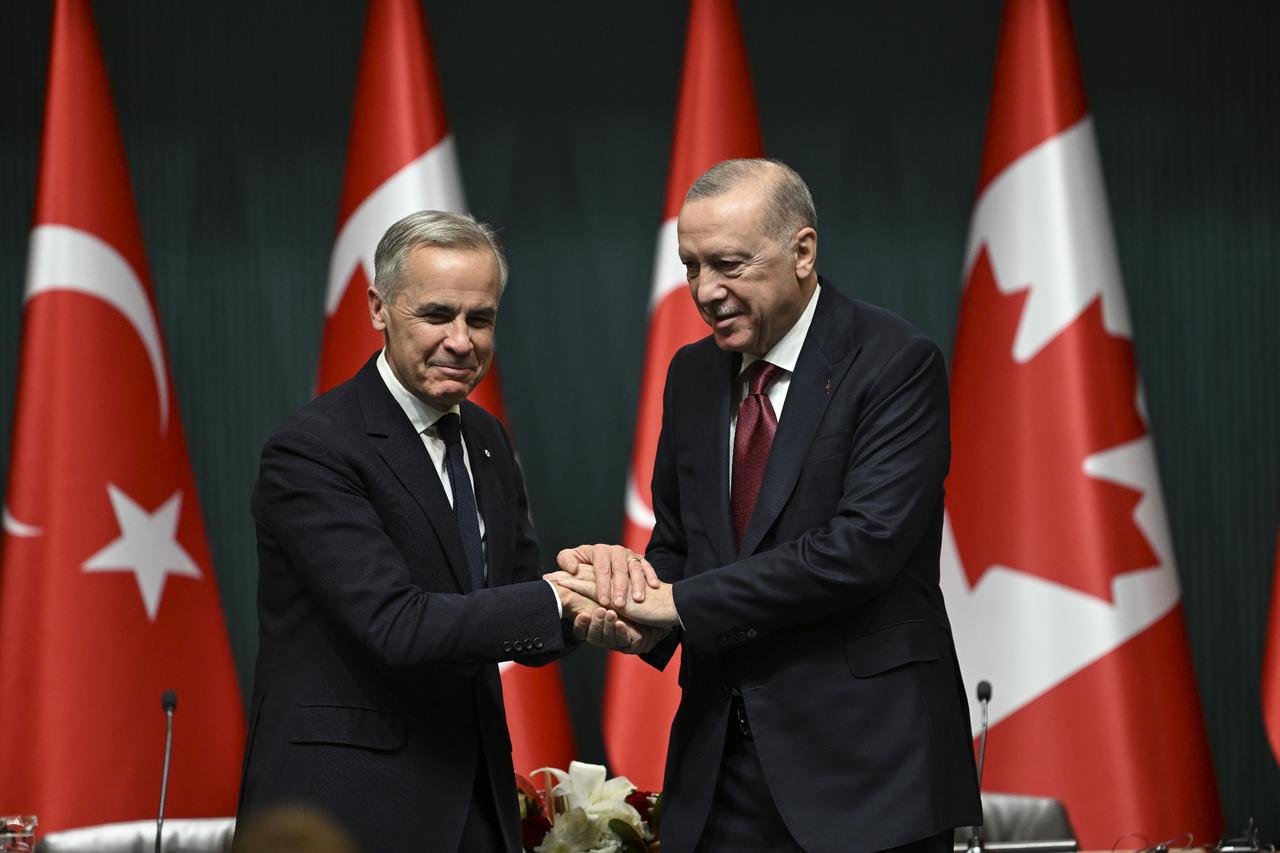
Erdogan called the visit the end of a long "disconnect" and the start of a "new era."
Carney pledged that the relationship would grow "for generations to come." Formal free-trade negotiations are slated to kick off before the year is out, with inaugural rounds scheduled in Ankara next month.
Merhaba is the easy part: it is a greeting, and everyone in the room can say it. The grammar arrives when negotiators sit down to write tariff schedules, and Canada learns whether a country it barely trades with can become the partner its prime minister's speeches already describe.
Ottawa’s this new strategy, championed by its premier, goes by a clear moniker: middle powers. Carney’s argument is that mid-sized economies cannot individually resist pressure from a giant, but if they trade, buy weapons and build reactors with one another, no single capital can squeeze them all at once.
He insists this is no rival superpower club, as he told the European Parliament plainly that he’s “not proposing a third bloc.”
That’s why Mark Carney’s global tour stretching from Australia to Saudi Arabia is driven by anything other than a renewed effort for the Non-Aligned Movement.
It’s only a way to make sure nobody can control Canada’s open markets or threaten its sovereignty. In practice, it is a web of overlapping deals, and each one adds a little insulation from Washington.


 Set as preferred source
 Set as preferred source


 1 min read
 1 min read