Newsletters





Türkiye is facing a problem it once associated mostly with American teen dramas: school bullying. While extreme acts of violence among students occasionally make headlines, a quieter and more widespread problem unfolds every day in classrooms and schoolyards.
And it does not stop there: in a report compiled by the Education and Science Employees’ Union (Egitim-Is) based on data from the Turkish Statistical Institute (TurkStat), the number of incidents involving children rose from 447,575 in 2015 to 609,959 in 2025, representing a 36.28% increase. The figure is not specific to schools, but it raises an uncomfortable question: what is happening inside Türkiye’s schools?
The Egitim-Bir-Sen Strategic Research Center’s (EBSAM) report, published in October, draws a picture of the situation. The study draws on responses from almost 8,000 people from almost every city, including teachers, middle and high school students and parents.
On a 1-to-5 scale, teachers rate “schools are safe” at 3.48, while parents rate it at 3.38 and students at 3.24. These numbers show that the people who spend the most time and have the most interactions there rate the school’s safety the lowest.
Overall, 35.4% of students say bullying affected them at least moderately, and 18.3% of all students describe the impact as “severe” or “very severe.”
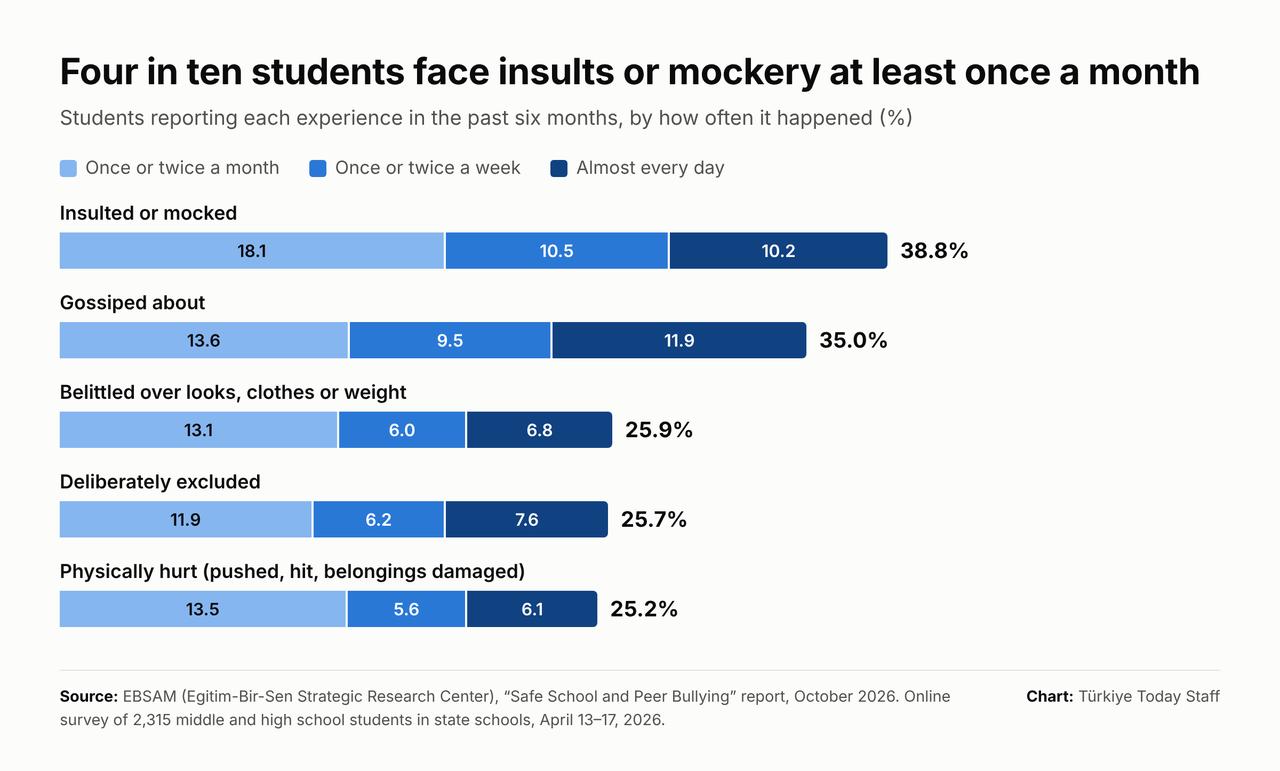
Insults and mockery are the most frequent experiences: 18.1% of students say they were insulted or mocked once or twice a month, 10.5% once or twice a week, and 10.2% almost every day. As bullying frequency increases, students’ trust in the school’s protective capacity sharply declines.
Taken together, almost 40% of students experienced insults or mockery at least once a month over the past six months. Gossip follows (35%), along with being belittled over appearance, clothing or weight (25.9%), social exclusion (25.7%) and physical violence (25.2%).
Students with special needs or a diagnosed condition, and those who rate their own academic performance as low, are more likely to be bullied. The type of bullying also varies by gender: gossip and relational bullying are more common among girls, while physical violence, threats, and sexual remarks are reported more often by boys.
Bullying generally happens during breaks or in class and is perpetrated by classmates. Some 63% of students have also seen another student being bullied.
When asked what they usually do when they witness bullying, informing a teacher was the most common response (31.2%), followed by supporting the victim (29.3%) and stepping in to stop it (28.6%).

More than half of the students have smartphones and their own social media profiles. Among those with more than four hours of screen time, 14.9% face cyberbullying. But only about one in eight parents know whether their child has faced cyberbullying or not, even though, interestingly, they say they follow their children’s internet use (3.94 on a 1-to-5 scale).
Another point: while parents think that their children share their emotions freely (4.06 on a 1-to-5 scale), they also tend to agree that bullied children often hide it (3.11). Furthermore, 46% of parents do not know whether their child has witnessed bullying at school, while 63.4% of students say they have.
About 21.1% of children considered reporting bullying to their school but did not. They gave two main reasons: they believed the school would do nothing, or they feared the situation would get worse. The data supports that skepticism. Students who experience physical bullying almost daily rate their trust in teacher intervention at 2.6 out of 5, compared with 3.35 among students who do not.
Teachers’ views of discipline regulations add another dimension. They do not see the regulations as a deterrent, rating them 1.98 on a 5-point scale, and they do not feel the regulations support their actions, rating them 2.31.
Both students (71.8%) and parents (86%) are on the same page that teachers must follow a disciplined approach in the classroom.
According to Louis Althusser, the school is one of the state’s ideological apparatuses. It transmits rules and laws, knowledge of the nation’s culture, and the values of good citizenship, and in doing so it instills belief in the nation. When schools give children confidence in the future, those children are more likely to strive to be good citizens, not only for their own sake but for the nation’s.
Because the school is the state in miniature, it must feel safe to everyone connected to it. According to the report, that bond is weakening. When children, who generally dislike disciplinarian figures, say that teachers should be stricter, something is clearly wrong.
Ultimately, and perhaps most critically, if there is no safety, people tend to provide that safety through their own methods, and it will likely become more individual and violent.
The report already hints at this cycle: students who are insulted or mocked are far more likely to do the same to others (27.7% vs. 3.5%), and the gap is similar for physical bullying (10.8% vs. 1.9%).


 Set as preferred source
 Set as preferred source


 1 min read



 1 min read