Newsletters


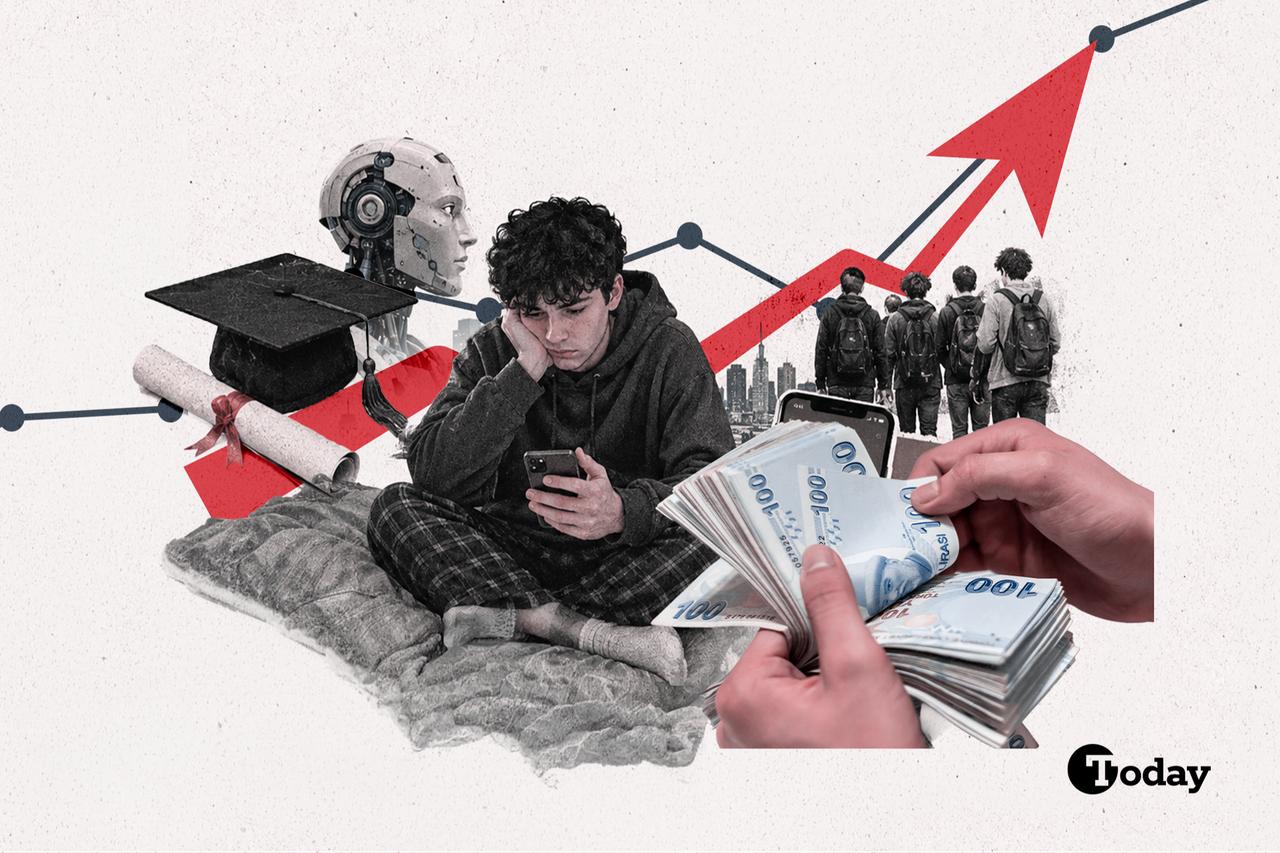


Tech companies are growing, AI robots are everywhere, and automotive companies are transitioning to electric cars. Yet, big companies are downsizing, unemployment is increasing, and education does not guarantee a job. There is a group that is both the avid user and the unavoidable victim of all these shifts: young people.
The global trend is more visible in Türkiye due to the years-long economic crisis.
According to Turkish Statistical Institute (TurkStat) data, 27.7% of young people aged 15 to 34 are neither in education nor in employment. This category accounts for nearly 7 million people who can't properly participate in Turkish society.
They have a name in Turkish: "ev genci," which means “a young person at home.” Globally, they are referred to as NEET—not in education, employment or training.
For the modern ev genci, the day doesn’t begin with an alarm clock, but with the familiar hum of a computer fan. Outside their bedroom window, the streets of Istanbul or Ankara bustle with an economy that has left them behind.
Over the past few years, Türkiye’s staggering inflation and the relentless devaluation of the lira have rewritten the rules of survival.
For businesses, skyrocketing operational costs have forced a significant chunk of the youth into a defensive crouch. Companies that once scouted fresh talent on university campuses are now freezing entry-level roles, downsizing teams, and boarding up their windows to the future.
Under the TurkStat definition, the youth population in NEET encompasses individuals aged 15 to 29. Within Türkiye’s standard educational timeline, students typically complete secondary education at age 18. For those pursuing higher education, university graduation generally occurs at 22. When factoring in the mandatory six-month military service for males, many young men do not enter the labor market until at least age 23, even without academic delays. Amid an ongoing economic downturn, the vast majority of these recent graduates face severe challenges in securing employment within their fields of study.
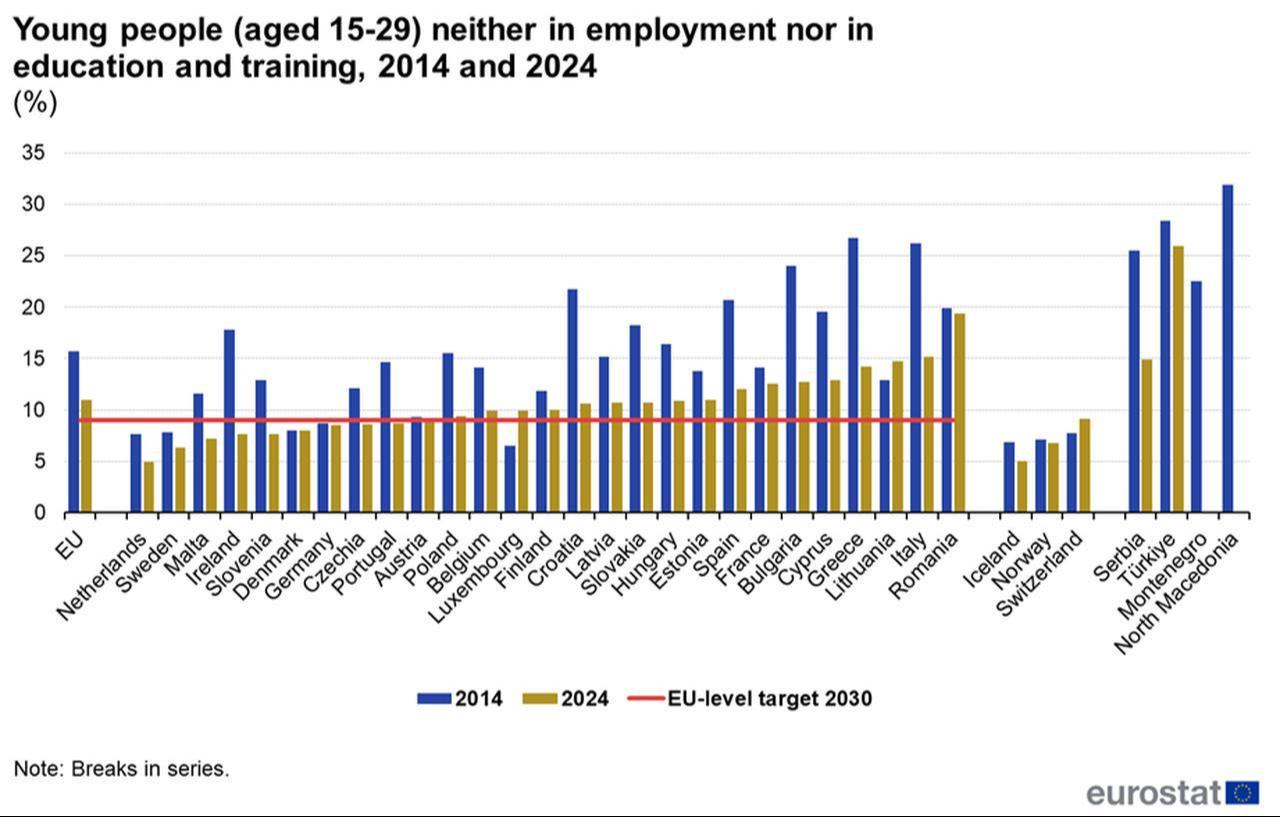
This stereotype does not only belong to Türkiye. According to Eurostat’s data, all European countries have similar problems: there are not enough jobs, and the education system does not meet expectations. Young people cannot afford the life they dreamt of.
Generally, the group shares its opinions via social media in a scattered manner. “In fact, I can’t even afford to rent a place in the neighborhood where I live. I can’t afford the kind of life I grew up with. At the very least, I should have been able to secure the same standard of living my family provided for me through my own efforts,” says a 31-year-old graduate software engineer living in Istanbul with his mother, aunt, and grandmother to the Turkish YouTube channel +90.
His approach brings the close relation between economic problems and expectations about life to the surface. The sentences he stated showed the root of the fertility problem: “I know that even if I get married and have a child in the future, I won’t be able to provide for them either.”
While the problem is connected to the economy, young people are finding new ways to provide for themselves by using the internet to secure remote jobs.

There was one easy but controversial exit for the youth in NEET.
During the COVID-19 pandemic, influencers and streamers saw a massive surge in attention and viewership. Instead of fading after lockdowns ended, this trend persisted—and looking at the rising number of NEETs, it seems their audience is here to stay.
Some individuals work full-time as "streamers," signing contracts with streaming websites and are online for eight hours a day. So, they work and have a job, actually, but their remote setups break the traditional mold of leaving the house for a standard workday.
The number of streamers in April 2026 is 6,294,898, according to Twitch Tracker.
Another expanding sector is OnlyFans, which remains highly controversial in Türkiye. The website is banned in the country for allegedly violating public morals and child protection laws.
According to the OnlyFans stats, there are 4.63 million creators globally, and it increased 1,222% between 2019 and 2025. OnlyFans users reached 377.5 million accounts. While the average creator earns $131 monthly, some make over $40,000, and total fan spending reached $7.22 billion in 2024. The sector is also on the rise.
That global interest, excluding Türkiye, shows that the youth tend to work on their own terms, viewing these jobs as a path to personal and financial independence, despite concerns about public moral values.
The outcome for other people except NEETs is that the world is changing too fast, and sometimes there is no job for anybody.
Every generation has some advantages and disadvantages. For instance, Baby Boomers lived in prosperity because there was affluence in Europe and the U.S.A. after World War 2. But apparently, Gen Z has not had this wealth.
They have technology, and they are trying to use everything to get money and live on. While new things popped up every day, it’s hard to follow them personally and psychologically. Because nobody has time to stop and think about the new things as good, bad, useful, or not, etc.
Their motivation is based on their feelings. “I’m at home, but I don’t belong here. I want to go somewhere else, but I can’t get there. Yet even here, my spirit wanders, and I feel all too keenly that I don’t belong here. The deepest despair I feel is the despair of not belonging anywhere,” one unemployed Turkish university graduate says.
If they cannot leave the parents’ house, they try to earn money there.
The newest example of this is a website called dare.market, which operates on a challenge-based model: complete a task, and you earn a set amount of money. Anyone can post a dare and set the bounty. To claim the reward, users must upload video or photographic proof that they completed the challenge. Some of the controversial dares already performed include filming highly inappropriate behavior in public, pulling down one's pants in a crowded area, or even drinking one's own urine.
Whilst the examples given offer a glimpse of how the technology could be used, they do not provide concrete solutions to the existing NEET problem.
Although the group in focus has the opportunity to earn money through these means, such jobs are not sustainable. In the absence of long-term solutions, short-term and often unconventional alternatives are likely to keep multiplying.


 Set as preferred source
 Set as preferred source



 6 min read