Newsletters


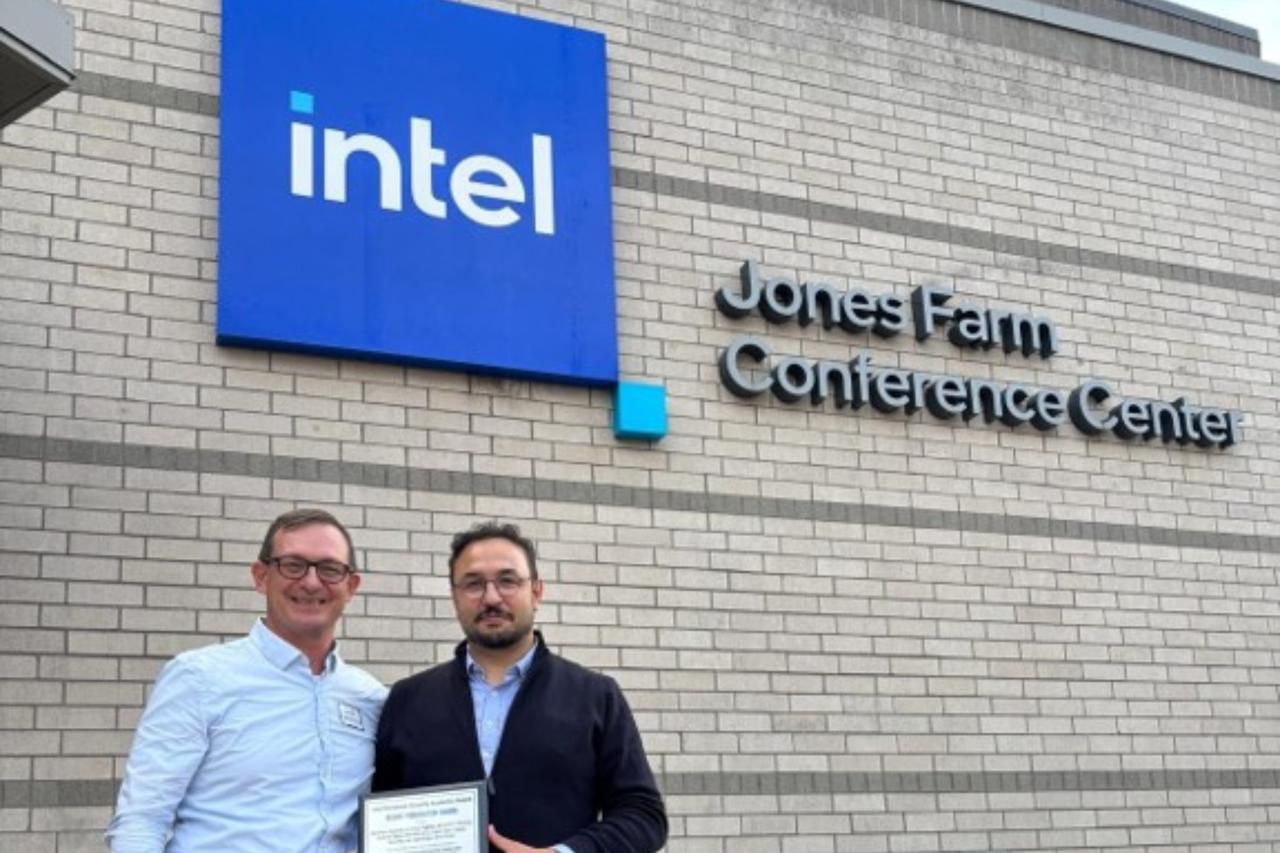


Researchers from Türkiye helped write both papers that won Intel’s 2026 hardware security awards, and they account for seven of the nine authors of one.
Intel announced the winners on Sept. 30 at its invitation-only Academic Security Conference in Hillsboro, Oregon. The Test of Time Award went to a 2014 paper that first demonstrated RowHammer, a flaw in computer memory. The Recent Publication Award went to Chronus, a 2025 paper that analyzes the industry’s newest RowHammer defense and proposes an improvement.
Professor Onur Mutlu of ETH Zurich in Switzerland co-authored both papers.
Mutlu leads the SAFARI Research Group at ETH Zurich. He accepted the Test of Time Award with co-author Konrad Lai.
Five of the seven Turkish Chronus authors completed master’s degrees under Professor Oguz Ergin at the Kasirga Microprocessor Laboratory at TOBB University of Economics and Technology (TOBB ETU) in Ankara. Ergin also co-authored the paper.
RowHammer affects DRAM chips, which make up a computer’s main memory. Their cells sit so close together that repeatedly accessing one row of memory can flip bits in neighboring rows.
Attackers can use this to alter data they cannot reach directly and gain higher privileges on a system.
Google’s Project Zero team used the flaw in 2015 to gain control of an operating system’s kernel. In 2016, researchers at Vrije Universiteit Amsterdam in the Netherlands used it to gain full privileges on Android phones.
The 2014 paper, “Flipping Bits in Memory Without Accessing Them,” found the flaw in more than 80% of the memory modules it tested from the three largest manufacturers. It also examined seven possible solutions. Memory makers later redesigned their controllers and chips.
In April 2024, the memory standards body JEDEC added a protection called per-row activation counting (PRAC) to the DDR5 standard used in new computers and servers. According to the paper, the Chronus team was the first to study it in detail.
The paper found that PRAC slows four-core systems by an average of 5.8% on current chips and by an average of 78.5% on future, more vulnerable chips. It also showed that PRAC remains open to a technique called a wave attack.
Chronus keeps the counters apart from the data and updates them during ordinary memory accesses. In the same tests, the slowdown stays below 0.1% on current chips and reaches 8.3% on future ones.
According to the paper, the method outperformed the six current solutions it was compared with. Its code is open source, and an independent evaluation at the IEEE International Symposium on High-Performance Computer Architecture confirmed the results are reproducible.
Intel has given the awards since 2021, and this was the fourth edition. Chronus was chosen from more than 75 applications. Five works reached the finals, and two others received honorable mentions. A. Giray Yaglikci accepted the award on behalf of the authors.
Lead author Oguzhan Canpolat trained in the Kasirga laboratory, and Chronus was the subject of his master’s thesis at TOBB ETU.
He began the work as a visiting researcher at ETH Zurich. He finished the thesis in August 2025 and is now a doctoral student at Stony Brook University in the U.S.
Yaglikci is now a faculty member at the CISPA Helmholtz Center for Information Security in Germany. Ataberk Olgun, Nisa Bostanci and Ismail Emir Yuksel are doctoral students at ETH Zurich. Kasirga teams have also won five first places over four consecutive years at the Teknofest Chip Design Competition in Türkiye.
Ergin said most of the young researchers involved in the work were trained in Türkiye.
Mutlu said the problem has changed memory industry designs and standards over 12 years but remains unsolved. Canpolat said he was glad to see academia and industry work together on the problem.


 Set as preferred source
 Set as preferred source



 1 min read